At the century old The Palace,
cinema and theater have co-existed harmoniously
Navroze D. Dhondy
Scoring a century has become passe these days. So for a cinema hall to stay the course, duck those fiery bouncers, deftly handle the deceptive googlies and reach that magical three-figure milestone with an elegant, master class of all round performance is the stuff only legends are made of.
In the year 1925, six years before Alam Ara, the first Indian movie with sound was released, starring the young Prithviraj Kapoor, The Palace, a city icon, was born. The broad, tree-lined, central avenue of Civil Lines, the grand Canning Road of Allahabad, saw a rather imposing building come up. The pristine white structure, an architectural gem built in neo-classical style with tall rounded pillars, two angels perched atop blowing their trumpets was The Palace. This iconic structure, since its founding a century ago, has become one of the city’s most recognized landmarks.
Top: The Palace in Allahabad; inset: detail of angels blowing trumpets on the facade
Photos: Navroze Dhondy, Hemant Chaturvedi and Vaibhav Maini
The Palace was not just another cinema hall. It had an irresistible charm of its own — a distinct personality that set it apart from other cinema houses. It was where cinema and theater co-existed harmoniously, bringing the best of celluloid and stage performances to mature and discerning audiences who appreciated and patronized the arts. It was the first choice of the elite gentry of Allahabad (especially the old, established families of Civil Lines) where they would invariably turn out in their Sunday best to enjoy the experience.
Plays were staged at The Palace with as much gusto as films were screened. The Kapoor patriarch’s travelling troupe staged many a show at this venue, as did Geoffrey Kendal and Laura Liddell’s theater company, Shakespeareana. The famous son of Allahabad, Amitabh Bachchan, saw his very first film at The Palace when he was all of four, being taken for a morning show as a special treat. His mother Teji Bachchan was a regular and popular artiste who had staged several performances at The Palace.
This was the only cinema hall in Allahabad (possibly one of the very few in the country) with an open ticket counter. The box office was made of polished Burma teak, and the cinema-going public stood in perfect discipline and harmony, awaiting their turn to buy tickets.
Founder Kershasp Ghandhi
Besides theatrical evenings, The Palace played host to performances by legendary artistes such as Pandit Ravi Shankar, Bade Ghulam Ali Khan, Begum Akhtar, Bhimsen Joshi and Birju Maharaj, to name a few. Even the great playback singer Geeta Dutt performed to a full house, receiving a rousing, warm reception from her fans. The Palace was steps ahead of its time. It graciously opened its doors to scores of young performing artistes, many of whom had their inaugural performance at The Palace.
The facilities at The Palace were first rate. The dress circle had posh, comfy, burgundy leather sofas and up to the early 1950s also boasted a licensed bar which served beer and wine, with liveried staff attending to patrons. Possibly the forerunner to today’s gold class!
It was one cinema hall in Allahabad which was known for its high standards of discipline and for being the most punctual when it came to show timings, especially in an era when other halls were known for their lack of it. This was the "go-to” cinema for the latest and best Hollywood releases. English movies and The Palace were synonymous. Those, like me, who grew up in Allahabad often recall with a deep sense of nostalgia the great times we had at the movies. For many of my generation, it was at The Palace that we saw our first movie. As for me, The Palace gave me a window to a world of cinema and, in some ways, perhaps subliminally, laid the foundation of my future career in advertising and media. It’s strange that while I was still in college, the first advertisement I designed for the iconic restaurant in Allahabad, El Chico, was a cinema slide… to announce its new Chinese menu. And that slide was screened at The Palace. It was a humble but impactful beginning in the world of advertising.
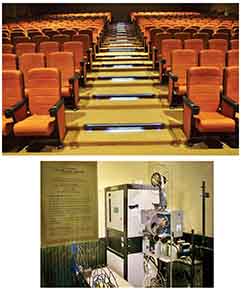
Top: interior of the theater; above: vintage projector
The Palace in 1925
I remember watching Charlie Chaplin’s The Great Dictator, films of the laugh riot duo of Laurel and Hardy, Hollywood classics such as The Ten Commandments, Ben Hur, Fiddler on the Roof, The Sound of Music, Mary Poppins, Gone with the Wind, My Fair Lady, Mackenna’s Gold, the James Bond films, The Godfather trilogy, Where Eagles Dare, lots of western and war movies, and cult movies such as Saturday Night Fever and Enter the Dragon, which had a profound impact on the popular culture of the late 1970s and early 1980s. Not to forget the impactful Hindi cinema with hits such as Aradhana, Zanjeer, Manthan, and many more.
Kershasp Shapoorji (KS) Ghandhi was the man behind this landmark of Allahabad. After creating this work of art, he handed over the business operations to a Parsi family, the Madans of Calcutta, pioneers in the cinema exhibition business in India. The Madans ran a chain of cinemas that spread from Calcutta to Peshawar. After a decade or so, Ghandhi took back the running and management of the cinema and was seen almost every day, keeping a close watch, ensuring that the reputation The Palace had garnered remained intact. After his demise, his nephew Dossabhoy Ghandhi (my father-in-law) took over the reins and kept up the reputation of the eminent establishment. On July 4, 2013, the cinema was extensively renovated, revamped and re-launched, giving Allahabad its best cinema hall, once again. It is currently being managed by my mother-in-law Vera and brother-in law, Darius, making it the third generation to keep the flag flying, upholding the high ethical standards and principles laid down by the founder. One cannot overlook the yeoman service of our dear manager, Lalit Srivastava, who has spent more than 55 years with The Palace, a service of selfless commitment and devotion, having worked with all three generations of the family.
My family (the Dhondys and the Patells) and the Ghandhis have shared a common history of Allahabad for over a century. Our elders had been close friends for over three generations and, as willed by fate, we became one family when Nilufer and I tied the knot.
As the city’s cultural icon, The Palace has had the privilege of hosting performances by most of the leading personalities of the 20th century — ustads, singers, poets, authors, playwrights, dramatists, actors, magicians and musicians. And, of course, as a modern, fully equipped single screen cinema it continues to show the biggest Hollywood and Bollywood movies as well as regional cinema.
May this iconic cultural institution of Allahabad (Prayagraj), live on for another hundred years and go on to score a double!