On his retirement from the Supreme Court, Justice Rohinton Nariman and his peers from the legal fraternity offer insights into his life
Parinaz M. Gandhi
With mixed feelings I leave. The first feeling is of enormous relief. I will still wake up at 6 a.m. but without facing a pile of briefs,” stated Justice Rohinton Nariman after demitting his "grueling” judicial responsibilities on August 12, 2021 after completing seven years, one month and six days in office at the Supreme Court of India. He was addressing members of the bench and bar at a function organized the same afternoon by the Supreme Court Bar Association (SCBA) in New Delhi and live streamed on YouTube when nearly 1,600 admirers of the jurist had logged in to hear Nariman’s parting words as also those of India’s topmost law officers. The next evening, the Bombay Bar Association (BBA) convened an online farewell function on the Webex platform where Nariman delineated to the signposts in his life that prepared him for the long legal ordeal.
Having faced judges and advocates in the courtroom at different points in his career, the retiring judge declared at the SCBA meet, "Now that I have been on both sides, I can say this side is much more difficult. You have to read much more. I can’t say I have enjoyed every moment…”
He alluded to his seniors in the legal fraternity who had made a lasting impression on him. He remembered Nani Palk- hivala arguing in court with his "forensic brilliance, extreme simplicity and clarity of thought buttressed with examples.” When fighting for the reinstatement of the basic structure of the Constitution, Palkhivala had forcefully asserted, "Not even a lunatic would dream of crossing the wall from West Berlin to East Berlin.”
On his return from Harvard University after completing his Master’s in Law, the young Nariman had joined the chambers of K. K. Venugopal, current attorney general, whom he considered "my guru for life.” A pre-recorded message from Venugopal described his star junior as "a polymath in the true sense… He dazzled his audiences with his punditry.”
Nariman acknowledged the role of then Chief Justice of India M. N. Venkatachaliah who "propelled me to become a senior advocate eight years before my time.” He further recalled a case in Venkatachaliah’s court when Rohinton’s father Fali was at the top of a battery of lawyers and young Rohinton at the end. Rohinton gave Fali credit for having the knack "to divine the judge’s mind.” The judgment delivered by Venkatachaliah apparently did not resonate with Rohinton’s reasoning and seeing the expression on the junior’s face in court, the Judge had summoned Rohinton to his chambers to determine the reason. "After I pointed out the loopholes in my usual blasé fashion, he recalled the order and issued a notice,” reminisced Rohinton.
The fifth judge to be directly elevated from the bar to the Supreme Court bench, Rohinton referred to then Chief Justice Rajendra Lodha who having determined that the senior advocate would make an even better judge "made me do a public service internship… It is time more direct appointees” are inducted to the Supreme Court, said Rohinton advising prospective advocates, "It is your solemn duty to never say no, having reaped so much from this profession… I believe there is a legitimate expectation in the people of India and the litigating public to get a certain quality of justice from this final court. For that, it is very clear, merit must predominate, subject, of course to other factors. But merit always comes first,” stressed Rohinton.
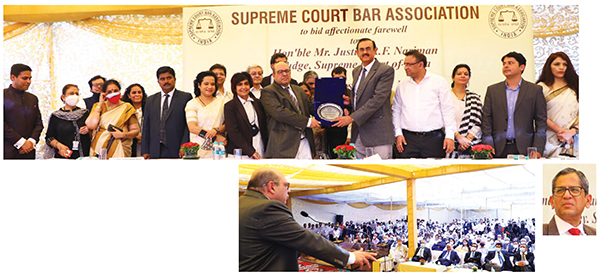
Clockwise from above: Rohinton Nariman (10th from l) receiving memento from Vikas Singh
as members of the bar look on; Chief Justice of India N. V. Ramana; Nariman addressing the distinguished audience
At the SCBA meet, the Chief Justice of India N. V. Ramana described Rohinton as a flourishing "banyan... His impact cannot be measured in scales.” He spoke of the sacrifices necessarily made by a judge. Accepting a judgeship implies monetary loss when a senior advocate has a roaring practice. Contrary to the misconception among the lay public that judges have a cushy life staying in bungalows, working from 10 a.m. to 4 p.m. and enjoying their summer vacations, judges are burdened with work, often staying up till midnight or rising before sunrise. A judge’s greatest reward though lies in "upholding the law.” At the Court reference to Rohinton earlier in the day, the Chief Justice had remarked, "I feel like I’m losing one of the lions that guarded the judicial institutions.”
Others who spoke on the occasion included the president of SCBA Vikas Singh who referred to the "respect and awe” that Rohinton commanded from junior lawyers who were intimidated by him. But as an "embodiment of the eternal flame of justice… he was completely reformed, particularly nice to the younger members of the bar. Having read the brief more than the lawyer, he granted relief that the junior lawyer did not know existed!”
The second adieu
Encomiums came pouring in for Rohinton on his 65th birthday on August 13 at the farewell function organized by BBA. Describing him as "the Renaissance Man of the Supreme Court,” BBA president Nitin Thakker quoted British author Enid Bagnold, "Judges don’t age, time decorates them.”
Senior advocate Janak Dwarkadas believed Rohinton was blessed with a rare combination of being "born great, achieving greatness, and having greatness thrust upon him. He has four distinct compartments in his brain, each a storehouse of immense memory: world history, western classical music, comparative religion and law.” His close friends wondered aloud how he would manage to control his impatience on the bench when dealing with advocates who may not be be as quick as him. They were amazed by his response, "I have taken an oath, I will be a kind and considerate judge.” Not a single person has complained "of being rustled in Ro’s court….I am sure that retirement will only be a small comma in his life,” added Dwarkadas.
Senior counsel Navroz Seervai described him as a "cornucopia of know-ledge — that knowledge he brings to bear at an appropriate time and place.” To Darius Khambata, erstwhile additional solicitor general of India, Rohinton’s tenure on the Supreme Court will be "long remembered for the scholarship of his judgments, particularly in the fields of arbitration and insolvency law, for his courage and integrity as a judge and for his desire to do justice by truth and law, uninfluenced by the pressures and mores of the day.”
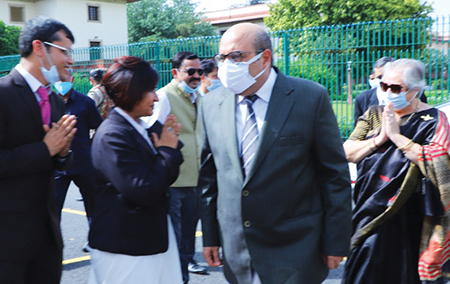
Rohinton and Sanaya Nariman accorded a welcome
Starting his legal practice in the Bombay High Court, Rohinton related "there was more courtship than court” for that was the time he had found a match in Sanaya! In his address, he further recalled some of his life transforming experiences. His navar training as a 12-year-old child at the Tata Agiary in Bandra when "incarcerated for 28 days, sleeping for the first time on a leather bed with only a little fan at the top proved to be one of the greatest experiences.” Leading a life of seclusion he was permitted a bath once in 10 days. The senior priests who were "very grandfatherly” towards him ensured he prayed five times a day, including at 12.40 a.m.! On the 23rd day he belted out for three hours the Avestan prayers he had memorized in front of an audience that included his great-grandmother.
When Fali took Rohinton to meet the legal legend Sir Jamshedji Kanga who was then almost on his deathbed, the father proudly informed Kanga that he had brought his newly initiated son. The senior perked up and enquired of Rohinton how many of the 72 has (or chapters) he had memorized. When Rohinton told him that he had learnt 50, Kanga impressed on him that since Rohinton had learnt 13 more than him, he should be 13 times better than him!
While his navar training helped him to chisel his memory, it had not prepared him to face an assembly of teachers and students at Cathedral and John Connon School when he was asked to elucidate on the ritual and prayers he had arduously learnt. The boy was tongue-tied. "I vowed I would never look idiotic again in public,” recalled Rohinton. He pored over translations but found them extremely difficult to comprehend. Wondering whether there was "some deficiency in me or in the Avestan translations, I read a translation of the Bhagwad Gita. It made perfect sense to me on the first reading.”
Years later when he was at the Harvard Law School, Barzo Taraporewala sent him a copy of his father Irach Taraporewala’s monumental translation of the Gathas that helped him understand the tenets of his own faith vis-à-vis other world religions. "I had stopped praying. I started praying again only after reading this. When you study your own faith against others’, everything becomes so much clearer… The moment you have a radar, the ship doesn’t run aground.”
Whilst majoring in constitutional law at Harvard, Rohinton had opted for Dharmashastra law (Sanskrit theological texts constituting divergent commentaries and treatises on duties, responsibilities and ethics to oneself, to family and to society) as one of his subjects, submitting a paper on the difference between penance and punishment. Referring to the US constitution as the "oldest written constitution known to mankind that has endured,” Rohinton commented that the 13th, 14th and 15th amendments "did away with slavery but not discrimination.”
While many would prefer to forget the early days of the pandemic, Rohinton acknowledged that his "second and third books are thanks to Covid-19 when one junior and one stenographer came to me every day” for six weeks. His second book Zoroastrianism in Other Faiths showed his mastery of comparative religions just as his first work, The Inner Fire: Faith, Choice, and Modern-Day Living in Zoroastrianism was a reflection of his in-depth study of his own religion. The third book, Discordant Notes, that gives law students and practitioners insights into deferring judgments, was released on August 14.
To upcoming lawyers, Rohinton advised, "The more diverse your experience with subjects other than law,” the deeper is your understanding of law. "Law itself is greatly interconnected. You realize it at the Supreme Court more than anywhere else.”