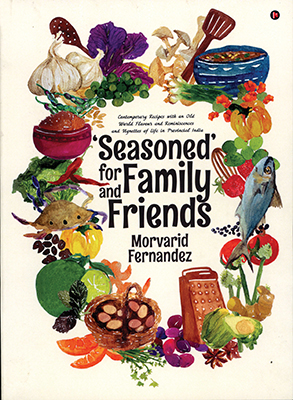
‘Seasoned’ for Family and Friends. Contemporary Recipes with an Old World Flavour and Reminiscences and Vignettes of Life in Provincial India by Morvarid Fernandez. Published in 2016 by Notion Press, Old No. 38, New No. 6, McNichols Road, Chetpet, Madras 600031. Pp: ix + 306. Price: Rs 750.
It’s official. The good news is that grannies are back in fashion.
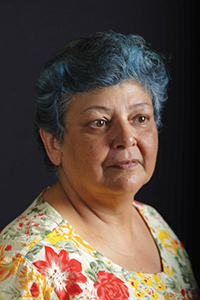
You can forget quinoa, the chia seeds, ditch the Keto diet, but be kind to the Veganistas, they are all over the place. Morvarid Fernandez’ (pictured) glowing compendium of recipes celebrates not just her grannies, but her eccentric collection of aunts, uncles, her father Farokh Irani and mother Sheila, who drove an ambulance during the World War II, her siblings and the life they lived under sheltering eaves of a grand old bungalow called Krupalaya at Mysore, when that gracious city still had a Maharaja living next door in his magnificent palace.
If Fernandez’s enchanted early life feels a little like Enid Blyton meets Gerald Durrell, it’s because she has managed to make her recipes sound like an endless picnic out in the garden. There are stories about prized bulls stamping on her newly acquired non-stick saucepan, or the Bee Whisperer coming to harvest the honey from the hives of the wild bees, while her mother makes stacks of sandwiches with carrots. Or memories of baking in a Baby Belling oven that was the prized asset of proud housewives who waited eagerly for the arrival of Woman and Home from England with recipes for carrot cake and upside-down pineapple cake. There’s a wonderful recipe for carrot cake with frosting decorated with edible flowers. Never mind that today Betty Crocker rules and recipes for eggless cakes, an abomination if ever there was one, are now what people prefer to make at home.
Ramu, the Bee Whisperer belongs to her current life. It’s in a remote part of the Western Ghats in Karnataka, where Morvarid and her husband David bought a piece of land in 1981. They built a house called The Hermitage while engaging in what was a trend in those days, a return to the land by gentlemen farmers. They settled down to do organic farming. In 2003, they opened a guest house. This is where Morvarid entertains her guests with her own cooking using the repertoire of her mixed heritage of influences that include Persian, Zoroastrian, Irish, Dutch and Tamil recipes. It’s leavened with what one might add a hearty dose of Anglo-Indian treats, particularly when it comes to jams, jellies, chutneys and cakes. Do we need to add that there is an awesome selection when it comes to akoori, the Parsi contribution to scrambled eggs? Or that she actually advocates putting a little ghee into that very same scrambled egg?
First things first, however. Before we can get to the recipes there’s the matter of genealogy. Since many of the anecdotes about her family come distinguished with a quick resume of what they did in life, together with photographs, it’s actually advisable to go with the flow, tasting the culinary highlights that they bring to Morvarid’s mind. Here for instance is what she tells you about the Irani Café Sunrise started by Mohammed Sadegh, the father of a good friend Mehdi. "On a good day in 1984, when a cup was priced at 90 paise, he sold between 1,500 and 2,000 cups of Irani chai (tea) through the day.” Then she gives you the recipe and how it was dispensed, the gently simmering tea kept in a separate samovar and the creamy buffalo milk in a nearby vessel. Her own grandfather, Khudmorad Jamshed Irani and his wife Motibai lived in Poona. They had migrated from Yazd in what was then Persia. He owned a piece of land, she tells us, in Golibar Maidan, on the outskirts of Poona that he had rented at a very small price to the local shepherds. He would travel to collect the rent three times a week and then spend the rest of the morning at The Kohinoor Irani café on Main Street catching up with his fellow Iranis. Golibar Maidan is now in the heart of the city.
Her grandparents on her mother’s side are even more interesting. Una Maud Fergusson, her grandmother was one of seven sisters with a Dutch ancestry. She then goes on to add: "Una Maud’s mother was Sarah Scattergood of whom we know very little, other than the fact that she was an excellent cook. I have a handwritten recipe of hers for sooji halwa. I had it framed and it hangs on my kitchen wall. The family tree however does trace her lineage to John Scattergood and Arabella Forbes who married in 1706 at Fort St George, Madras.”
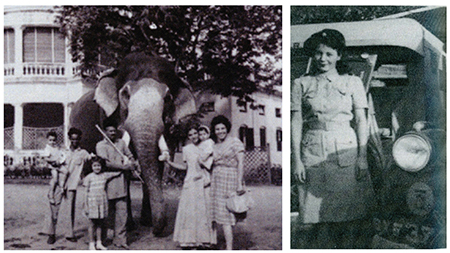
(Above) Morvarid in the arms of her mother Sheila (2nd and 3rd from r) with (from r) aunt Siloo,
mahout, cousins Kayandokht and Meherab (in arms of domestic Ramu);
(above right) Sheila as an ambulance driver during WW II
Una Maud was a nurse who met and married Egbert George, an Irishman who had been sent to Mesopotamia during World War I as a medical doctor. "I have to confess that there were so many more aunts and uncles from both sides of the family tree that I stopped worrying about them to enjoy the food that they loved to share.”
For instance, there is a recipe for pomegranate and rose ice-cream with star anise which sounds gorgeous, not to mention details on how to process the seeds of a custard apple to make a quick pudding. If you happen to have a stash of mulberries she recommends a
Mulberry Clafoutis to be served with a pot of cream. There are also wonderful descriptions of Christmas at Krupalaya spent with the extended family. It allows her to devote a whole section on different kinds of yogurt, how to make it, how to flavor it, how to make home-made paneer and cook a "Running Dhal with Devils Dung.” You will have to read the book to find out what Devils dung tastes like.
There are also a number of Persian sourced dishes with a local flourish added. For instance, the famous berry pillao becomes the Tamil black rice – Kuravan — with Persian barberries, or zeresht. There are also recipes for other zeresht dishes, which she clarifies are like a stew. She adds a little warning when it comes to frying prawns. Do them in small batches at a time, she advises, otherwise they will clump together and become a stew. As for Foogaths, of which there are quite a variety, she explains that it is the Portuguese for stir-fry and but for the addition of a few shards of ginger and chili, a foogath is just another reason to chop and stir what you might have at hand, or outside in the garden. Not only are nasturtiums recommended, with the accompanying water color illustrations by Annushka Hardikar that add greatly to the charm of the book, she tells you how to dry and powder the seeds of the papaya to create a nutritious supplement.
For the health conscious, Morvarid does take you on a ramble through the different types of millet, how to deal with taro roots, how to sun dry your tomatoes and how to find a now almost extinct variety of banana called the Nanjungod Rashale. She’s also trendy when it comes to including a recipe for lassi with wasabi and a compote of mulberries with mascarpone.
This is the ideal gift to give someone. For not only will it gladden the heart with Morvarid’s summoning the recollection of her family’s rich past, it will prompt you to tie an apron and head straight into the kitchen muttering "mulberry clafoutis!”