Two panel discussions organized by the World Zarathushti
Chamber of Commerce in Orlando reflected how participants had
interwoven their faith with a flourishing enterprise
Text: Parinaz M. Gandhi Photos: Jasmine D. Driver
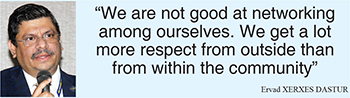
Encourage children to be free and make mistakes... instead of passing derogatory comments like "bania jévu karéch (acting like a businessman)… With machines and Artificial Intelligence this is the age of the entrepreneur. We at the WZCC (World Zarathushti Chamber of Commerce) are trying very hard to change the narrative,” stated Ervad Xerxes Dastur, partner of V. S. Dastur and Company, Chartered Accountants and director of WZCC India, when moderating the panel discussion on Zoroastrianism and Entrepreneurship after the annual general meeting (AGM) on May 1, 2019 at the Marriott Springhill Suites in Orlando, USA. "Profit and social change should both serve as motivators for business…Whilst solving the big problems of the world, effective businesses can see the value of tackling problems like hunger and mass migration. We are not good at networking among ourselves. We get a lot more respect from outside than from within the community… We are too much in our comfort zones,” remarked Dastur.

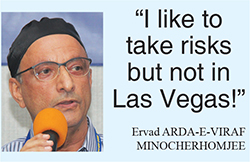
When determining one’s net worth, one should also account for our spiritual net worth, advised Ervad Arda-e-Viraf Minocherhomjee, founder and managing partner of Chicago Growth Partners and president of the North American Mobeds Council. At the 2018 AGM of the Federation of Zoroastrian Associations of North America (FEZANA) he had learnt a saying in Hindi, "Dhandha mé dharam rakho, dharam mé dhandha mat rakho (be righteous in business, do not bring business into religion),” he added. "We have to bring Zoroastrian values of truth in business. The issue is not ‘what you can do’ but ‘what you should do.’ The Zoroastrian bar is much higher, doing business the right way.” He recalled the advice his mother gave him when he left India, "Don’t forget God, the poor and humility.” He acknowledged that now he looks for these traits in others before deciding on a business partner.
"Do you insert religion into your business? As a mobed I always do. When I invest, I am skeptical of atheists. I look for a person who is truthful. How does he treat other people? Is he willing to listen to others? Does he serve some charitable organization? It is better to lose wealth for the sake of truth than your soul for the sake of falsehood.” The "formula” for attaining happiness is enshrined in Gatha Ushtavaiti Yasna 43.1 that states, "Ushtaa ahmaai yahmaai ushtaa kahmaaichit (may happiness be unto that person through whom happiness may reach others).” This prayer also beseeches Ahura Mazda for wealth, good blessings and a good mind. He looked forward to the arrival of the "Golden Age of Zoroastrianism.” That will happen "in North America,” promptly interjected Ervad Soli Dastur, spiritual leader to the Florida community.
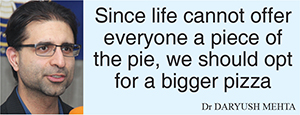
Since life cannot offer everyone a piece of the pie, we should opt for a bigger pizza, suggested Dr Daryush Mehta, director of the Voice Science and Technology Laboratory at the Center for Laryngeal Surgery and Voice Rehabilitation at Massachusetts General Hospital and assistant professor in surgery at the Harvard Medical School. Whilst matching engineering with medicine, he noted, "To work sustainably or get to the truth in the right way” has been his endeavor. Collaborating with doctors and clinicians to help people with problems speak better through improved voice intonation, he considers this activity as his contribution to "hukhta (good words).”
Valuing the principle of Yatha Ahu Vairyo prayer that advocates doing good for others in need, he stated that as a professor he felt it his duty "to pass on knowledge to his students, give them tools and then get out of their way. Dharma (or duty) is what everyone does, but when you believe in what you are doing comes passion.” Referring to the importance of both nature and nurture, he conceded that whilst "expressed genes do play a role, without input we wouldn’t see output. Improvements may not happen organically.”
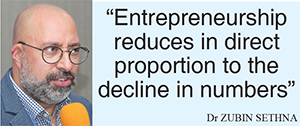
"The future is in the past,” was the philosophical comment of Dr Zubin Sethna, associate professor of entrepreneurial marketing and consumer behavior at Regent’s University in London. Tracing the behavior of Zoroastrian businessmen from the Achemenians who had trade links with India, the Sassanians whose trade was marked by domination of the seas, the Parsi trader alluded to by Vasco da Gama, the artisan enterprises of carpenters and shipbuilders during the British rule, to the opium trade between India and China, Sethna remarked that their "affluence and influence was because of their ability to create a network whilst avoiding local business politics.”
He further commented that the savvy community of yore was high in "OR (opportunity recognition) and when they saw an opportunity they grabbed it with both hands. I am not sure if the community would do so now.” On the Global Entrepreneurship Monitor (GEM), one of their matrices measures the willingness to take risks which was found to be highest among West Africans because they have nothing to lose. Advocating a "risk taking appetitite,” he continued, "Risk is something you have to take; but not silly risks.” To him, "entrepreneurship is not a process (with a sequence or number of steps) but a method (that offers a toolbox from which one can pick depending on the context).”
He referred to his own foray as an entrepreneur when at the age of 12 he realized he could make money by availing of a financial offer made by his uncle to wait in an overnight queue for tickets. Once he was relieved by his uncle the next morning, he rushed to sell coke bottles at 10 times the original value to those in the queue desperate for a drink. He cited a study that determined "transgender entrepreneurs behave in similar ways to ethnic entrepreneurs who have a passion to improve their lifestyle, to send their children to university and for whom enterprise was a means to an end… (Within a community) entrepreneurship reduces in direct proportion to the decline in numbers.”
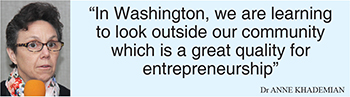
"Their quest for knowledge and individual responsibility to leave the earth better than we found it,” is the characteristic of Zarathushti entrepreneurs, observed Dr Anne Khademian, presidential fellow and professor with Virginia Tech as also president of the Zoroastrian Association of Metropolitan Washington and Avesta class teacher. "We need to be conscious of where we come from… In Washington, we are learning to look outside our community which is a great quality for entrepreneurship…The nature of entrepreneurship is changing, seeking sustainable strategies where the scope and scale of problems is enormous. Our Zoroaastrian youth are social entrepreneurs,” she is convinced. "The young ones are looking beyond traditional disciplines, seeking collaborative and human centric pursuits.”
Perzen Patel who launched the Bawi Bride Kitchen in Bombay enquired if it was wrong to market herself on social media when the panelists were advocating humility. She was reassured that as long as she was honest about her strengths, there was nothing wrong in promoting her brand. According to Hoshi Mehta of Chicago, "Two things go against entrepreneurship: higher education and not encouraging failure.” Advised Minocherhomjee, "It is up to you what you do with your education.” It is a safety net on which you can fall back.
"Don’t leave your full-time job until you are successful in your part-time job,” cautioned Rusi Gandhi of New York. When Shernaz Engineer, chair of WZCC-UK commented that "people are averse to risk… You have to take a leap in the dark,” Minocherhomjee admitted, as a venture capitalist "I like to take risks but not in Las Vegas!”
Parsis in India who were flourishing under the British became complacent once the rulers left, observed FEZANA vice president Arzan Wadia, referring to the breed of laid-back "Central Bank Parsis” as compared to the enterprising ones who came to the US in the middle of the last century. The upswing of entrepreneurship since 2000 was possibly due to technological advances, he felt. Parsis feel the need to "be fair, give others a chance,” commented Dinshaw Tamboly chair of The WZO (World Zoroastrian Organisation) Trust Fund. He believed, "as a community, we ourselves are to be blamed. Everything was made available to us on a platter. ‘Parsi chhèo (you are a Parsi), come and join.’” Fortunately "entrepreneurship is no longer a dirty word. The spirit of entrepreneurship which was in hibernation is rising.” Alayar Dabestani referred to his thriving real estate and theater business in USA and Canada that employed 450 people of whom 75 were Zarathushtis, among the most honest.
"Identify people in the community with fire in their belly. See their needs and go and help them. Unfortunately we are talking to the wrong audience,” said Rustom Engineer of Houston knowing that the audience comprised mainly of senior citizens.
Adding value
Participating in the second panel discussion were some of the young stars on the US horizon: Dr Jennifer Avari Silva, director of pediatric electrophysiology at Washington University (WU) and co-founder and chief medical officer of SentiAR, a venture backed, software device spinout from WU; Dr Jeannie Kenkare, co-founder and chief medical officer of PhysicianOne Urgent Care with 18 centers in three states; Dustyn Shroff, founder of The Shroff Insurance Agency; Khush Italia, co-founder of LCI Partners, a real estate firm. Guiding the discussion was Dr Behram Pastakia, a radiologist who serves as chair of three FEZANA committees: Youth without Borders, Information Receiving and Disseminating (Publications) and Zoroastrian UN-NGO. He urged the panelists to speak about their successful ventures, their challenges and their willingness to make time for the Zarathushti community.
To Silva, "innovation should add value,” and in her field this implies "value to the patient and/or physician even though such value may not always be aligned.” Whilst originally practicing medicine and doing surgery within the walls of the University, she created a tool that hundreds of physicians could use "to amplify the value.” Although in academic medicine, she realized she wanted "to make money,” to leverage her talent whilst taking better care of patients in need. Having faced sexism in her enterprise, she was amused that venture capitalists would initially ask for her husband and co-founder, but he would redirect them to her.
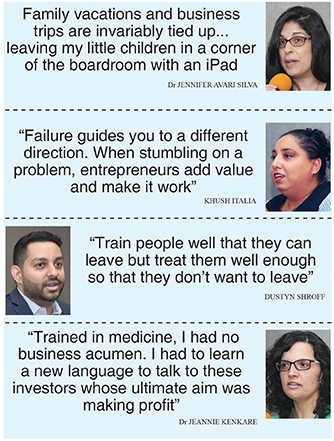
Time management was a major issue when for weeks she would not even return her parents’ calls. She eventually had to opt for a full-time domestic help. Family vacations and business trips are invariably tied up. She has attended business meetings with 20 people in a boardroom, leaving her little children in a corner of the room with an iPad and her son occasionally slipping onto and off her lap during such meets for they have been taught early that their mother has to work hard to keep others healthy. Describing herself as "brutally honest, I cannot lie,” on occasions her colleagues would request her to refrain from attending a meeting so that she did not divulge more information than required! Appreciating the help that she has received from the community, she feels the need to "pay it forward, return the favor, share my time with people who need it.”
 Those who possess a spirit of entrepreneurship "harness fear and make it work to their advantage. They are able to motivate people around and under them,” commented Shroff. "I did not like people managing me. It wasn’t fulfilling.” Able to sell innumerable goods on the internet with his persuasive skills, it was a joke in the family that "if dad didn’t lock his door I would sell him on eBay too!”
Referring to his growing insurance business, he admitted that he may not love selling insurance but he enjoys "talking to people, building relationships, getting pressure off their shoulders in case of accidents.” As compared to earning regular salary and commission, in his independent business he could see that "the fruits of labor were not coming immediately.” There would be periods when the phone would not ring. "It is like running a marathon, not a sprint.” His leadership style recognized that while some in the team were motivated by dollars, others liked a Friday off to tie up with the weekend. "Train people well that they can leave but treat them well enough so that they don’t want to leave,” has been Shroff’s approach that has propelled his growth to two offices in four years. Happy to assist when required, he reassured the community, "We are here for you.”
"An entrepreneur will find a way when one is not available. It is like baking a cake without flour,” said Kenkare. "I always wanted to be a physician,” she mentioned, but regretted that "the system is broken. We don’t deliver heath care perfectly.” Looking for an opportunity to improve on it she felt patients deserved to have access to good emergency care "at the right time and right cost.” This led to her first center that has now grown to 18 after 11 years and by bringing in financial partners. "Trained in medicine, I had no business acumen. I had to learn a new language to talk to these investors whose ultimate aim was making profit.” Along the way they have "added value to so many stakeholders — patients, physicians, the health system... fostered meaningful, trusting relationships with people.”
Having attended Zoroastrian Association of Greater New York (ZAGNY) religion classes as a child, she now takes her three children every month to the dar-e-mehr that is a two-and-a-half-hour drive away. Dependent on a nanny from the time her youngest was four weeks old she appreciated the "incredible support” she has received from the family with everyone making sacrifices. Grateful that her husband is very supportive in raising their children as Zoroastrians, she would like them to enjoy the sense of community and belongingness as Zarathushtis. She offered to share her professional expertise and mentor others.
Convinced that there is "no such thing as failure,” Italia noted, "Failure guides you to a different direction. When stumbling on a problem, entrepreneurs add value and make it work. An entrepreneur is a master of none and jack of all trades.” A national level tennis player, an injury compelled her to forego her athletic dreams and join the corporate world. "When working for somebody else, even if you have the drive, they have the final say which may not align with your vision,” she realized. When she left the corporate world, she was not able to find a job for 13 months until she and her brother decided to venture into real estate, working all days of the week to achieve "personal growth and to sustain my lifestyle.” Having felt stifled in her earlier jobs, she now permits creativity to her staff members for "all of us have a need to fulfill what is within us…
 "Traditional methods of education are not serving people in this day and age. A lot of people are learning things online,” remarked Italia, offering to mentor others and share her story for the benefit of the community. "But the youth are always missing at such meets. What we have to offer is not enticing compared to other things available,” she added. Having attended a Return To Roots program (where youth from the diaspora are brought to India to experience their Zoroastrian roots) she noted, "It is up to Arzan (Wadia) to provide a platform and share videos where we can learn from each other.”
"Totally blown away by this God given talent,” Aban Rustomji of Houston enquired of the panelists, "When do we see you as chairs of our committees?” Italia who had helped in the organization of the North American Zoroastrian Congress in Los Angeles in 2016 during the time she was unemployed, candidly responded, "It is not easy to work with so many cooks in the kitchen. Empower the youth. Let them have a go at it without the pressure of failing. Rather than put restrictions, fund the individual events that they may want to lead. The older generation needs to take a step back. I do not want to step on anyone’s toes.”
"It is time to make a sea change. Our definition of youth keeps going up as we grow older,” agreed Astad Clubwala, president of ZAGNY that will host the 12th World Zoroastrian Congress in 2022. "Are you willing to step up and say ‘we are ready?’” he challenged the youth, reminding them "your generation can make or break the community. Our generation has had the opportunity of (picking up Zoroastrian values through) osmosis. Your generation has not had so many Zoroastrians.”
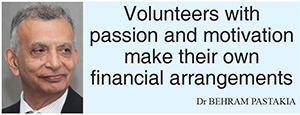
Pointing out that "you get the most when you give the most,” Italia noted that "young people don’t have funds to fly out (to venues of Zoroastrian meets). Fly us out so we can do it.” Pastakia commented that volunteers with passion and motivation make their own financial arrangements for different programs. "Value is a simple equation of quality plus service divided by cost or time,” he explained, and referred to 11,000 volunteers in 11 years signing up for RAD-AID, an organization that offers radiology and imaging technology in resource-limited regions. Wadia responded that many youth don’t want to make time for even conference calls. They don’t show up for events specially planned for the youth.
Shroff said, "I’d love to be part of the WZC.” He further added that boards of Zoroastrian associations run because the retirees have time to devote.” Responded Kenkare, "Lovji Uncle (referring to former ZAGNY president Lovji Cama) wasn’t retired when he taught me at Sunday Class. I would be happy to help.”
Silva assured the organizers that she would be present in 2022 along with "two little Zarathushtis!”
Reports on other WZCC proceedings will be carried in forthcoming issues of Parsiana.