A sandalwood tree. An indigo plant. These and other rare species thrive in south Bombay as part of the native biodiversity garden Vriksha Valli (VV) on the grounds of the Prince of Wales Museum [renamed Chhatrapati Shivaji Maharaj Vastu Sangrahalay (CSMVS)]. The 414 sq m (4,456 sq ft) garden that was funded by the H. T. Parekh Foundation and implemented by the Centre for Environmental Research (CERE) founded by Dr Rashneh Pardiwala and Kitayun Rustom, opened to the public in May this year.
"In 2023, CSMVS turned a 101 years…One of our bicentenary visions is to care for the environment and its close relation to culture,” Joyoti Roy, assistant director, projects and public relations at the Museum told Parsiana on July 31. "VV reminds us of the diversity in flora in India, which makes our country one of the richest in the world.” She stated that the garden is a gift to Bombay and its citizens "who can now walk into the Museum, not only to enjoy art but also the creative genius of the natural world… now also bringing in new birds, butterflies and insects.”
The garden borrows its name from an abhanga (devotional poetry sung in praise of the Hindu god Vitthal) in which 17th century poet Saint Tukaram describes plants, creepers, and animals as man’s friends. "Native plants play a unique role in rejuvenating local bio diversity,” Museum director general Sabyasachi Mukherjee who conceptualized VV with the Foundation’s chief operating officer Ziaa Lalkaka told The Times of India on May 21.
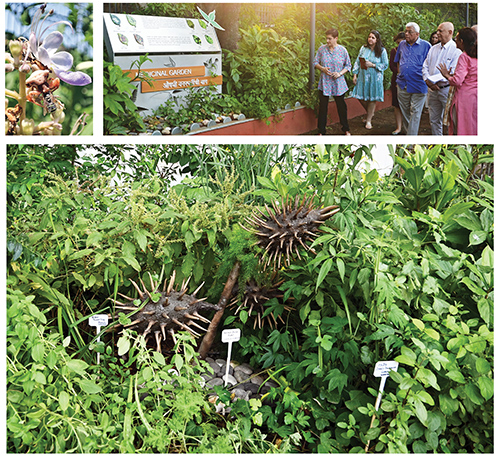
Clockwise from above l: crab spider devouring a wasp at Vriksha Valli;
Dr Rashneh Pardiwala, Ziaa Lalkaka, Deepak Parekh and other officials; view of the garden
Prince of Wales Museum (now Chhatrapati Shivaji Maharaj Vastu Sangrahalaya) Photo: Wikipedia
"With rapid urbanization and concretization of megapolises, many plants are not commonly found in Bombay,” stated Pardiwala to Parsiana in a detailed note. The rare plant section of the garden also includes indigenous varieties like mahua (a forest tree from whose flowers a potent liquor is made), dhup (whose wood is used for puja), agarwood (a resinous tree) and khus (vetiver). "Some of these are vulnerable and threatened even in the wild,” stated Pardiwala.
"Native plants play a unique role in rejuvenating local biodiversity,” said the environmentalist. "These have evolved over millennia in a specific region and have special features that help them adapt to a particular environment. In turn, these plants support local fauna that are dependent on them for food and shelter.” Once native plants have been sown they regenerate habitats and support the entire ecosystem of a region, she stated.
"We Parsis love drinking tea made with mint leaves... Have we seen the flowers of the mint plant? They were flowering abundantly in the garden last month,” noted Rustom.
For VV, which was inaugurated by Foundation director Deepak Parekh on May 6, with 200 native species and over 7,000 plants, CERE envisages three aims: attracting local flora and fauna; an outdoor education center "where biology books come alive;” a repository of plants to conserve a gene pool. They hope that VV "starts a trend to move away from manicured, highly chemicalized gardens with exotics that offer little by way of ecological services.”
Implemented around five themes — historical, medicinal, vertical, kitchen and spice, and butterflies — when Parsiana visited on July 19, a group of excitable children were being shown around. As stated Pardiwala in her note about the displayed models of leaves, "These are for school kids to understand the diversity of shapes, sizes and leaf margins.” Yet another family was peering at models of pods, which Pardiwala said were used to explain different types of seed dispersal methods. Another couple, ostensibly lost in each other, was clicking selfies against the backdrop of the vertical green wall. Entry to the garden which is from the main entrance of the Museum, is free. Integrated with the Museum grounds and the neighboring Bombay Natural History Society, VV is "physically and symbolically connected to India’s man-made and natural heritage,” noted the CERE website.
"Who talks about the role that plants played in shaping India’s history, and in fact the world’s history... for instance, the pepper plant that led to the discovery of a sea route to India which subsequently resulted in its colonization?” queried Rustom, offering a snippet from the historical section.
Pardiwala noted that "the historical section in the garden may very well be the first of its kind in India and globally… We have not heard or read about any initiative in the world where the indoor artefacts in a museum are co-related with the plants grown in the gardens outside.”
CERE’s note explained that "various experts ranging from botanists, taxonomists, landscape designers, educationists, display board experts, sculptors, civil engineers, masons, electricians and a team of skilled gardeners were involved in the project… Project ideation started in May 2022, work at site commenced in November and the garden was ready in April 2023.” Pardiwala even hand carried three large tea plants on a flight to Bombay after a field visit to Assam!
Besides conceptualizing and implementing the green space, CERE has also designed the all-weather bilingual signage and the exhibits, designed and installed a drip-irrigation system, with the soil enriched with manure and earthworms. Gardeners have been trained in carrying out maintenance. CERE will develop educational activities based on this biodiversity garden to help school students. "Some of the activities would be based on the artefacts in the Museum and their connection with the plants from the garden.”
The Centre has implemented a similar garden in Alibag (see "Ecological Eden,” Parsiana, October 21, 2016), and in Poona, Bangalore and other places.
The H. T. Parekh Foundation is the philanthropic arm of Housing Development Finance Corporation (HDFC) Limited, India’s leading mortgage lender and financial conglomerate, now merged with HDFC Bank. Autonomous and non-aided, the Museum is one of the premier art and history museums of the country.