A two-day seminar at The K. R. Cama
Oriental Institute viewed the evolution of
design as an art form in India
Farrokh Jijina
Everyday objects such as teacups and kettles and other similar articles can teach us about our culture, stated Dr Annapurna Garimella, the keynote speaker at the two-day seminar titled "Design, culture and history: The idea of objects in modern and contemporary India” organized by The K. R. Cama Oriental Institute (KRCOI) on January 5-6, 2019. "There is a deep relation between design and folklore… objects ‘move’ between people and histories,” said Garimella. Titled "A humble theory of design and sociality,” Garimella’s talk focused on "humble” objects: cups, kettles and pots used for tea drinking; designs of temples; and grinding stones and mixers used for food processing. The designer, art historian and head of the curating firm Jackfruit Research and Design stated that historically, tea has been the favored drink of an English memsaab (lady) as well as Indians in villages. Objects for consuming the beverage vary across regions, from fine bone china to clay pots, plastic cups and stainless steel cups. Their designs were created and evolved keeping in mind cultural backgrounds in which they would be used, said Garimella. Fashionable tea sets now sold by tony home stores like Fabindia and Good Earth are a happy mingling of the industrial crafts and arts, she said. Discarded grinding stones now form decorative objects in chic homes and art exhibitions, she narrated.
As noted KRCOI president Muncherji Cama in his message, the conference aimed to provide an "understanding of design in India through a historical framework,” starting with the colonial and industrialization era. Academic advisor to the seminar, Dr Kaiwan Mehta noted that the 1851 Great Exhibition (the Great Exhibition of the Works of Industry of All Nations) in Hyde Park, London was a "landmark moment that defined design around the world.” Organized under the leadership of Prince Albert (husband and consort of Queen Victoria) and members of the Royal Society for the Encouragement of Arts, Manufactures and Commerce, the Exhibition was a celebration of modern industrial technology and design. Its prime motive was to make clear to the world the role of Great Britain as an industrial leader.
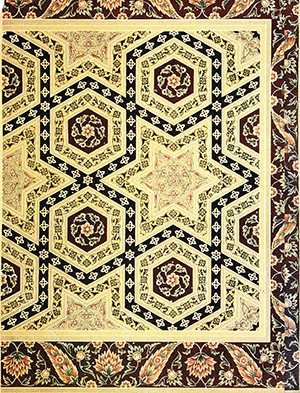
Jeypore portfolio of architectural details
image courtesy Sir J. J. College of Architecture archives and
Dr Mustansir Dalvi, reprinted from seminar brochure
Above, l-r (seated): Judy Frater, Dr Nawaz Mody, Dr Tapati Guha-Thakurta, Tasneem Mehta,
Dr Annapurna Garimella; (standing): Mortimer Chatterjee, Dr Seema Khanwalkar, Dr Kaiwan Mehta,
Rahaab Allana (bearded), Abin Chaudhuri, Ranjit Hoskote, Deepti Mulgund, Dr Sudeshna Guha,
Dr Mustansir Dalvi, Dr Abigail McGowan; inset: Muncherji Cama
In her welcome address KRCOI honorary secretary Dr Nawaz Mody appreciated Mehta’s efforts in reaching out to "distinguished speakers and chairpersons.” This was the first time in the history of the KRCOI that they had to close registrations early due to a great response, she said.
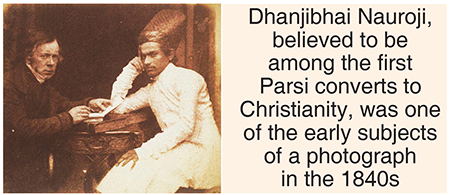
Dhanjibhai Nauroji, believed to be among the first Parsi converts to Christianity, was one of the early subjects of a photograph in the 1840s, stated curator Rahaab Allana. The publisher of the Alkazi Foundation for the Arts showed a picture of Nauroji, seated with Rev John Jaffray of the Free Church of Scotland, wearing a pugree; the fingers of his right hand seem to be holding up his face, while his left hand rests on his knee. Allana explained that the style is called "pictorialism.” Wikipedia states that in this style, the photographer manipulates the subject as a means of creating an image rather than simply recording it. This aesthetic movement dominated photography during the late 19th and early 20th centuries, according to the online encyclopedia. Community photographers J. S. Taraporewala and Shapoor Bhedwar were among the first to take to pictorialism, a tradition continued by Homai Vyarawalla, Allana noted. In his talk "Pictorialism and early photography exhibitions,” the curator stated that this style of composing photographs "widened viewer engagement” at exhibitions. As a technique, it continues to be used, even in online exhibitions, said Allana.
"Don’t do it yourself… you will (mess) it up… we will do a good job (meeting your requirements).” This was the message that design firms and modern home interior providers in India of the 1930s to 1960s sent out to their potential customers through advertising, said Dr Abigail McGowan. The associate professor of history and associate dean at the College of Arts and Sciences at the University of Vermont was speaking on "The commerce of design: Design firms and modern Indian home interiors, 1930-1965.” McGowan noted that designers were telling their future clients that they provided "expert designs for material needs.” Basing her research on advertising material of interior firms like Kamdar Limited, the Army and Navy Stores and Chippendale, McGowan said that the manufacturers were messaging that they provided bespoke furniture, "from Louis IV chairs to modern writing tables.” These firms "tried both to imagine a modern Indian home and to build market share… The inspiration for their design was commerce,” she said.
The first session of the conference was themed around the foremost art school in the country: Sir Jamsetjee Jejeebhoy (J. J.) School of Art. Dr Mustansir Dalvi, professor at J. J. College of Architecture stated in his talk "The unstill life of the documentary drawing: Imagining the future of Indian architecture at the Bombay School of Art (1890-1947)” that for the early students of the College, copying of designs from previously made drawings and documenting the architecture of built structures was a key activity. The stress was on the ornamentation on columns, ceilings, balconies, rather than basics of the building, stated Dalvi who chairs the board of studies in architectural education at Bombay University. "The plates created by the students became part of future pedagogy (method of teaching)… these tools could be used to create further designs,” stated the professor. The designs helped students when they were given very brief instructions like "Make a temple in an Indian city,” or "Make a gymkhana in Mughal style,” said Dalvi. On excursions to ruins of ancient sites, students were encouraged to visualize and draw them in their previous, intact state. But, "copying is a dilemma… you should copy to learn, but not all the time,” stated Garimella while commenting on Dalvi’s lecture.
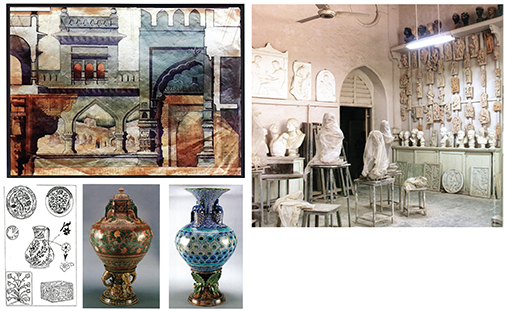
Clockwise from above left: documentation of Teen Darwaza at Panhala Fort
image courtesy Archives of Sir J. J. College of Architecture;
view of a studio; samples of Bombay School Pottery from the collection of the
Dr Bhau Daji Lad Museum; samples of patterns reprinted from seminar brochure
The collection of art objects attached to the College is vital in teaching architecture, stated Deepti Mulgund who has recently submitted her doctoral thesis on art in colonial Bombay. Her talk was titled "The J. J. School of Art: The art school and the museum in the colony and the making of visual pedagogy.” The objects were first assembled for use in teaching a 23-stage design curriculum for art education prepared by the Science and Art Department of the British government in the UK. By 1896, the College had "the best collections of casts… no student could go in or out of the School without seeing them,” noted Mulgund.
Wondering and admiring
The curriculum employed at the Sir J. J. School of Art influenced the collecting policies of the Victoria and Albert (now Bhau Daji Lad) Museum in its formative years. The curator of the Museum was also the School principal, stated managing trustee and honorary director of the Museum, Tasneem Mehta. Bombay Pottery, the term given to creations of local potters supervised by the staff and students of the School, is an important part of the Museum’s collection, she noted. Her talk was titled "Wonderland pottery: showcasing Indian design to the world.” In different shapes, embellished with Islamic motifs, patterns from Sind and the murals of Ajanta, the pottery was a favorite at international design expositions in the country and overseas. The creations came to be known around the world as Wonderland Pottery, derived from the term "Hall of Wonder” that naturalist Sir George Birdwood used for the Museum.
 "We would like to see our city laid out like ancient Nineveh,” noted Bombay residents in the mid 19th century when obelisks (a tall four-sided stone column that narrows towards the top and ends in a point) from an archeological dig in West Asia were displayed in the city, stated Dr Sudeshna Guha. She teaches history at Uttar Pradesh’s Shiv Nadar University and was lecturing on "Antiquities in the design of a nation: Object lessons for archeology.” The study of antiquities excavated from archeological expeditions informs us of the history of design and the arts and crafts movement, believes Guha. Patterns for clothing, jewelry and luxury goods in the USA and UK were heavily influenced by Egyptian patterns following the 1922 discovery of King Tutankhamun’s tomb. The teacher rued the fact that there was no regulation of unbridled copying of antiquities like the sculpture of the dancing girl from Harappa, or the Ashoka pillar, and their use as souvenirs.
There was perhaps no university in the world where one could gain so much knowledge about India as one could at the world exhibitions of the industrial and decorative arts that were popular in the last decades of the 19th century, noted Dr Tapati Guha-Thakurta. The former director and history professor at Center for Studies in Social Sciences, Calcutta structured her talk titled "The designed object and its imperial histories: On T. N. Mukharji and the ‘art manufacture of India’” around the design of objects and imperial exhibitions. Troilokyanath Mukherji, curator of Calcutta’s Indian Musuem and collector of all things, "from minerals and raw materials to plants and seeds,” put together a compendium on collections in imperial exhibitions. This tome is referred to by researchers even today, noted the historian. The items on display at the 1851 Great Exhibition included life-sized models representing various communities of India. Subsequent shows in London and Glasgow had various artisans, including "potters, weavers and wheel makers,” seven "Bombay servants” serving tea at the display pavilions, with some inmates from the Agra jail brought in to depict Indian craftsmen!
To be continued