The North American Mobeds Council confers its Distinguished Scholar award to three senior priests
Porus Cooper
Ervad Arda-e-Viraf Minocherhomjee, president of the North American Mobeds Council (NAMC), had a question about funeral rites he was called upon to perform.
So, he turned to a man he and others in the mobed fraternity in the US and Canada often turn to as an authority in these matters. Minocherhomjee called Ervad Gustad Panthaki, in Toronto.
The answer was quick to come.
"Gustad almost has instant answers to everything,” Minocherhomjee recalled as he discussed the NAMC’s recognition of Panthaki and two other mobeds — Ervads Adi Unwalla and Cawas Desai — as "distinguished scholars” of the religion.
"Gustad gave me three references on what to do,” Minocherhomjee recalled.
NAMC’s "Distinguished Scholar” award for 2019 is in its second year. It was instituted in 2018, when Ervads Jehan Bagli of Canada and Soli Dastur of Florida received it.
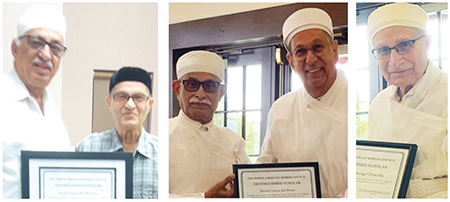
Above, from l: Ervads Kobad Zarolia and Gustad Panthaki Photo: Porus Pastakia;
Ervads Behram Panthaki, Cawas Desai and Adi Unwalla Photos: Farzad K. Irani
The award is meant to honor mobeds who both display a scholarly bent and freely share that knowledge with fellow mobeds and other community members, Minocherhomjee, a California resident, said.
There is one other impetus: Age. All of those recognized so far are in or near their 80s, and they have devoted a lifetime to providing spiritual services and guidance to the growing pockets of Zarthoshtis in the US and Canada.
"Last year, the Council decided that before such senior mobeds fade away we ought to recognize their service and their contribution,” said Ervad (Brig) Behram Panthaki (Retd), who serves the Washington DC-area community. The retired Indian Army officer and his wife Zenobia are co-authors of an acclaimed biography of Field Marshal Sam Manekshaw.
It was Behram who was tasked by the NAMC to present the certificates of recognition to Unwalla and Desai. He did so at a September 29, 2019 gahanbar jashan and luncheon organized by the Zoroastrian Association of Pennsylvania and New Jersey (ZAPANJ). Behram is Gustad’s younger brother. The award to Gustad was presented by Ervad Kobad Zarolia, past president of NAMC at the Shahenshahi Navroz function of the Ontario Zoroastrian Community Foundation.
Health issues have of late prevented Gustad from performing jashans. But, he says, "I read a lot, and that is all I do. I try to understand the problem, and if I don’t understand the problem, I try to inquire and get information.”
His bookshelves are crowded with source material, including seven translations of the Gathas, tomes on the Yashts and Vendidad, and works on Hinduism and Buddhism.
Unwalla is co-author, with Bagli, of four manuals on Zarathushti rituals. Each guide, in English, has become a must-have for younger mobeds, especially those unfamiliar with Gujarati.
The first book Unwalla co-authored, Understanding and Practice of Jashan Ceremony, published in 1999, "has become the Bible of the mobed fraternity, not only on this continent but also in India,” Behram said.
Unwalla has also co-authored similar manuals on performing obsequies and navjote and wedding rituals, and on the navar ceremony.
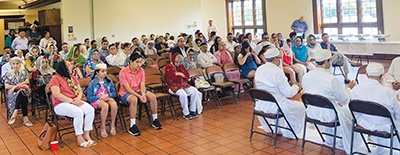
Audience at the ZAPANJ gahanbar jashan Photo: Farzad K. Irani
Among North American mobeds, Behram added, Unwalla is among just a couple who have "the distinction of having entered the sanctum sanctorum of Udvada. He has done boi ceremony in Udvada.”
Unwalla has also served as someone akin to a head priest in the Philadelphia-area community among whom he has resided for decades. He and his brother-in-law, Ervad Noshir Karanjia, have performed countless jashans, obsequies, weddings and navjotes, and are regular instructors at the monthly religion classes of ZAPANJ.
Often, they work together with Desai, all of them contributing their time and efforts at no charge.
In accepting the award, Unwalla recalled how, long ago in India, he was the beneficiary of "the generosity of community members and philanthropists who established institutions to provide us with religious education almost free of cost.” He feels now it is his "duty to give back to my community.”
Behram described Desai as "a research scholar and historian.” He noted how, in scholarly papers, Desai has chronicled both the vicissitudes of the history of the Zoroastrian people and how their religious texts and rituals have evolved over the centuries.
Speaking at gatherings of his ZAPANJ community and similar groups, Desai has also served as a popularizer of Zoroastrian history, tailoring his presentations to lay audiences.
Desai, for his part, deflects credit to Unwalla and Gustad. "I am not a scholar, I am a student,” he says. In that he echoes Gustad and Unwalla, who aver that the other two were more deserving of the recognition.
The Mobeds Council, which numbers about 100 members, itself is modest about its influence.
At their annual meetings, NAMC members discuss "burning, contentious issues that affect our diaspora,” Behram said. "We have free and frank discussions and we arrive at a decision. But the decision of the Council is not binding on any of the priests.”
The NAMC’s decisions also "may not be in conformity with those prevalent in India,” Behram added. "Our intention is to look after the (North American) community keeping in mind the environment we will face.”
In one respect, however, the NAMC has been a trendsetter: Nearly 20 years ago it passed a resolution that drew a clear distinction between the terms "Parsi” and "Zoroastrianism.”
"Parsi is a race; Zoroastrianism is a religion,” the NAMC said.
Treating the two as synonyms, Desai said, is the "root cause of the problems we have in India.”
Porus P. Cooper is a veteran journalist in the United States