The woodland at Doongerwadi is a natural heritage that needs to be protected
Parinaz Gandhi
Everything green doesn’t play a role in the ecological system,” asserted Dr Rashneh Pardiwala standing under a closed canopy of gliricidia trees that keep shooting up on the Doongerwadi property in Bombay. Founder and director of the Centre for Environmental Research and Education (CERE), Pardiwala explained that once gliricidia (also known as Australian Acacia with compound leaves resembling ferns is suited to a dry climate as it prevents desertification) invade a site, they rapidly proliferate and a healthy, diverse forest of native tree varities can be ruined into a monoculture of one exotic species. Keen to see "Doongerwadi survive as the last green lung of south and central Bombay,” with CERE’s infrastructure Pardiwala has been rendering honorary service to the Bombay Parsi Punchayet (BPP) since 2015.
To set right "the mindset within the community that Doongerwadi is a natural forest” which does not need intervention, Pardiwala sought to clarify that five years ago the ecology prevailing at Doongerwadi was "not of a natural forest. There was a load imbalance with a preponderance of gliricidia, dead wood and termites.” Arranging for the removal of 40 tons of termite ridden logs from Doongerwadi at her cost, Pardiwala remembers the scene when laborers handling logs of dead wood "literally had bhooka (sawdust) down their backs.”
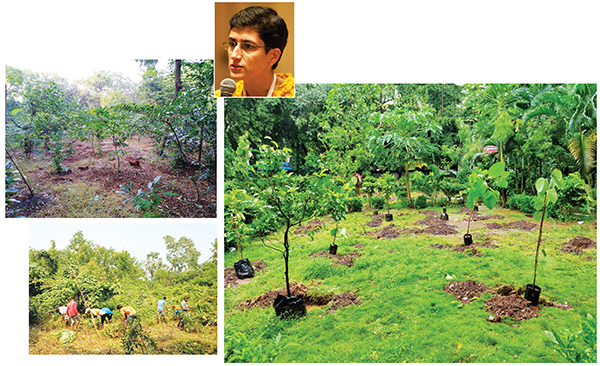
Clockwise from above: clearing the undergrowth; tending native trees;
Dr Rashneh Pardiwala; new plantations at Doongerwadi
Hoisting trees that were uprooted during the last monsoons
Drawing our attention to an untended gliricidia plant outpacing the growth of rows of other freshly laid saplings around it, Pardiwala said, "Look at this fellow.” Viewing trees as "living beings that require proactive maintenance,” she is concerned about the well-being of the 7,092 Indian native trees painstakingly planted under her supervision on around 15-20 acres of Doongerwadi and Ambawadi property since 2015. During plantation time that coincides with the monsoons she is on the site "five days a week,” alongside the laborers, to ensure that healthy saplings with rich nutrients are sown at the prescribed distance. At Doongerwadi that is situated atop a hill with a substratum of rocks and boulders, and little topsoil, it is always a challenge for the new plants to take root. Soil erosion is a certainty during torrential downpours. Compounding the problem is the unwanted vegetation that invariably impacts survival of young plants that need to compete with them for sunlight, water, space and nutrients, she explained.
During the last monsoons, Cyclone Nisarga and torrential rains led to the collapse of 80 tall trees at Doongerwadi and Ambawadi, many of them gliricidia that have a shallow root system and get easily uprooted. The native species of the uprooted trees that could be replanted were given priority before the roots dried up. Showing us uprooted jackfruit and peepul trees near the Sagdi that yet have "the potential to be replanted,” Pardiwala mentioned that hydraulic cranes will once again need to be hired to haul these giant trees off the ground and thereafter kept upright with tree anchors till the roots are firmly planted in the rocky terrain once again.
Making every effort to save native tree varieties where possible, Pardiwala is disturbed that "overenthusiastic community members choose to call the D Ward municipal office or the police station to lodge complaints” against activities they mistakenly perceive as a threat to the environment. Every tree that is to be cut or pruned requires permission from the Bombay Municipal Corporation (BMC) for which an application has to be made. Usually after two months or so they send an official to visit the site and sanction felling/pruning. But if a complaint is lodged, the BMC is sure to send an officer immediately.
Pardiwala related the disturbing incident when on one such complaint by a self proclaimed community do-gooder, the Doongerwadi manager and the contractor were detained at the Malabar Hill police station for several hours until Pardiwala could arrange for their release. She too has been threatened with legal cases but the ecologist is persevering, knowing she is "providing service to the community and city.”
Valuing the environmental work she is undertaking at Doongerwadi and Ambawadi, "thankfully all the BPP trustees are supporting me,” mentions Pardiwala. She had earlier been approached by the BPP when the then divided board needed an independent opinion on the extent of termite infestation at Doongerwadi. When she initially offered to cover Doongerwadi under CERE’s Urban Afforestation Project (UAP), the BPP trustees showed no interest and expressed their inability to make any financial contribution. Nevertheless, Pardiwala convinced them to let her restore a five-acre plot at Ambawadi with CERE bearing the cost. To clear the thick undergrowth which was an arduous task, she specially brought down Warli tribals from Dahanu. Seeing her success at Ambawadi, the trustees permitted her to work at Doongerwadi too.
In the last five years, over 50 varieties of flowering and fruiting forest species have been planted under the auspices of CERE at Doongerwadi and Ambawadi. These include jarul, bahava, sawar, saptparni, jamun, sandalwood, ber, bael, phanas, beheda, bibba, palas, raktchandan, chandan, saag, shisam. Three to four-year-old healthy saplings with lateral branching were selected for plantation at Doongerwadi to ensure a survival rate of 98.2 %.
Just as she is given credit for the new plantations, to CERE too goes the credit for laying new pipelines and putting in place a technically designed drip irrigation system at the site.
Around the Banaji dakhma, the insides of which have been visible to the Grand Paradi apartments in the vicinity, she arranged for the plantation of two rows of giant bamboo trees that have already grown to a height of around 15 feet. To address complaints of an offensive stench from residents of Spenta building on Ridge Road (connecting Hanging Gardens to Ardeshir Godrej Chowk), alongside the Anjuman dakhma, she has created a bamboo trellis supporting 200 fragrant shrubs like raat ni rani, jasmine…
The BPP and the CERE conjointly use their resources — time, money and labor — to tend the newly planted trees. They are constantly struggling against the adverse conditions created by rapidly growing gliricidia that tend to block sunlight from reaching the under-storey of the plantation. The resulting dark and damp environment contributed to decay and fungal growth, pest attacks and severe termite infestation that had spread to surrounding structures and even homes in Godrej Baug. (Last year, 43 hectares of hill slopes in Poona were cleared of this "blooming headache” by the forest department, according to a report in Hindustan Times.)
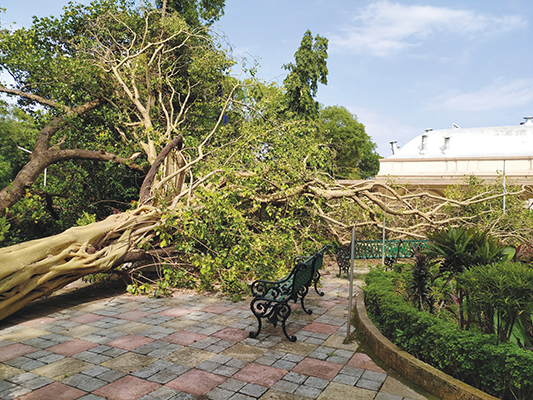
Uprooted trees near the Sagdi awaiting replantation
The afforestation effort at Doongerwadi is expected to reap many benefits according to the "Doongerwadi and Ambawadi Plantation Report — 2020” prepared by CERE: The plantation of 7,092 native trees has the potential for long-term removal of 1,567 metric tons of carbon dioxide from the atmosphere over 15 years. The green cover absorbs pollution, thereby improving air quality. Besides serving as a living herbarium for endemic tree species, the flora at Doongerwadi will promote biodiversity by drawing a wider variety of fauna like birds, snakes, mongooses, butterflies. The flight of a white bird in close proximity made Pardiwala pause mid-sentence to register the presence of the new avian. It was the first time she had spotted an egret at Doongerwadi.
Appreciating the financial support from donors — Bai Maneckbai Jeejeebhoy Trust Fund, IndusInd Bank,Vispy Dalal, Firdosh Anklesaria, Dr Feroza Panday — that have sustained her initial efforts at Doongerwadi, Pardiwala believes the community needs to invest Rs 20 lakhs to 25 lakhs per annum on a long-term environmental management plan at Doongerwadi. A young, qualified forestry expert would be ideally suited to take on this task. "While currently there is a shroud of secrecy around Doongerwadi,” if its ecological significance is publicized, Pardiwala is sanguine "others will fight on our behalf to save it, the whole city will support us for this is a natural heritage to be invested in.”
Rashneh, not Rachna
A total of 1,46,663 trees, comprising 130+ native species, have been planted to date by CERE at 89 different urban and peri-urban locations across India, as reported by Pardiwala. CERE has worked in partnership with numerous landowners such as the Mahrashtra Forest Department, the Indian Navy and Army, the Maharashtra and Uttar Pradesh Police Departments, Municipal Corporations of Gurgaon, Bangalore and Madras, and has been appointed on the Biodiversity Management Committee for the Municipal Corporation of Greater Mumbai. In conjunction with the Raigad Zilla Parishad, CERE has created the first-of-its-kind Native Biodiversity Garden near Teenvira Dam in Alibaug (see "Ecological Eden,” Parsiana, October 21, 2016).
Since its inception in 2002, CERE has been promoting environmental sustainability through research and innovation, formal education, government and corporate partnerships and publications. They also undertake solar energy and rainwater harvesting projects. Twenty-seven titles published by CERE have been used as prescribed curriculum books by schools across India. The educational component of CERE is looked after by co-trustee Kitayun Rustom who convinced Pardiwala to return to India after she earned her doctorate in climate change from the University of Edinburgh.
A mix-up of identities that led to their first hurried meeting at Ness Baug and a post haste decision by Pardiwala to accompany Rustom to Dahanu was vividly recounted: Assuming she was Rachna from the Tata Institute of Social Sciences who was to assist the Dahanu Taluka Environment Welfare Association with its crusade against the coal based power plant, Rustom prevailed on Rashneh to go with her to Dahanu. By the time the folly was realized on the train journey, the only option left for Rustom was to take Rashneh to her home in Dahanu. Aimlessly leafing through the environment reports lying at Rustom’s house, Rashneh who had done her masters in environmental management noticed the discrepancies in the findings and pointed them out to Rustom. "This was just a week before I was to return to Edinburgh for my PhD,” recalls Rashneh who deferred her PhD studies by a year and assisted them in Dahanu. Subsequently her Marine Coastal Biodiversity Report helped them win a case against the proposed Vadhavan Port which was deemed unfit in an ecofragile area.
On completing her PhD dissertation Rashneh returned to India with a dream to improve India’s environmental issues. The realities of setting up a not-for-profit trust with a meager corpus of Rs 1,000 and finding trustees made her first turn to her family who has been her "greatest support.” Family includes mother Dr Roda, a gynecologist, father Noshir, a chartered accountant who retired from Great Eastern Shipping Company, and elder brothers Cyrus, a senior global partner with PricewaterhouseCoopers in New York and Dr Dinshaw, orthopedic surgeon who heads the Centre for Sports Medicine and is director of Arthroscopy Service at Kokilaben Dhirubhai Ambani Hospital.
Besides Rustom, the others functioning as CERE trustees are Noshir Pardiwala, Elizabeth Virkar, Panday and Sheba Thomas. The first project undertaken by CERE in India was Documenting Successful Models of Environmental Education with the support of Sir Ratan Tata Trust and Tata Motors that donated a secondhand Tata Safari in which she and Rustom could undertake the journey. Passionate about driving although she would like to minimize her carbon imprints, she enjoyed this assignment and others that have taken her across 22 states of India. In her younger days she had represented Cathedral and John Connon School, and St Xavier’s College from where she graduated, in sports like swimming and badminton. The former state level badminton player and member of the national water polo team now only finds time for driving and trekking.
In the last decade Rashneh was awarded the Ford Fellowship to study at Columbia University in New York and was selected by the Svenska Institute in Stockholm for a Fellowship program on Corporate Responsibility and Sustainability. At the start of 2021, the Swedish consul general along with the Swedish Chamber of Commerce, India requested Rashneh to collaborate with them for optimization of environmental sustainability of Swedish companies in India. The United States Indo-Pacific Command, a unified combatant command of the US Armed Forces, has invited Rashneh to address the Pacific Environmental Security Forum this month. These updates were shared by Rustom "so that the community can learn that one can straddle one’s professional life yet continue to work for the community’s betterment.”