Running an average of one race a week across the world earned
the enthusiast mention in the Limca Book of Records
Adil Nargolwalla
My addiction to long distance running is something that has been with me for some years now… I finished the year 2016 with participation in 53 different races. I had applied to the Limca Book of Records in July for a racing frequency related record. Come Christmas, Santa dropped it in my stocking...
Although I managed five podium finishes, I’m not a speed-chaser, preferring to run purely for the happiness... and the sheer clarity of thought that a long run produces. I like to use that clarity to figure out life and work concerns. I love combining the joy of running with the passion for travel... most of my races are "run-cations” rather than vacations. The sights, sounds and smells of a new place always add a special charm to a run. As such, I don’t train as per a program with an eye on finish times... instead, I just land up at starting lines as often as I can manage, with some cycling with my friends Pooja and Ajay Bakaya and a moderate amount of strength work in the gym to back me up.
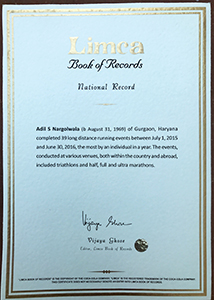
When 2016 began I was well into the momentum of attending races with substantial regularity and by March I consciously started thinking that I should give a shot to averaging one race a week for the year. I’m thrilled to say that I have succeeded in this endeavor with the year’s total including 13 marathons (including four Abbot World Majors — London, Berlin, Chicago and Tokyo) and 16 half-marathons. I raced a total of 1,274.54 km, 1,180.9 of them running, 66 while cycling, and 1.55 while swimming, not to mention the 26 km hurtling down a river in a funny-looking boat, an inflatable kayak. My races were on different types of terrain, ranging from sea level to 14,000 feet above it. Forty-three of the races were in India (in 12 different states), three in England, two in Germany and five in the United States.
My three personal bests were a timing of 4.31 hours in the marathon, 1:55 hours in the half marathon, and 48 minutes in the 10 km. Of course, statistics can never tell the whole story. Under the cold precision of numbers is a whole substructure of intangibles — sacrifices in terms of unconsumed desserts and unattended parties, early nights and earlier mornings.
There is an inexplicable reward of racing in all conditions that the sport can possibly offer — stadium track to road and trail, big cities to tiny villages and virgin countryside, river beds and ocean beaches to mountain ridges — with locations ranging from right outside my house to halfway around the world. The biting cold and wind-chill at the Keswick Half and the draining heat, humidity and traffic chaos at Madras despite a 4 a.m. start. Rain... the expected, persistent showers at Cherrapunji, at one time the wettest place on earth, the surprise mid-race rain at the DRG Puma Half in Delhi. Yet more rain, washing the cobbled streets of Nuremburg as I raced my fastest 10 km there, probably because, for the better part of the first kilometer, I erroneously latched on to the 30-minute pacer!
And after the race, the most precious of all intangibles that stay with one for the rest of one’s life — the memories: the traditional post-race festivities at Café Leopold after the Mumbai Marathon; the beautiful rural trails of Auroville; the hard-packed sand of the idyllic beach at Kihim in the morning with a view of the Arabian Sea as the rays of the rising sun sparkled on the waves. In an out-of-this-world Himalayan experience, I crossed the Rohtang La so that I could race at the spectacular crescent-shaped, meadow-surrounded, freshwater Chandrataal lake in the lap of the mighty Kunzum La in Lahaul-Spiti, on the toughest mountain trails amid some of the most spectacular views in the country. Running for and with specially-abled kids in the Muskaan Run was an unbeatable feeling.
The long drives across North America, so that I could race on both coasts; and the overnight dash from Bangalore to reach the start of the Kaveri Trail Marathon taught me that often the actual running of a race may be the easy part, as compared to the logistics of reaching it! Obstacle races I found particularly exhausting especially since both the ones I attempted were scheduled after other races earlier in the day. Even five kilometers can be intimidating for an ultra-marathoner when they are peppered with barriers that only a person with military-level training and fitness can overcome with any amount of speed. For mere mortals like me, an hour or so is what it took each time.
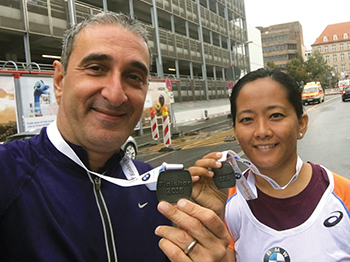
Running enthusiast Adil Nargolwalla and with wife Rinchen after the Nuremberg 10 km run
My running year was a team effort. Without the assistance and encouragement of a long list of people, this kind of endeavor is unthinkable. At the top of that list is undeniably my wife, Rinchen who I lovingly call Inchee. She planned the itineraries, booked the tickets and hotels, filled entry forms and paid registration amounts, even collected bibs and pinned them to my vest, all the while stoically tolerating the demise of our social calendar.
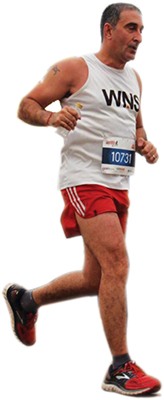
The WNS Cares Foundation logo that I sported through the world and will continue to do so wherever I run. My running group, the Ultrons, consists of some very high performance amateur athletes who are iron men, ultra marathoners and worthy champions in their own right. They always made me feel special at every finish by cheering me on to the next one. A special mention for the doctor in our group — Meenakshi Sharma — with whose help my plantar fasciitis (common cause for heel pain) was kept in control when it tried to talk me out of every race... and mentally I just shut it up.
I could write a book, and still not find enough space to enumerate all my experiences. Having run most of the World Marathon Majors, my next goal is to run the remaining one, Boston, to get the Abbot Majors title which less than a thousand runners in the world (and only a handful of Indians) hold.