A well frequented, 143-year-old library in Poona strives to remain relevant
A studied silence pervades the main reading room of the Albert Edward Institute and the Cowasjee Dinshaw Hall and Library on a Sunday afternoon. Students sit with their heads bowed over their books. On the verandah and front porch, young women pore over their notes or a mobile. An elderly gentleman sits besides an arch on the side passage reading the day’s newspapers. The 143-year-old structure located in the heart of Poona’s Cantonment area on East Street is strategically situated, adjacent to the Victory Theatre and opposite the Kyani Bakery and Badshah Restaurant, all well-known Poona Parsi establishments.
The Institute was established in 1875 to commemorate the visit of The Prince of Wales Albert Edward, subsequently King Edward VII. Cowasjee Dinshaw’s name was added 26 years later as Rs 15,000 from his estate and "all the books and library furniture belonging to (him) were donated to the Institute,” notes the introduction to the Institute’s rules, regulations and bylaws. Dinshaw was a businessman from India who made his fortune in Aden.
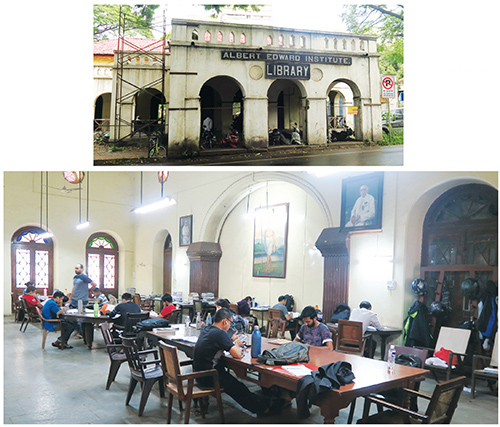
Facade of Institute and Reading Hall
The Library whose aim is "the diffusion of knowledge and provision of literary and cultural needs of its members” is open 365 days of the year with the Reading Hall open from 8 a.m. to 8 p.m. and the Library from 9.30 a.m. to 1 p.m. and from 4 p.m. to 7 p.m. The establishment has around 450 members including a handful of life members. Students frequent the Hall more in the mornings while seniors drop in during the evenings, the Library assistant Sandeep Adsule informed us.
Twenty-nine newspapers in a variety of languages are subscribed to by the Institute, stated Adsule. Incidentally, Rule 20 of the Libarary specifies "no individual member may read a newspaper or periodical longer than 15 minutes if it is demanded by another member.” New members are charged Rs 3,600 on joining, plus Rs 1,200 deposit and monthly fees of Rs 200. Students are from all over India and many prefer studying in the Hall rather than at their hostels, observed Adsule.
The managing trustee Saroosh Dinshaw, great-great-grandson of Cowasjee is happy the Institute is utilized though he notes the Library is less frequented. The other trustees are Poona residents, Sir Cowasjee Jehangir and Statira Wadia. "All the older Poonaites know about the Institute,” notes Jehangir. The Reading Hall is well frequented and serves a purpose. "It’s a haven” in a bustling city.
There is not much interest in the old books, Saroosh stated and certain material needs to be weeded out so there is space for new books. He wants to "modernize” the Library but notes that when wifi services were offered, some members used the facility to watch movies on their phones or pads/laptops. He is trying to spruce up the place and reclaim some of the premises rented out to tenants or encroached upon long time ago, an expensive proposition.
Two cars of an occupant are parked in the front compound. As honorary secretary Sorab Daruwala, who voluntarily assists at the Library was showing us around the rear of the premises, a lady occupant in the corner of the garden watched our movements with a guarded eye before retreating to her quarters to inform the others. But no commotion occurred. Daruwala, an engineer by profession and a former manager with Philips India and India Forge, is unafraid. When an auto rickshaw driver refused to take the Parsiana representatives back to their residence, Daruwala stood in front of the auto, whipped out his phone and was about to call the police, when the driver relented.
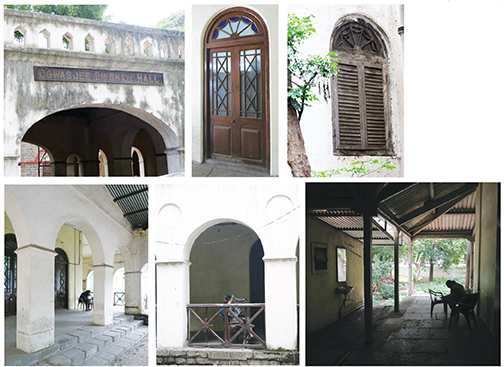
Saroosh sent out an appeal this July end for donations. The letter noted, "The Library consists of two stone structures which are inter-connected. One is used as a reading room (it can seat up to 100+ members) and the other is where books are issued and maintained. There are three additional reading rooms in the premises with benches in the back side.
"The Library has served Poona city well over many years, is well patronized by members of all communities and we charge a very nominal user’s fee.
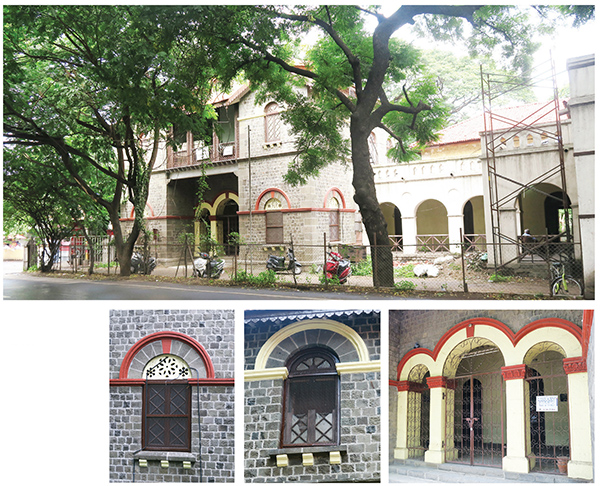
Second structure built in 1881 houses the Library
"Since the corpus of the Library is quite limited, the interest generated on funds is barely sufficient to meet the running expenses (which includes salaries, taxes, purchase of books and general repairs and maintenance).
"The trust has spent over the last two years an amount of Rs 25,00,000 (USD 35,327) approximately for repairing the entire roof, compound wall and external façade of the buildings. We still need to spend about seven to nine lakhs, (USD 9,891 to USD 12,717) to finish ongoing work.”
An earlier appeal in August 2011, listing the extensive repairs required, resulted in a donation only from philanthropist Darius Forbes of Forbes Marshall. But more was needed.
As The Indian Express of March 2, 2009 noted, the establishment "is clearly past its glory days. Its once magnificent arches need a fresh coat of paint. The old furniture requires much sprucing up. The welcome, musty smell of thousands of books gets a tad too overpowering… ‘In 1872, Prince Albert Edward came to India and paid a visit to Poona. This was the first such occasion since the British conquest of India and it was decided to suitably commemorate it,’ relates a historical account of the Library, written in 1952 by M. C. Medora and Dr A. Dias.
"‘The Library was first opened on a small scale in 1875. In 1878, the present site, formerly the Cantonment Jail, was granted and the new building was inaugurated in 1881 by Sir James Fergusson, the then governor of Bombay,’ added the account.”
An article in the Pune Times of June 27, 2007 describes the scene in the Institute:
"The shine is gone but the grandeur is evident everywhere, from the books in the cupboards to the glass panelled doors… A large round table at the center of the Hall, in contrast to the rectangular ones covered with (a laminated board), stands like an old guard. Old wooden chairs stand in harmony with the recent molded ones. Portraits of gentlemen from ages gone by stare at the readers… On the backside of the Hall another cosy verandah looks on to a small garden with trees and few flowers. Sitting on an armchair, a gentleman scoops in the newspaper amidst the lush green ambience. He is removed from the activities on East Street. The multistoried (building) beyond the boundary wall has not blocked the little sunlight that Pune’s clouds allow. The chirping of the birds is no distraction for him… A young member leisurely goes through the pages of Palmerston by Philip Guedalla. His neighbor delves in The Last Colonel of the Irish Brigade by M. J. O’Connell…
"In another hall are books in English, Marathi, Gujarati and Hindi. Between these two halls is a spacious room where a young man sits alone, staring at the world outside. Perhaps, he is wondering which way to go. Maybe it is a choice between a recent magazine or a book from the 19th century.”
If the Institute is to survive in the 21st century, more funds will be required. Donations to the Institute are to be made in favor of "The Albert Edward Institute and Cowasjee Dinshaw Hall and Library” and sent to 2430, General Thimayya Road, Poona 411001. Persons to contact are Daruwala (mobile: 9881326638, 9545451004) and Adsule (mobile: 9921585771). The trust is in the process of obtaining an 80G certification.