If you are fed up with bitterness
in the BPP, savor Parsi sweetmeats
Berjis Desai
Like American writer Mark Twain, the owners of the Parsi Dairy Farm (PDF) recently asserted that reports about their imminent demise were exaggerated. At its peak, PDF was the community’s favorite institution. On account of its obvious association with happy and auspicious occasions, it was a vendor of joy. Years ago the octogenarian solicitor Burjor Antia, representing PDF in a family dispute, chastised us for accepting a family disputant’s brief, expressing dismay as to how our client could sue an institution feeding mithai and malai (sweetmeats and fresh cream) to the community.
At dawn, the ubiquitous PDF bhaiyyas (delivery men), clad in blue shirts, balancing aluminum milk containers on their head with ballerina-like skill, would fan out all over the city (for Parsis, the city ends at Dadar Parsi Colony). Frothy full fat milk gushing out of the container tap into the customer’s stainless steel utensil was received in exchange for a prepaid coupon. Costlier, but more wholesome and purer than other competing milk. Believe it or not, being a PDF customer was at one time a status symbol and there was a long waiting list. Next morning, the refrigerated milk would be covered by an inch thick layer of cream to be eaten with fresh white bread (not whole wheat or toast) after sprinkling it liberally with sugar. The cream would unclog one’s arteries, the sugar excite the pancreas and the white bread would make one slim. The cream was literally to die for. The remaining cream was then boiled down to produce ghee, which one could also buy readymade in tins from PDF. It was distinctly different in taste than the famous Porbandari gai nu ghee (cow’s milk ghee).
In the winter months the bhaiyyas delivered doodh na puff (sweetened creamy milk froth cooled by the dew in the open). In those days to call their dahi, yogurt would have been sacrilege. Set in earthen pots, the mildly sweetened dahi (not the oversweet mishti doi), sprinkled with good quality pistachio and thinly sliced almonds, was so thick one could cut it with a knife. The tongue would be instantly orgasmic.
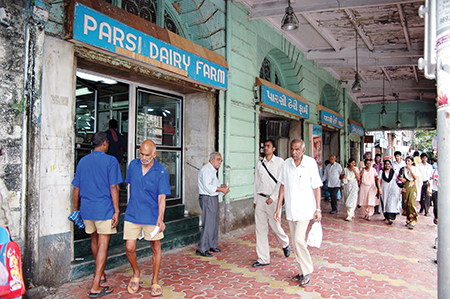
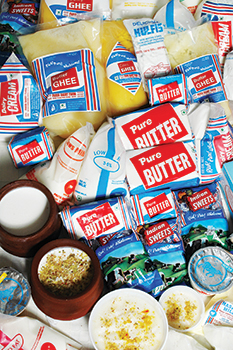
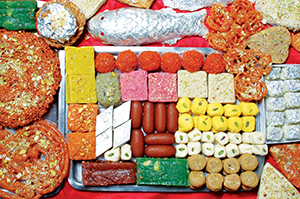
Parsi Dairy Farm shop at Princess Street and some of their products
From their buffalo farms onwards, the vertically integrated dairy farm processed the milk products to produce mava molded into the traditional sweetmeats like pendas (yes, not pedas) and barfi, which was shaped sometimes into a unique fish form called mava ni machhi, with its red candied eye and cutely shaped tail. The fish looked so real that our then neighbor, an old Jain lady, immediately wanted it off her table. Their signature sweetmeat, however, was sutarfari [in shuddh (pure) Gujarati called sutarpheni], white candy floss circularly threaded, best enjoyed with a large slurping spoon after dunking it into cold milk. The mawa ni machhi dunked in frozen milk was reborn as PDF kulfi, circular and wrapped in butterpaper, the palate cleanser of sorts, after Godiwala’s lagan nu bhonu, at weddings.
However, when it came to malai na khaja (flaky pastry filled with fresh cream), Parsis preferred a Bohri sweetmeat vendor called Lookmanji. The malai khajas carried a label reminding one that they had to be eaten fresh lest the cream turn sour, unlike the more durable mava na khaja. These delicious cholesterol cakes were to be eaten along with lightly brewed tea laced with fresh mint leaves and lemon grass. Like the khajas, Lookmanji was and remains a favorite with the community for that quintessential Parsi sweet, agharni no laarvo, dubbed by Adi Marzban as "pregnancy balls.” Distributed on the occasion of baby showers, these are nothing but conically shaped laddoos, meltingly soft when fresh. The tip is reserved for wannabe mothers, guaranteed to deliver better results than any IVF (in vitro fertilization), it is said.
PDF’s range of offerings included halwas — the rubbery ones, loaded with gelatine, and the so-called "ice-cream” variety. No amount of lethal washing powder could possibly remove the grease formed on the mithai trays.
Traditional Parsi sweetmeats, not available commercially, included sadhana (slightly sourish crepe made of toddy marinated dough); popatji, the butt of many double entendre jokes in Parsi comedies, a deep fried pastry with a small protruding beak (and its crispier cousin, the karkaryu); varadhvaroo, a hard crusted cake with a softish interior; the agiary triplets of malido, mehsoor and koprapaak, the latter two Parsi-style; and kumas, a kind of honey flavored soft cake. In the towns of Gujarat, Parsi ladies earned their livelihood by making these sweets on festive days as well as weddings. RTI (Sir Ratan Tata Institute — nothing to do with the Right To Information) outlets do sell some of these sweetmeats. Dar-ni-pori (we won’t translate) and minced sweetened coconut dumplings called khaman na laaroo, also qualify as Parsi sweetmeats (the latter made on the day a toddler takes his/her first steps or a child is given the first bath after recovering from a bout of chicken pox).
Today, the PDF brand is shared. As a part of a family settlement, one branch operates independently under the same brand. The bhaiyyas distribute the milk in pouches. The dahi comes in soft and slippery plastic containers and can now safely be called yogurt. Doodh na puff is a distant memory and varadhvaroo is extinct. Sadhana is confused with a Bollywood heroine of yesteryears. Nothing can now be gorged without guilt. Except, of course, nostalgia, the staple diet of a dying community.
Berjis M. Desai, managing partner of J. Sagar Associates, advocates and solicitors, is a writer and community activist.