Nature’s fury and man’s greed have adversely
impacted Udvada’s heritage character
Jamshid Bhiwandiwalla
This abridged and edited article has been reprinted, with permission, from the brochure for the Iranshah Udvada Utsav, December 2024.
The first of the challenges faced by Udvada has been the loss of heritage wrought by the demolition of numerous old buildings over the years. Today we enjoy being in Udvada and experience the townscape through its lofty old buildings located in the narrow, winding streets which our forefathers had designed and built keeping in mind local craftsmanship and the influence of the weather. Most of Udvada’s houses are over 100 years old, planned one next to the other with shared walls, along the typology of the well-known Ahmedabad pol houses (traditonal residential clusters reflecting the city’s history, culture and communal living). The rooms were planned as per the status of the family and to respect the privacy of the owners. These houses have various characteristics ranging from the Persian to the Portuguese to the local vernacular Gujarati style.
Until the 1960s Udvada had a sizable Parsi population, both athornan and behdin. This is why the town has amenities such as a school, the Damanwala Dispensary, the Unwala library, the Sodawaterwala and J. J. dharamshalas, the Mirza public hall, Dastur Baug, etc. With most people moving away to seek better prospects, only the old and those who tend to the Iranshah Atash Behram have been left behind. As a result many houses have been badly damaged due to neglect. Most families don’t come for years together to look at their properties; others are involved in disputes as families have grown and there are many owners of the ancestral property, none of whom want to maintain it. They seek to solve the problem by putting up the house for sale and often fall prey to land developers and brokers who further wrongly advise them to sell the land after demolishing the structure and retrieving the aged wood their ancestors had used. As a result several perfectly good houses have been demolished. These could have easily been repaired and would have lasted for another century. The resources invested by our forefathers form an integral part of the town and our heritage, and the houses could have been sold intact even if for a minimal sum.
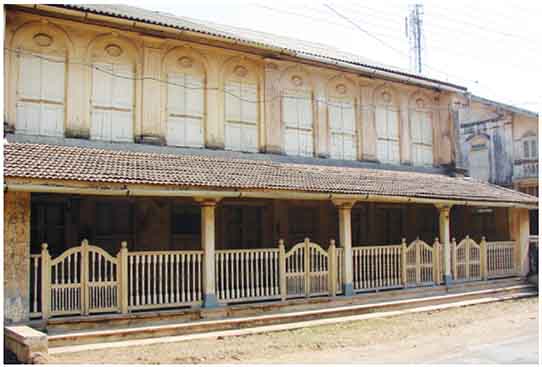
Quaint architecture in Udvada has earned it heritage status
Along with such loss comes the loss of traces of culture because each demolition entails the loss of belongings, memories, furniture, lifestyle. This, in technical terms, is called loss of tangible and intangible heritage. And who is to blame but our own community members, some of whom have been misguided while others are motivated by greed? Today the Udvada experience is special because of the distinct townscape and building fabric; once this is lost to new construction, Udvada will be like any other town with reinforced cement concrete (RCC) buildings and no identity to call its own. Those opposing the value of heritage and propagating modernization need to understand that not everything new is good and that what is old is truly gold.
From 1998 I have been observing that approximately eight to 10 perfectly good homes in Udvada were being pulled down annually until a few years back when the then chief minister of Gujarat Narendra Modi placed Udvada under the Udvada Area Development Authority (UADA) and listed the core of the town as a heritage precinct, thereby getting all the houses notified. Today, demolition of any house without permission is an offence. Also, when a house is pulled down, it weakens the perfectly good house adjacent to it, enabling the land developer to persuade the neighbor also to sell and pull down the affected house, creating a vicious cycle. The land developer justifies this by saying the new apartment project would offer more houses for devotees to own and would draw them to visit Udvada frequently. Sadly, these badly made RCC residential blocks look new only for a couple of years but then begin to deteriorate due to the harsh salty weather, entailing enormous maintenance costs for the owners. Udvada has lost at least 150 perfectly good houses and, in the struggle to obtain the Heritage Notification, it is ironical that we had to take the help of the state administration to protect our heritage from the greed of our own community members!
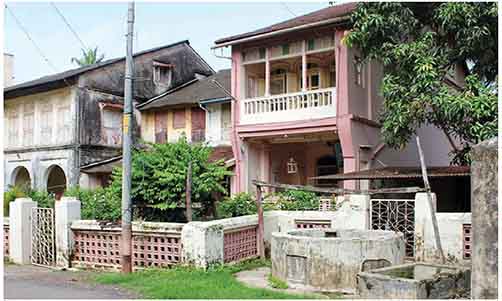
Wells are a recurring feature at residences in Udvada
Udvada is also under attack from nature with the rapid ingress of the sea due to coastal erosion causing damage to properties located along the shore. Since 1980 the eroding coastline has been a cause for concern. Due to global warming the sea level has risen and a number of properties have succumbed to its fury. The community initiative through the Save Udvada Project along with the state administration building embankments was a good start but yielded minimum results though the state government has continued to work on the embankments over the years with varied solutions through the Daman Ganga Department. Even today a proposal to the State Tourism Department to create a deep plantation belt as in the Dahanu-Nargol-Daman belt to minimize erosion, along with an embankment that could also serve as a promenade, awaits execution.
The ingress of the sea has also to a certain extent destroyed the sweet water wells of the town. Our forefathers were able to identify land close to the sea which had sweet water for their consumption. The town has 300 odd wells; for priestly families it is essential to have well water for conducting various rituals. Hence we see a well in every house or sometimes a well shared by two houses either in the front or back yard. This makes the character of the town more unique and noteworthy. The houses were perfectly planned with rear service streets for night soil to be picked up (an age old system of disposing human excreta either through pigs or being removed by the lower class). Today houses have septic tanks which have deteriorated over the years, causing the effluents to pass through the cracks and enter the sweet water table, thereby polluting the wells. There is an urgent need to install a drainage system to remove the effluents from septic tanks to soak pits far away, to protect the very essence of the priests’ homes. There is a need for better water harvesting systems. Large tracts of agricultural as well as horticultural lands are being converted to non-agricultural plots with extensive paving. Housing colonies are pulling large amounts of water using high powered pumps. This is allowing the saline sea water to creep in further, which will result in the destruction of most wells sooner or later.
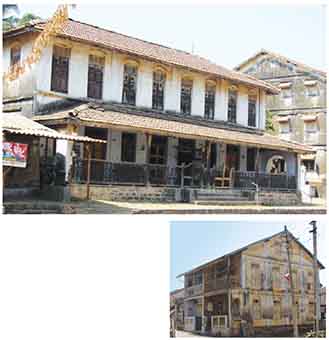
Top and above: typical old structures in Udvada
Recently large tracts of land, double the size of Udvada gaam (village), were acquired by developers for industrial use. This would have been disastrous for the fragile environment of the town had it not been contested in the court of law, by likeminded people who stood by Dastur Khurshed Dastoor of Udvada. He had opposed these developments thereby preventing further land and water pollution. Lastly, with the decline of entrepreneurship within the community to a handful of hotel owners, along with the dwindling resident Parsi population within the town numbering about 70 persons, most of them senior citizens, it is with great difficulty that it can be claimed that Udvada belongs to the Parsi community and that their say and opinion actually matters when the town is highly populated by other resident communities. As a result, Parsi houses are being broken into frequently and there is an ever growing sense of insecurity among our senior citizens.
The state government has always shown willingness to help address our concerns, giving Udvada the special status of Pavitra Yatradham and starting Destination Development Projects which have resulted in Udvada being allocated considerable funds for the upkeep of the town as per the vision of Prime Minister Modi who has always promoted it, referring to Udvada as a center for peace and integrity.
Detail of wrought iron balcony
Dastoor’s efforts to organize the Iranshah Udvada Utsav need to be applauded as these events keep Udvada in the limelight, attract government attention and investment in infrastructure which many little towns are not so fortunate to receive. As for our community, the Utsav is held to celebrate the idea that we have contributed to the building of this country with our culture, distinct identity and integrity which we preserve and are so very proud of! The next time you zoom into Udvada to pay your respects at the holy Iranshah do pause and remember that there is a lot you can do now that you are more aware of the challenges faced by this fragile town battered both by nature as well as manmade activities fuelled by greed. You can support and protect the highest altar of our religion and our existence!

Architect Jamshid Bhiwandiwalla is principal of Aditya College of Architecture, Bombay. He was on the heritage panel of UADA and has been working on the town since 2000. His Master’s project was on the conservation and management plan for Udvada. He has been officially appointed architect by the state government for the Destination Development Project for Udvada.