To facilitate welfare activities in India, members of the Global Working Group approve the formation of the Global Council of Zoroastrians Trust
Text: Parinaz M. Gandhi Photos: Jasmine D. Driver
The creation of a Global Council of Zoroastrians Trust (GCZT) that is meant to facilitate funding and welfare activities in India readily won acceptance from the representatives from USA, UK, Iran, Pakistan, Australia, Dubai and Hong Kong present at the Global Working Group (GWG) meeting at Bombay’s Banaji Atash Behram Annexe Hall on January 7, 2020. However, five of the six Bombay Parsi Punchayet (BPP) trustees present at the meet stated they had not had a chance to discuss the draft of the trust deed at their weekly meeting as they had received the document only five days earlier. But after expressing their misgivings for over an hour, in the interests of "moving forward” they eventually agreed to the formation of the new body on being reassured that changes could still be incorporated in the 21st draft. They were repeatedly reminded that GCZT would be formed, with or without their approval.
Thus GCZT that will be registered in Bombay will function with two arms: the funding arm consisting of settlors for life and trustees who will have a four-year term; and the operational arm comprising the informal GWG that will continue to function in its present form but within the framework of GCZT. There were many exchanges during the meeting on the GWG being subsumed within the GCZT and the settlors enjoying veto powers but in a subsequent clarification, GWG non executive chair Neville Shroff, president of the Zoroastrian Charity Funds of Hongkong, Canton and Macao maintained, "No individual or organization will have dominance or veto power over others, and that includes GCZT over GWG.” Dinshaw Tamboly, chairman of The WZO (World Zoroastrian Organisation) Trust Funds reiterated the same sentiments: "In the draft of the GCZT that I have perused, there is no veto with any individual or region. Everything is to be done through discussions and consensus.”
While the objective of the Trust is to ameliorate the conditions of deserving Zoroastrians in India by way of relief of poverty or medical aid, the expertise and support of the global community will be harnessed, explained former BPP trustee and solicitor Burjor Antia who was credited as being the architect of this Trust. "We are at a delicate juncture… Let us be positive and not negative. Some throw stones, instead we should build a house with bricks,” recommended Antia who categorically announced that it would be good if "you join us; if not, bye-bye.” He repeated the popular catch phrase of Prime Minister Narendra Modi, "sab ka saath, sab ka vikaas (through unity pave the path for progress).” He hoped the start of the year would see the community "saaathé malé ané saathé bhalai na kaam karé (come together and work together for the common good).”
"To make the GWG effective we need a trust…a bank account… The trust deed will be decided by people who can work in harmony and achieve maximum results,” declared Shroff. "We are here to support each other… not undermine the good work many of us are trying to do…Put aside personal differences for the well-being of the community, refrain from derogatory comments,” he reiterated in his introductory remarks.
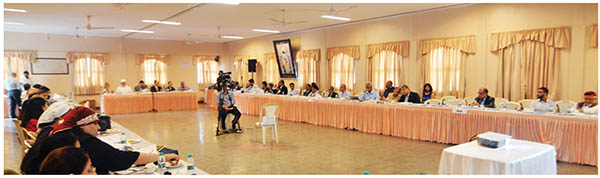
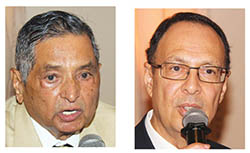
Top: Burjor Antia (l) and Neville Shroff; above: GWG meeting in progress
"This Group is determined” to go ahead with the formation of the GCZT. "I would request each one of you to look at it in a broader perspective,” Yazdi Desai, chairman of the BPP and president of the Federation of the Parsi Zoroastrian Anjumans of India (FPZAI) appealed to his co-trustees who repeatedly stated that they had not had a chance to review the document that reached them just five days earlier. Shroff though maintained that all GWG members were sent the 21st draft at the same time and except for the India representatives all had "accepted” the document. "There is a tremendous amount of work that has gone into it. We have tried our best...We want to be inclusive.” Considering that the GCZT, to be registered under the Bombay Public Trusts Act and the Income-tax Act, wants to help Zoroastrians in India, he failed to understand why the BPP trustees were allegedly procrastinating.
When Desai remarked that "a Parsi Irani Zoroastrian is not defined in the trust deed,” Antia promptly responded, "Give a definition. We’ll adopt it now and move forward.” BPP trustee Noshir Dadrawala stated that the Trust covers "Parsi/Zoroastrian. Should there be a slash (between the two words)?” Antia felt this "minor” issue could be rectified. The FPZAI also has "an ambiguous definition of Zoroastrian,” pointed out BPP trustee Kersi Randeria who felt that since the BPP has been in the forefront of this Group for a long time "to say ‘Come with us or we will go ahead without you’ is not the way forward.”
Dadrawala opined that a trust established for the benefit of a particular religious community would not be eligible for tax exemption. He subsequently observed that since the objective of the Trust is charity and it will not be dealing with religion, even if a percentage of the help is extended to non-Parsis it should not matter for it would assist the Trust to get necessary exemptions under the Income Tax Act. On the basis of their recent experience, Desai and co-trustee Xerxes Dastur were sanguine that non-Parsis would not be required to be brought within the ambit of the trust deed to obtain the necessary section 80G and 12AA exemptions to benefit the donors and the Trust. Determined to progress, Antia asserted, "Anything you say we will adopt, but please move.”

From l: Yazdi Desai, Armaity Tirandaz, Noshir Dadrawala, Kersi Randeria, Viraf Mehta, Xerxes Dastur
BPP trustee Viraf Mehta wanted to know "Who are the settlors and trustees? Who has chosen them? I find the process of selection neither independent nor transparent.” Responded Shroff, "Fourteen founders of this team decided on certain reputable people a day or two ago... These are the people who have worked non-stop.” They have agreed on Antia, Tamboly and Kersy Bhesania of Dubai as settlors with Antia, Meher Bhesania of Dubai, Yazdi Tantra, vice president of the World Zarathushti Chamber of Commerce (WZCC) and Sam Balsara, chairman and managing director of Madison World as trustees. When Mehta enquired regarding their term, he was told that settlors are for life while trustees will enjoy a four-year term.
"Once the Trust is formed, more trustees from other regions (can also be brought in)… Please be happy the Trust is in India,” stated Meher, adding, "We fought with Rohinton Rivetna [founder president of the Federation of Zoroastrian Associations of North America (FEZANA) who promoted GWG] that the Trust has to be formed in India.” Dadrawala though wondered why India was chosen considering that besides the Foreign Contribution Regulation Act (FCRA) which is a bane, the country "is not known to have the most enabling laws.” To be eligible for registration under FCRA, the Trust needs to complete a minimum three years and spend at least one million rupees on its objectives, he added.
Mehta noted that no BPP trustees nor FPZAI representatives have been included. "In the next decade the power of the settlors will pass into the hands of trustees,” maintained Kersy Bhesania. "As soon as the charter is formed the next set of trustees from the BPP, FPZAI, FEZANA and ZTFE (Zoroastrian Trust Funds of Europe) will come in. This is where the legacy will continue…”
When changing trustees at the end of four years, elections and politics are bound to creep in, felt Byram Avari, president of the Karachi Parsi Anjuman Trust Fund (KPATF). He recommended that the number of founder trustees "be increased by one more person as the representative of the BPP and solve the problem.”
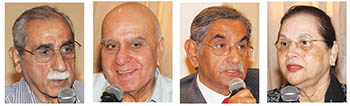
From l: Rohinton Rivetna, Dinshaw Tamboly, Kersy and Meher Bhesania
"There is a provision for 15 trustees… It is open for lots of others to become trustees. To jumpstart the organization we needed a certain number of people. That’s all there is,” explained Rivetna. Dastur though maintained that "founding trustees and trustees have different rights.” Dadrawala sought to convince him that the Trust is not going to serve as "the voice of the community but is being formed for good, charitable work, predominantly for the community.”
The role of settlors will be to assist in funding, and that of trustees, for operating, Astad Clubwala, president of the Zoroastrian Association of Greater New York (ZAGNY), differentiated the working of the two divisions. He considered it "commendable that the real intent has been philanthropic.” However since legitimate concerns are being voiced that those at the helm appear to be a "family connected group… we can allay their fears and move ahead for the good of the community” if reassured that their "role is to collect funding and to help India.”
It was Dorab Mistry, erstwhile president of the ZTFE, who managed to assuage the fears of the BPP trustees saying, "People on the ground who were very actively involved like Rohinton, Neville and I have pulled our names back because of Indian laws. (Under FCRA regulations, only if the trustees are Indian nationals does a trust qualify to receive funds from overseas, although Persons of Indian Origin and Overseas Citizens of India are permitted as trustees.) Yet our commitment to the project remains 100%. This is a tremendous example of voluntarily withdrawing to let the project move ahead…” Earlier Mistry had asserted, "The BPP and the ZTFE have been historical allies, both classified as traditional anjumans. We at ZTFE have gone through the trust deed with a fine comb and we are completely satisfied with its bona fide intentions for community service by western anjumans. The diaspora is well off. Poverty exists only in India. If you trust ZTFE, this is kosher, completely in order, something for which the time has come. Please go ahead.”
Finally with Mistry proposing and FEZANA president Homi Gandhi seconding, everyone present at the GWG agreed to go ahead with the GCZT making Rivetna comment, "Let it be recorded in the annals of our history that after what seems like an eon… our worldwide community without borders came together… to work for our mutual benefit and the prosperity of our worldwide community.”
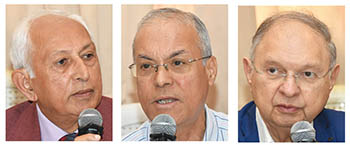
From l: Homi Gandhi, Dorab Mistry, Byram Avari
From l: Astad Clubwala, Edul Daver, Rustom Engineer, Arzan Wadia
Actively addressing
An outline of the proposed Global Zoroastrian Survey at a cost of USD 275,000 (Rs 1,94,64,775) was presented by Edul Daver, president of WZCC. Aspiring to gather demographic, behavioral and attitudinal data from every Zoroastrian in the world through an online survey (supplemented with manual entries where necessitated) that will be anonymous, the initiators of the project hope the results will mobilize Zoroastrian associations to launch initiatives that address the needs and aspirations of their constituents. The School of Oriental and African Studies, University of London will be responsible for data input, data analysis and compiling a report of the findings of the survey. Hoping to initiate the pilot study in the UK in May 2020, they plan to complete the survey and compile the report by December 2021.
KPATF has managed to assist 50 families comprising nearly 200 Zoroastrians to migrate to Toronto, Canada, reported president Byram Avari. Additionally, each migrant is given an allowance of $ 250 per month for two years to defray the costs of food and accommodation. "Most immigrants have settled down,” he mentioned. Formalities are under way for 25 more families. Believing that "we must utilize our funds,” he referred to the KPATF having introduced a scheme, four years ago, with the cooperation of local trusts to cover the medical costs (barring orthodontics for adults) incurred in Karachi by every Parsi Zoroastrian of Karachi and other parts of Pakistan.
The intervention of Dastur Khurshed Dastoor, the Zoroastrian representative on the National Commission for Minorities, helps the youth from Pakistan to obtain Indian visas to attend the Return to Roots (RTR) program, acknowledged RTR coordinator Arzan Wadia who is also the vice president of FEZANA. Even this year Dastoor’s efforts will facilitate seven youth to come to India.
The 12th World Zoroastrian Congress (WZC) will be held at the New York Hilton Midtown from July 1 to 3, 2022 with the delegates being free to witness the Independence Day celebrations on July 4, announced Clubwala, co-chair of the Congress. They received 176 entries for the WZC logo competition which will be evaluated by judges from six countries in the next three months. Besides the executive steering committee, they are constituting other committees with the most important finance and fundraising committee under Daver. This Congress is keen to introduce a Legacy Project as part of which historical information and visuals of thriving and defunct community properties will be documented and exhibited.
The 18th North American Zoroastrian Congress (NAZC) will be held in Houston from December 29 to 31, 2020, reminded Rustom Engineer of Houston. The Eighth World Zoroastrian Youth Congress will be held in London in 2023. Wadia who was program chair for the Seventh World Zoroastrian Youth Congress in Los Angeles in July 2019 referred to the outdated Congress guidelines that will need to be re-written by the GWG. The second World Zoroastrian Youth Leaders Forum at Asha Centre, London will be held in May 2020.
The next meeting of the GWG may be held in Houston before the NAZC in December or in Dubai in January 2021 to coincide with the World Expo, or in London in May 2021 at the time of the global annual general meet of the WZCC.
A report on further discussions at the GWG will be carried in a forthcoming issue of Parsiana.