The second marriages of her two grandfathers proved beneficial to the families
Dosebai Jessawalla
Extracted, with permission, from The Story of My Life by Dosebai Cowasjee Jessawalla, with an introduction by Jerry Pinto. Published by Speaking Tiger Books, 2023.
Seth Cursetjee Manekjee Shroff, my paternal grandfather, was descended from a noble and well-known family, and during his life enjoyed great popularity amongst Parsis, Europeans, Hindoos, in short amongst all castes and creeds. The needy and the poor found in him a staunch supporter and, by being placed at the head of the Parsi Punchayet, he was enabled to expose the foibles and counteract the oppression of the rich and protect and cherish the suffering of the poor, willingly rendering them assistance to the utmost extent of his purse and power.
During his life, which was a happy and prosperous one, he enjoyed such honors as his high character deserved. At that time, when the grievances of the poor did not transpire before the public, his services and still more his tact in reconciling litigant parties were most admirable. He used to send his own carriage to fetch the parties at variance or he would meet them at some chosen house and by simple and effective argument disarm their animosity and effect a speedy settlement of family feuds.
Ruinous and dilatory proceedings in courts of law were little dreamt of in those days and thus he became the recognized dispenser of justice amongst the Parsis. People then did not see their fortunes melt away under the greedy grasp of attorneys and barristers, as is unfortunately but too often the case now; no wonder, then, if their prosperity remained unblighted by the chilling blasts of adversity.
Under the present deplorable state of affairs, it is no exaggeration to say that the great proportion of the intelligent Parsis cast their mental eyes back longingly to the good old times when Cursetjee used, without assumption, to dispense justice. Thus his name is still remembered and honored by the oldest inhabitants. To the rising generation his name may possibly be forgotten, but a considerable time after his decease, his noble deeds and his exemplary life were chronicled in the leading papers of the day. By virtue of the high authority vested in him, he was enabled to alleviate the sufferings of many of his poorer brethren, and his pious life was commemorated and his memory preserved by a splendid statue, occupying a prominent position at the junction of four roads, just opposite Messrs Treacher and Company’s shop, at the intersecting point of Bellasis and Duncan Road — a point well-known to every citizen. Typical of his cool disposition, fountains of pellucid water, thrown up by flute-shaped jets and collecting again beneath in stone basins, refresh many a weary wayfarer. Thus, living or dead the poor of every caste and creed rise up and call him blessed. As a tribute of filial affection and gratitude, this monument was erected in his memory by his son Manekjee, and in spite of diverse difficulties and objections, as futile as they were trivial, on the part of the municipal authorities, he at last succeeded in putting it up on its present site.
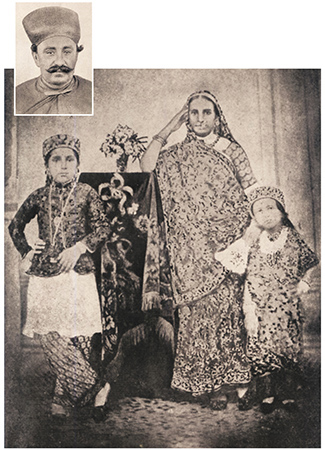
Above: Dosebai Jessawalla with children Goolbai (l) and Dadabhoy;
inset: Cowasjee Jessawalla
Nothing short of sterling virtue and disinterested benevolence could have entitled Cursetjee to this unique and universal homage. Unlike the "sethias” (leading members of the community) of today, he never spent his money to gain titles and rewards, but aspired only to divine honors in his charities and efforts on behalf of the countless thousands of the poor. During the latter period of his life, he had the misfortune to lose the greater portion of his wealth, but his sympathy with the poor continued unabated and his remains were escorted to their last resting place by such an immense concourse of people as has never been seen within the range of our memory. Rich and poor alike honored him and participated in his funeral obsequies, which lasted three days. Nowadays all bow to the rising and none to the setting sun, but in contradiction of this all but universal maxim, Cursetjee was honored even in his downfall.
When his marriage proved unproductive of issue, his wife, with magnanimity as unparalleled as her self-abnegation, suggested his taking to himself another wife.
In order to celebrate this second marriage with fitting pomp and festivity, the Parsi Punchayet were requested to lend the great utensils in their possession, but this they refused to do, contending that it was objectionable to contract a second marriage during the lifetime of the first wife. However, seeing that it was at the express wish and permission of the first wife that the second marriage was to take place that excuse was overruled, still the Punchayet persisted in their refusal to lend the public utensils and ultimately similar large-sized utensils had to be made expressly for the occasion. This singular marriage was celebrated amidst the greatest rejoicing, and to the credit of the first wife, it may be mentioned that she (as is customary amongst natives) not only participated in this important ceremony, but with her own hands decorated the bride and escorted her to her new home.
Cursetjee’s family was soon after blessed by a son of this second marriage. Cursetjee’s happiness may now be said to have been complete, as his second wife successively gave birth to four sons and one daughter. The first wife was looked upon as the head of this happy domestic circle and she exercised her power so considerately as never to give the slightest offence to the second wife.
Bai Barozbai, the first wife of Cursetjee, by her singularly urbane disposition, won the favor of all around her, and I am very sure that such nobleness of mind as hers would only be met with in one of a thousand. While living she was held in the highest esteem by her husband and all connected with her, and now that her place on earth knows her no more, we may well cherish the belief that she has found a home in the realms of bliss. I have given the leading incidents of this noble woman’s life to incite my fair readers to emulate her example of unselfishness and amiability. Before quitting the theme, I may mention that Bai Barozbai was kept in close custody by her bigoted parents who hoped thus to coerce her into withholding her consent to her husband’s second marriage, but, as we have seen, she rose superior to all objections and escaping from her parents’ roof she fled to her husband.
Through her medium providence blessed Cursetjee with a host of rosy-cheeked children and we, who owe indirectly our very existence to her, cannot but regard her as one of the most estimable ladies amongst the Parsis. The four sons by whom Cursetjee was blessed were named Eduljee, Dhunjeebhoy, Hormusjee and Manekjee and his daughter Aimai. It only remains to add that, with such a Godsent progeny, together with two wives all living in love and perfect harmony, Cursetjee’s life may well be styled supremely happy. In the course of time his second wife died.
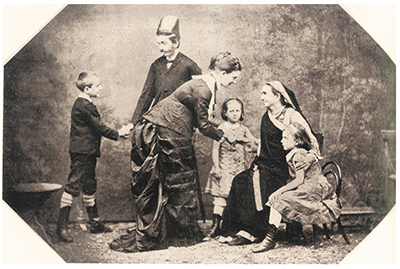
Ms R. Ahlers and her children with Dosebai and Dadabhoy (seated)
on their first visit to Europe in 1878
Dosebai and Cowasjee Jessawalla
Tardeo Estate, bungalow built by Dosebai
After this, Cursetjee’s life presents to our notice a continued series of misfortunes and woes. He lost two children in the prime of life, one of whom, his only daughter, whom he deeply loved, succumbed to a slight indisposition, lasting a single day. She had married into the well-known family of Heerjee Readymoney, her husband being Kaikhasroo, son of Soonabai Readymoney. She left one son. The bereaved father was destined to suffer a more terrible blow in the untimely death, owing to commercial difficulties, of his third son Hormusjee, in 1840, at the age of 30. Thus rendered woefully miserable by misfortunes following each other in rapid succession Cursetjee passed the eve of his life in great sorrow, leading a sort of ascetic life.
Notwithstanding this, his zeal to benefit the poor continued unabated. He was much attached to the children of his son Hormusjee, who had left a widow, four sons, and one daughter to mourn his loss. On the 12th day of the eighth month, 1214 Yerdizardi (Parsi), Cursetjee breathed his last, at the patriarchal age of 81, leaving behind him a happy group of children and grandchildren.
Seth Jamsetjee Nanabhoy Guzdar alias "Supla” by which cognomen his family was readily known, was the maternal grandfather of the authoress. Being a timber merchant, he was proficient in mensuration, hence his surname of Guzdar (guz being, in Gujarati, a yard). His other surname seems to have originated in his ingratiating and sweet disposition when in the company of juvenile friends, they calling him "sipla” (Gujarati for telltale) which became corrupted into "Supla,” by which name he was universally known. He was charitable and popular, maintained a large family in comfort, and led himself an easy, pleasure-seeking life, but it is not recorded of him, as of Cursetjee, that he was ever ready to extend a helping hand to the needy.
By his first wife (for he had also to contract a second alliance) he had an only child; a son named Ardeshir, who, according to the prevailing custom, was during his boyhood married, with all the pomp and ceremony attendant upon such an event. But the fond hopes and aspirations which the father had centered on the sole heir of his name and fortune were cut off by the death of his son at the age of 14.
Soon after this sad blow he made a journey to Surat to transact some business on behalf of Seth Hormusjee Bomonjee Wadia, and there he contracted a clandestine marriage, clandestine that is to say, towards his lawful wife, but with the full approval of his revered mother. This created quite a scene, because he had consoled himself with another wife within a short period after his only son’s sad death. Under these trying circumstances, he thought it best to pacify his enraged spouse by allowing her to have her own way in all ordinary matters, at the same time reasoning with her on the purity of motive which alone necessitated this second alliance, he at the same time instructed his new wife how to conduct herself, and by this prudent management created a sort of harmony out of the discordant elements.
Though on the shady side of 40, providence blessed him with a host of children, two sons and seven daughters, and thus far the eve of his life was supremely happy. The eldest of the group was the well-known Bai Meheribai, held in the highest respect by the rest of the family, and possessed of an interest equal to a son’s in the family assets. I doubt not my readers will have perceived a striking analogy in the matrimonial affairs of my two grandfathers. Three years after the said Meheribai’s birth, Cursetjee’s third son, Hormusjee, was born, and it seemed desirable that two families holding such an influential position among the Parsi community should be united. Thus, despite the disparity of age, Meheribai and Hormusjee were destined for each other. This pair, whom I am permitted to call by the endearing name of "parents,” owed their being in each case to a second union, and this incident, I trust, will not fail to interest my readers by its tinge of romance.