Gallerist Kekoo Gandhy’s tryst with
contemporary art and the voice of bold
artists in Independent India are captured in the documentary Kekee Manzil-The House of Art
Parinaz Gandhi
As an adolescent, Behroze Gandhy was raring to escape her family home Kekee Manzil and its occupants. Around five decades later, filled with nostalgia and pride, she was keen to show her childhood abode in Bandra to an appreciative audience who had come to view the nearly 90-minute documentary film, Kekee Manzil-The House of Art.
Her father, art connoisseur and gallery owner Kekoo Gandhy is the central figure who dominates the film. "There is always a timing,” said the daughter who as director and producer was keen to present the first screening on his 100th birth anniversary on February 2, 2020 but due to technical reasons had to delay it by 11 days. At an exclusive preview of the documentary at the Little Theatre at the National Centre for the Performing Arts in Bombay on February 13, 2020, Behroze explained her reason for the parental residence earning the title of the film: "I recorded him a lot in Kekee Manzil.”
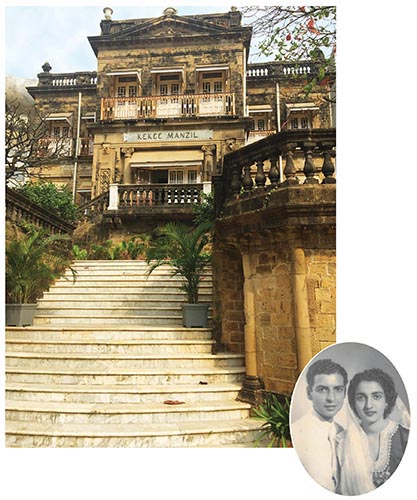
Above: Kekoo and Khorshed Gandhy Photo: Homi Dadyburjor and Kekee Manzil
Built in 1920, the same year as Kekoo’s birth, the imposing, 100-year-old manor serves as the mainstay of the film. Home to generations of the Gandhy clan, it was one constant amidst a changing landscape, a mute witness, while "the social butterfly,” as Kekoo is referred to in the film, found his true purpose. It stood transformed when Kekoo and his wife Khorshed chose to keep an open house for artists and other refugees, or host moholla committee peace meetings following the 1991 communal riots.
Initially resenting her father who devoted more time to his fraternity of artists than his family of four growing children, Behroze gradually recognized his worth when her career as a film and television director in the UK was intertwined with his involvement with art and civic causes in India. Her determination to capture vignettes of his life, focusing on his forte and frailties, made her labor on this project for 18 years. "It painfully became apparent that I was capturing a world that was slowly seeping away,” the 68-year-old daughter mentions in the narrative of the documentary. Kekoo’s aura permeates the film as it captures his persona at different stages in his life, whether his absence from family celebrations or presence at art events. Frequently staring us in the face are the masterpieces that the Gandhys drew inspiration from and which had created waves when completed by the artists. Archival photos of Bombay in the bygone years remain imprinted on the viewer long after the narrative ceases.
"My father was a bit of a chancer,” states Behroze in the film. When studying economics at Pembroke College, Cambridge, the outbreak of World War II necessitated an early return to Bombay. His life took a different turn when a chance encounter with a Belgian businessman Roger van Damme on Juhu Beach led to the start of the Chemould framing business, for many years India’s only manufacturer and dealer in wooden moldings for picture frames. From some Italian prisoners of war in Bombay who knew how to wield the brush, Kekoo learnt to appreciate the finer nuances of art. Soon he became a wheeler-dealer. To market his frames he would put a picture in them and then lure customers to buy the picture.
Always happy to interact with known and unknown figures, the walking in of Austrian artist Walter Langhammer at the Chemould Frames shop in 1944 resulted in Kekoo’s attention shifting from frames to the artists and thus commenced the framemaker’s involvement with the Progressive Arts Group. The Artists Centre on Rampart Row was then a hub for emerging artists who were making bold splashes in a free India. Kekoo and Khorshed’s contribution was to set up Gallery Chemould as their "Temple of Modernity” in the precincts of Jehangir Art Gallery.
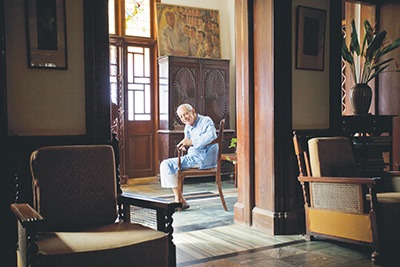
Kekoo Gandhy in a scene from the documentary Photo: Ram Rahman
Views of and from Kekee Manzil
Gandhy family: (above, from l) Khorshed and Kekoo with children Adil, Rashna, Behroze and Shireen
To piece together Kekee Manzil, Behroze was dependent on several inputs: conversations with her parents even though she has lost some of the earlier footage; reminiscences of her siblings Adil, Rashna and Shireen, uncle Dara and some other relatives; interviews with well-known artists Tyeb and Sakina Mehta, Anish Kapoor, Nalini Malani, Ila Pal who as a teenager had accompanied M. F. Husain on a tour for eight weeks; insights from authors Jerry Pinto and Salman Rushdie who were inspired to include characters in their fiction based on their knowledge of Kekoo. All of them are given a voice in the documentary.
Kekoo’s erratic functioning and mood swings, Behroze learnt from a letter written by her mother, was due to a bipolar disorder with which he was diagnosed in later life. The family was now able to empathize with his "grandiose schemes, energy, drive” and the constant need to be on the move. Adding a candid touch to the film was the reference to his walks during his advancing years when he would bring home flowers which the family felt was best not to probe. Whilst rituals of their own Zoroastrian faith offered solace to the couple, any form of religious bigotry was anathema to the Gandhys who upheld secular values and freedom of speech. They refused to be cowed down during the Emergency or communal riots, even if that meant risking their riches or relationships as witnessed in a temporary rift with Husain.
Making of the movie
After the first screening in Bombay, the original plan was to take the documentary to the India International Centre in Delhi in April, to London thereafter, and then at film festivals. But the pandemic brought down the curtain prematurely on Kekee Manzil. Even Parsiana’s plans to interview Behroze were put on hold for four months. The interview was eventually conducted via email in June. Recognizing that "Indian audiences are those with whom the film would most resonate,” over the first weekend of July the family offered those known to the Gandhys a password protected link to view the film on the professional video platform, Vimeo. As noted their communiqué, "In a time when communities have been fractured… we hope that watching this film truly reminds us of the importance of community and its nourishing and generative impact on our lives.”
Behroze maintains, "If one can begin a debate or discussion with a film, then I feel it has answered the question of why it has been made...
"I was not interested in just making a film about my father, but I have understood that he happened to be living in a very important period of the history of our country…and he was able to witness a new art movement in the making.” The target audience, she believes is "anyone concerned with questions beyond the story of my father: those interested in the contemporary art movement; how it coincided with the independence of India; art and politics…”
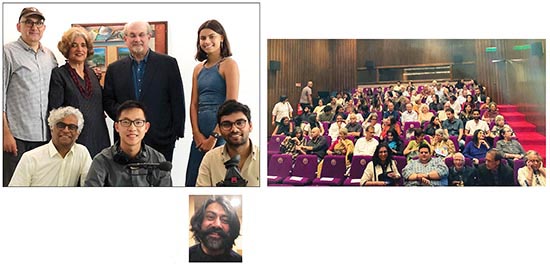
Top: The crew and cast (from l, standing) Dev Benegal, Behroze, Salman Rushdie, Svenya Korya;
(sitting) Dilesh Korya, Braulio Lin, Neeraj Jain; a section of the audience at the Little Theatre; above: Talvin Singh
In the absence of a narrative and a deadline "which I am used to as a film and television producer, time stretched on and the impetus for working would fall by the wayside, as other more urgent matters intervened,” admits Behroze. Being close to the subject also clouded her objectivity. She thus brought on board Dilesh Korya as editor in 2016 having collaborated with him in 2004 for a documentary on the Kumbh Mela for Channel 4 Television. As a Britisher, born in Uganda, with a Gujarati background, Korya was fully conversant with the context. "Without this man, this film would never have happened,” declared Behroze at the screening. Korya considered the Gandhys "a vehicle” to relate the story of contemporary Indian art and history.
Behroze gave credit to Talvin Singh, a well-known tabla player, for bringing "a whole new dimension to the film in telling the story in parallel with music instead of simply in words and pictures.” He was part of the New Asian Underground music scene in Britain in the 1990s and had won the Mercury Prize for his contribution to new music. Passionate about contemporary art having previously visited Gallery Chemould, he was able to instantly understand the mood required for the film. At the live performance following the first screening in Bombay his music troupe displayed the same enthusiasm.
Referring to her self financed 18-year journey, initially filming with a handheld camcorder, Behroze regrets that she could not incorporate some of the early footage she had with artists like S. H. Raza, Ram Kumar and Akbar Padamsee, and art historian Partha Mitter in conversation with her parents. "They were full of wonderful material but they were simply not of good enough sound quality since I had not hired a professional crew at that stage.” These artists have now passed on.
To the director, getting shots of the city of Bombay with its crowds and congestion "proved the most challenging as we had a solo camera person. Getting my extended family to talk around the table about my father was also very challenging with a single camera and with certain members of the family understandably not very comfortable in front of the camera. But I was driven, very persistent, and ultimately got my way.”
A year prior to Gallery Chemould’s 50th anniversary, Kekoo passed away and a year later, Khorshed. Whilst Adil is in charge of the framing business, Shireen has taken on the art mantle at the Gallery that has adopted the name Chemould Prescott Road after moving to its new location. All four children cherish the lasting legacy they have been left with: "ideals and values to hold on to in difficult times.”