The art of Parsi cooking: reviving an ancient cuisine by Niloufer Mavalvala. Published in 2016 by Austin Macauley Publishers Limited, 25 Canada Square, Canary Wharf, London E14 5LB; website:
www.austinmacauley.com Pp: xi + 109 Price: £ 17.99; € 24.99; $ 27.95; Kindle version (on Amazon India) Rs 308.

"I like to believe it caters to all foodies universally,” says Mississauga, Canada based Niloufer Mavalvala (pictured) about her 11th cookbook The art of Parsi cooking: reviving an ancient cuisine. "I wrote this book primarily because I wanted to share our wonderful cuisine that has not had many opportunities to step out onto the world platform,” the Karachi-born chef continues in an email interview with Parsiana. "The culinary world has never been more interesting than it is now,” she explains. One of the ways to make Parsi food stand out is to make it easily accessible, she states. The author signed copies of the volume at a pre-launch at the bookshop Books for Cooks, in Notting Hill, London, on July 28, 2016.
Expect to find all the standard predictables: akuri, patra ni macchi, three types of "par eedu,” dhansak, sali marghi, et al. Naming the papeta-ma-gosh as her "most favorite,” the chef elaborates that "I am sharing the best one available from my mother-in-law’s maternal family. It has been hard to beat for over a century.” The book includes vegetables cooked without the mandatory mutton in it. Wouldn’t true blue Parsis balk at the idea of papri or French beans without gosh in it? "While I grew up eating ‘ma-gosh,’ I had a peeve against eating mushy vegetables with the exception of potatoes. Once I started preparing my own meals, I always opted to cook the vegetables separately until ‘al dente’ with a crunch left in them!” Admitting that "to this day I have never cooked ‘ma-gosh’ for my family,” the Mavalvalas "eat almost every vegetable available and are still great meat eaters.”
.jpg)
Two unusual recipes stand out, and leave one wondering at their inclusion: calamari pakora and chicken wings (charmingly called chicken boti). Both inclusions are introduced as the author’s take on "Parsi-Fusion pub-grub.” Besides the favorites, "I also wanted to give my own personal touch to the book, so the calamari, chicken boti are included for that reason,” she adds.
Neatly divided into appetizers, second course, mains, rotli nu bhonu, desserts and tea time snacks, the tome is not exhaustive. Thirty-three recipes retaining the original Gujarati titles of dishes, all dutifully translated into English, are introduced with personal memoirs from the Wania household of her growing up years, the author’s travels or Parsi tradition in general. A particularly interesting one is where the author finds a dish similar to the papdi (flat-bread served as prayers for the deceased) — the Torta de Aceite in Spain.
All of Mavalvala’s previous books are named Niloufer’s Kitchen: XXX (with a suffix describing the cuisine or some aspect of the book in question). Her earlier book, Niloufer’s Kitchen: Quick and Easy also focusing on Parsi cuisine "was put together for university students who left home with one pot and a spoon in their bag.” Another of her e-books, Niloufer’s Kitchen: Persian Fusion was a "small nod towards Parsi cuisine.” The chef’s e-books which focus on cuisines like Moroccan, French and Spanish retail at about three dollers on-line for Kindle versions. When living in Dubai, she started experimenting, "one cuisine at a time …I particularly enjoyed the Thai, Moroccan, Persian and Middle Eastern cuisines there.”
Explaining her reasons for a paperback after 10 earlier e-books, she says, "My blog led me to a FaceBook page, which led to a Twitter account — that’s when the publisher, Austin Macauley approached me and were impressed, and decided to take a chance on me.”
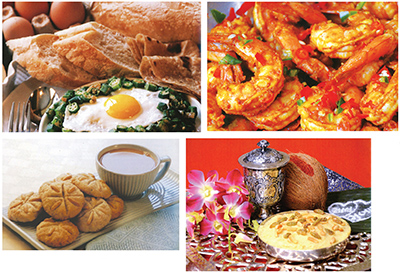
Clockwise from top: Bheeda per eedu; tamtamta jhinga;
ravo on a sagan ni thali; khatai
This book is dedicated to her late father, Karachi based eye surgeon Dr Jamshed Wania, who "had an infinite love of good food.” Mother Shireen, who took to baking after Jamshed passed away, was a consummate hostess; Villie fui (paternal aunt) was the "inspiration” with whom she shared a passion for food; and brother Hormuzshaw was the reason she started cooking. Growing up in a family that had "caramel custard prepared fresh every day,” it is little wonder then, that Mavalvala’s recipes are the kind that most Zoroastrian families will identify with and would have cooked a million times.
A section called Tips within each recipe highlights handy hints to make the cooking a breeze, though they may be a minor irritant to the experienced chef to be told, for instance: "If cooking in an oven, spread the chicken out over a large baking tray ensuring the pieces do not overlap.” Perhaps the author wants to cater to the largest possible audience. Traditional cooks will exult at the inclusion of the phrase "aik taar no seero (one thread syrup)” in the recipe on malido, but will frown on the use of the pre-mixed Betty Crocker’s Bisquick.
Two other Parsis feature in the book: Sheriar Hirjikaka and Zara Contractor, to whom are ascribed the photo credits and the cover design respectively. "Both are from Karachi. Hirjikaka, a doctor by profession, is a childhood friend,” says the home cook. Since 2007 they continue to devote a couple of days in the year to cooking, styling and taking pictures. A creative and talented graphic designer, Contractor who has developed Niloufer’s Kitchen logo, now works as head of the creative department at Xpert Services for Pakistan Herald Publications, Private Limited, a part of the Dawn Media Group.
A good book to browse through, especially for the photographs, western audiences may savor it with relish.