Living with ADI by Zarin Virji. Published in 2024 by Duckbill Books, an imprint of Penguin Random House India Pvt Ltd, 4th Floor, Capital Tower 1, M. G. Road, Gurgaon, 122002. Pp: 217. Price: Rs 299.
Adi Krishnan is a Grade 9 student. He gets straight ‘A’s and tops most tests. He is a treasure trove of information and knows, for example, that gulmohar leaves are "Fern like. Compound leaves. Doubly pinnate (feathered).” There is a good chance that he knows more about snakes than anyone else in Bombay.
Even so, Adi is different. He has no friends at school. He has a staccato speech pattern and always speaks his mind. He dislikes playing games, avoids dogs and hates being touched because he is horrified by the thought of colonies of bacteria multiplying on his skin.

Not everybody accepts Adi for what he is. His schoolmates taunt him and call him "weirdo” and "gaando (mad)” and "ghelo (crazy).” His teachers and the school principal ignore acts of blatant bullying and make him the scapegoat when things go wrong in the classroom. His grandmother, who often has to respond to angry calls from the school, views Adi’s acts as "plain and simple bad behavior.” His father, who lives in Singapore with his new family, believes that the problem lies with the school alone — and that his son is perfect.
There are, however, people who understand that Adi is on the autism spectrum and is neuro- divergent (a person whose brain processes information differently from what is considered typical). His mother and sister accept him for what he is — and love him for his razor-sharp brain and incredible memory, his direct style of speaking and his insistence on clear-cut definitions.
The big question is: how do they get the rest of the world to understand Adi?
Written by Zarin Virji (pictured) with warmth, tenderness and a touch of humor, Living with ADI is a book about dealing with an extraordinary child who refuses to fit the mold. The book is narrated from the points of view of multiple characters — Delna, the stubborn single mother who on her lecturer’s salary is struggling to pay the bills and understands her son like no one else; Jasmine, the typical collegian who is fiercely protective of her brother.
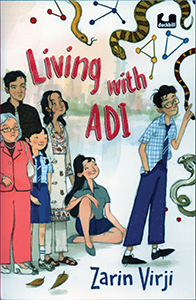
We also hear the voices of various classmates and teachers. And, of course, of the feisty, plain-speaking grandmother, Shirin Ardeshir Daruwala, who lives in Dadar Parsi Colony, makes bhakras and cooks up a storm for Parsi New Year. She thinks of her beloved granddaughter as "Mari nalli, mari mitthi (my little one, my sweetie),” but her grandson evokes more complex emotions.
Living with ADI is set in Bombay, and the reader gets glimpses into numerous aspects of the city. There is mad Bombay, with its messy monsoon showers, relentless traffic and constant construction racket. But there is also Dadar Parsi Colony, with its gardens and nosy neighbors — where everyone observes muktad and prepares for Parsi New Year with chalk, rangoli and patra ni machhi and chicken cutlets (barring the supercilious neighbor Naju who celebrates at a fancy restaurant).
Virji, who has been a teacher and school principal for decades, approaches her subject with lightness and sensitivity. In her deft hands, Adi wins our hearts and readers cannot help but root for him and for the many other children out there who are wonderfully different.
SHABNAM MINWALLA
Minwalla writes for newspapers, plays mother to three teenagers, devours murder mysteries and shops for saris. Her absolutely favorite activity is writing books for children.