His hierarchy comprised Zarthost Saheb, Tata saheb (sir) and aapro Rajo (our king, George V and George VI, not Edward VIII whose abdication of the throne for an American divorcee he did not approve of). Forty years before he was born in Khergam, a tiny hamlet near Navsari, the lifelong subject of his reverence, Jamsetji Tata, founder of the House of Tatas had been born in a nondescript house in Dastur Vad in Motafalia, not too far from our mythical Seervai Vad. The eldest son of a farmer, he was a duffer and enjoyed peeling vegetables more than learning the Gujarati alphabet, called barakhadi, in a makeshift school. Cooking was in the DNA of this robust lad who, at 12, migrated to Navsari to work as an assistant cook with a Parsi caterer in Malesar.
He was a magician of the open-air kitchen. Deftly adding spices to chicken and mutton (pork and beef were unZoroastrian), the giant chamach (cooking spoon) like a wand in his rough hands, he conjured up mouth-watering delicacies at weddings (those days navjotes and navar initiation ceremonies were not followed by dinner) and gahanbars (free community vegetarian feasts where the simple fare was divine). His caterer boss succumbed rather young to a cardiac episode possibly from fat choking his arteries. He seamlessly took over and remained Navsari’s most adored caterer for decades.
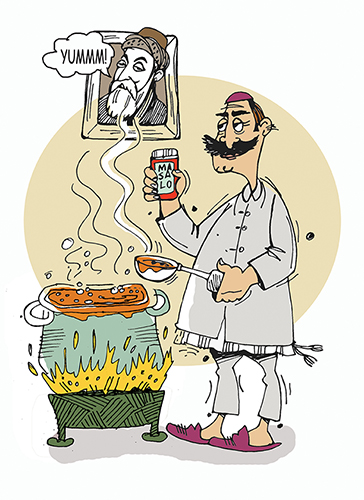
Illustration by Farzana Cooper
He rented for two rupees a month a two-storey house in Baria Vad, rather shabby and dark, with a spacious paachhloon baar (backyard) having a sweet water well and a few coconut and papaya trees growing alongside two latrines (one reserved for women in menstrual periods) where until the late ’60s, night soil was carried away by workers until the arrival of the water closet with flush. At 21, he married a petite woman of 15 with whom he had an idyllic married life for 58 years. She bore him a cricket team with an umpire thrown in. Out of those dozen children, six outlived the couple. Brothers and sisters and cousins from nearby villages added to the commotion in the bustling household. Somehow there was enough food for everyone including neighbors, hangers-on and even beggars. A green parrot with a red beak, in a cage on the so-called portico, could say "popat mitthoo (sweet parrot)” and was fed every afternoon before the first morsel was popped by anyone.
The caterer was appointed manager of Tata Vadi where the feasts were celebrated. In winter, the Tatas descended upon Navsari to preside over Tata school functions. The childless Navajbai Tata, in particular, (who later adopted Naval Tata) delighted in seeing kids feasting on sugar candies imported from London together with the local yummies prepared by our hero. Once a little girl was hauled up for pocketing some goodies. A furious Navajbai fired her tormentors and, upon learning that the girl was taking food for her mother who did not have enough to eat, decreed that the children be encouraged to take home as much food as they wanted. She would personally thrust sweets into their pockets, tears of joy rolling down her cheeks.
Our caterer was as bad at accounts as good as he was at cooking and earned just about enough money to provide food to the many who depended on his largesse. Like the fabled Akshayapatra of Yudhishthira in the Mahabharata, which never ran out of food, the more the hungry and poor ate at his table, the food miraculously continued to appear. His khurchan (liver, kidneys and other offal marinated overnight with curd and spices and then grilled), aantheli murghi and dhansak ni daar, were fare for the gods.
To produce tongue smacking delicacies on a mass scale was a fine art that he had mastered. This was authentic Parsi rural gourmet cuisine over which his patrons, the Tatas, exulted. He packed hampers when they left for Bombay, all at below market price. Embarrassed, his clients would urge him to charge more. He would refuse saying the magic will vanish if commerce enters. He had no money to educate his children beyond the free (for all) Tata boys and girls schools. All of them without exception became teachers, bankers and corporate executives. His youngest son once requested him to speak to Naval Tata (who adored the caterer) regarding a job with the Tata Oil Mills (TOMCO). The caterer point blank refused saying he had not sought favors for anyone and the son should apply on merits. Accordingly the son did and rendered lifelong service to his father’s patrons.
In his sunset years, the caterer sat on his portico, below the parrot cage, wearing a thick duglo né topi, with a grandchild frolicking in his lap, as passers-by warmly recollected his works of culinary art and remarked on how they were being missed, while Jamsetji Tata looked benignly at him from a large portrait on the wall.
Berjis Desai, author of Oh! Those Parsis and The Bawaji, occasionally practices law.