Jamshedji Madan’s pioneering
contribution to the theater and film industry
is recalled on his 100th death anniversary
Farrokh Jijina
When film producer and theater personality Jamshedji Framji Madan’s 101-year-old restored silent film Behula was shown in December last year, there was jubilation in movie circles. "Given that only 29 of 1,338 Indian films made between the late 1800s and the early 1930s have survived, it seemed like a significant achievement in the fight to save the country’s cinematic legacy,” noted The Times of India on December 19, 2022. Calling the film "a rare gem,” The Hindu wrote that "this is the third Indian silent film to be acquired by the National Film Archives of India but the first to be acquired in its entirety… The other two acquisitions were only footages… All three were made by the historic Madan Theatre.” The one-hour, five-reel movie was shown at a preservation and restoration workshop three months ago in Bombay. The year 2023 marks a centenary of Madan’s passing. He was born in 1856.
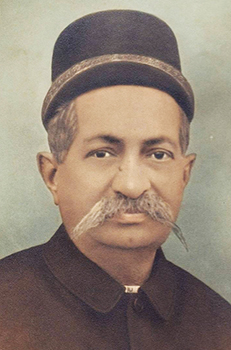
Widely considered to be one of the founding fathers of Indian cinema, having cut his teeth on the Parsi stage, Madan Theatres "grew to become the largest filmmaker, distributor and theater business in India. The company is credited with having brought the early film business to Calcutta… At its peak, Madan Theatres controlled half of India’s box office income and is said to have owned or controlled 127 theaters,” notes madantheatres.com, a website developed by the pioneer’s great-granddaughter Gool Ardeshir with other relatives Ashley Coates and Anjali Dhar.
The Madan-owned Corinthian Theatre, which he built in 1890, adjacent to his family home on Calcutta’s Dharmatala Street was, in 1902, the setting for some of the earliest sound recordings produced in India, wrote another great-granddaughter, secretary and trustee of The K. R. Cama Oriental Institute Homai Modi in the Dr Nawaz Mody edited The Parsis in Western India 1819-1920.
In the 1890s, Madan acquired two drama companies, Elphinstone and Khatau Alfred, including their repertoires.
Starting with exhibition of homemade and overseas movies in 1904, including one on the notorious partition of Bengal by the colonial authorities, Modi noted that "production of shorts in 1906 was almost entirely dominated by Madan’s Elphinstone Bioscope Company.” Madan became the first of the "travelling cinema showmen.” At a show in a tent in Calcutta’s Hati Market, when only two people showed up, the astute businessman showed them two movies! Acquisition of other drama troupes and fledgling theater companies followed.
Towards the end of the 1900s, Madan was the sole agent for Pathé, then the world’s largest film equipment and production company based in France, with exclusive distribution rights in South Asia. In 1916, he opened New Elphinstone Theatre in Madras. Inaugurated by the governor-general, the show place was noted for having an amateur boxing ring and being one of the first in India to raise funds for the Great War efforts through ticket sales.
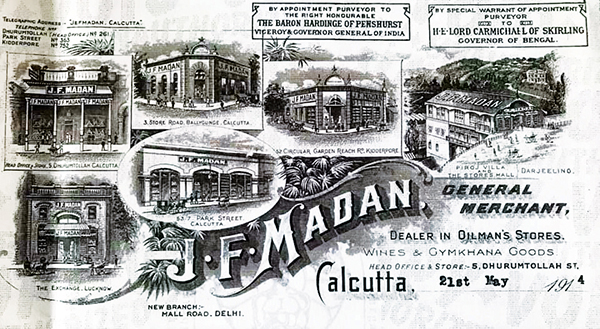
Jamshedji Madan (top) and memorabilia from his business and theater empire (above) that expanded so rapidly
Madan Theatre’s star Patience Cooper in Behula, a "rare gem"
Photo: Behula (Camille Legrand) © 1921 - Fondation Jérôme Seydoux-Pathé
By 1919, J. F. Madan and Sons, his merchandizing company, had become a joint stock company with Madan Theatres running the Elphinstone Theatrical Company and its flaghip Corinthian Theatre, noted Modi.
For the 1920 production of the mythological Nala Damayanti, Madan reportedly brought in technicians from France and Italy. On contract with his company was actress Patience Cooper (who also starred in Behula), among others. Quoting from the Encyclopedia of Indian Cinema, Modi noted that by 1927, the Madan distribution chain "controlled half of India’s permanent cinemas.”
Son of a priest
"The success of both his mercantile and theater businesses represented a considerable turnaround for a man who, at the age of just 11, had been forced to leave his formal education due to the failure of a land reclamation scheme in Bombay” in which a relative, who funded Jamshedji and his brothers’ education, had invested, noted Modi. Framji, his father, was a priest at Bombay’s Bai Avabai Wadia (Indawalla) Agiary.
Madan first found employment when barely a teenager in a play group at a monthly salary of four rupees. "He was considered to be beautiful and could also sing sweetly.” The exposure emboldened Madan to start a play company under the leadership of one Cooverji Nazir. Unfortunately, this venture was unsuccessful, noted Modi.
Above l: Elphinstone Picture Palace, first purpose-built cinema hall in India;
r: Madan Theatre — Palace of Varieties, later Elite cinema
Magazine coverage of King George V and Queen Mary watching a command
performance of Madan’s bioscope show of the Delhi Darbar of 1911
Memorabilia from Madan’s business ventures
The pioneer initially operated the Elphinstone Natak Mandali, where he became a partner at age 20, and then the Elphinstone Bioscope Company from which Madan Theatres evolved. The firsts attributed to Madan and his companies are listed on the website: the country’s first purpose-built cinema, the Elphinstone Picture Palace in Calcutta; the first Bengali feature film, Bilwamangal; the first Bengali talkie Jamai Shashthi; the first cinema chain; the movie Indra Sabha with 71 songs, among others.
In 1882, Madan left Elphinstone and showbiz temporarily to set up his own piece goods business in Karachi. Moving to Calcutta the following year, his trading company known as J. F. Madan and Company was founded in the eastern city in 1885 and soon had stores dotted across the subcontinent. The idea of going into trade emerged during his travels with the play groups, speculated Ardeshir. "He would go to these auctions and buy materials to sell at a profit.” This wholesale and retail business became one of the leading suppliers to the government and the military, serving the army across the country, with warrants of appointment to the British aristocracy. The businessman was recognized with the Order of the British Empire medal in 1918 for his services during previous expeditions to Afghanistan and Tibet. It was this enterprise which enabled Madan to invest and expand his theater business so rapidly, stated Ardeshir. In later years, Madan Theatres served as the managing agent for J. F. Madan and Company.
Married to Pirojbai Minwalla of Karachi, the Madans sired 12 children, six boys and six girls.
A devastating fire in 1925 marked the beginning of the decline of Madan’s cinema empire. The stock market crash of 1929 added to their woes. By the late 1930s, the enterprise was all but gone, noted Ardeshir. Film historian B. D. Garga offers this insight from an interview with Madan’s fellow Zoroastrian film magnate J. B. H. Wadia in Silent Cinema in India, A pictorial journey. When Wadia was asked "Why did something as unique and huge as Madan Theatres collapse so suddenly?” Wadia responded, "Only because it was a one-man institution…And one man who had a vision… His successors did not have that.”
"The closure of Madan Theatres by the late 1930s is attributed by different people to different reasons,” wrote Modi. "And so it was with all things on earth — the passing away of a mammoth cinema empire.”
"Discovery” of Behula
Poona based Ardeshir told Parsiana on January 9, 2023 that she heard of the "discovery” of Behula in July 2021 "when we received an email from Jitka De Préval, who was writing a historical account of Camille Legrand who directed the film… She said that the movie was discovered in 2018 in the archives of the Foundation Jérôme Seydoux-Pathé, and was being restored in Italy…. We were really thrilled by this news as nearly all the original nitrate films made under the banner of Madan Theatres were destroyed in a fire in 1925.” Ardeshir subsequently read a full account of the movie in the book that De Préval wrote and translated for her family from the original French.
Ardeshir bemoans that Madan’s pioneering film career spanning drama, short reels, silent films, documentaries and talkie movies is not more known outside of academic circles. "(Few) films have survived, hardly a couple of photographs… It’s only recently due to the interest of a few of us that we have established a website and historians and authors are contacting us for inputs on him,” she said.
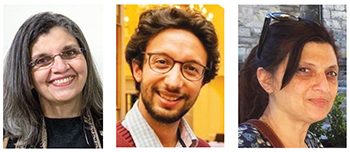
Above, from l: Gool Ardeshir, Ashley Coates, Anjali Dhar
Their website, established in 2013, is a "resource for people looking to find out more about Madan and his work in film, theater, business and philanthropy.” In addition to a time line of the pioneer’s handiwork, the website has a listing of the theater company’s filmography, locations of cinemas, memorabilia and select company documents among other material. Coates told Parsiana on January 11 that he took up this project so that all material about the pioneer could be made available in one place to those interested.
Yet another great-granddaughter of Madan, Delhi based Ferroza Madan Jassawala told Parsiana on January 10 that "Fram Jamshed Madan was his son and my grandfather… I do recall my father, Jamshed, who was a chartered accountant, telling me that his father (and grandfather) produced (among the first) talkie film in India called Shirin Farhad under the banner of Madan Theatres… My grandfather passed away at the age of 42 and with his demise, Madan Theatres did not produce many films.”
Madan’s magnanimity
Author Prochy Mehta notes in Pioneering Parsis of Calcutta that although he provided employment to needy community members in his cinemas and shops, "his help was not restricted to Parsis exclusively.” Reportedly, hundreds of beggars would gather weekly on a Sunday outside the Corinthian Theatre and each would receive around four annas (25 paise) from Jamshedji, notes Ardeshir.
Kicking off a subscription list with Rs 5,000, Jamshedji was able to put together a sum of Rs 1,00,000 by visiting Parsi homes for a second tower of silence in Calcutta. It was due to his influence that the government granted Rs 27,000 for the purchase of land for the dakhma, with Jamshedji contributing Rs 20,000 towards building it, noted Mehta. The businessman contributed towards the construction of an annexe to the city’s D. B. Mehta’s Zoroastrian Anjuman Atash Adran, besides donating funds for the chandeliers, lamps and utensils for the place of worship, noted the author. To house needy Parsis, Khorshed Madan Mansion was built in memory of his daughter Khorshed who predeceased Jamshedji. He also provided money for the aramgah in Darjeeling.
Noting that Jamshedji served as a trustee for the Adran, Mehta stated that he reportedly supported Dastur Kaikobad Noshirwan who went from Calcutta to Rangoon to perform the navjote of Bella, daughter of a Parsi mother and Goan father.
"Calcutta’s most respected citizen”
Veteran journalist and author Bachi Karkaria told Parsiana on January 11 that Jamshedji helped her grandfather Edulji Kanga financially to set up Navroz as a weekly to mirror and guide all the Gujarati communities which had settled and flourished in eastern India — Parsis, Gujaratis, Bohras, Khojas. "In gratitude his full page photograph appeared alongside that of my grandfather as ‘Navroz Na Palak Pita (Nurturers of Navroz)’ in the bumper Diwali annual right till the time the paper shut down in 1990 with the passing of my mother Jaloo Kanga… (Jaloo had) edited Navroz in partnership with my father Naval who had passed on 10 years earlier.”
When Jamshedji passed away in 1923, an obituary in Gujarati in Navroz called him "Calcutta’s most respected citizen.” In appreciation of his cosmopolitan charities, he was recognized as Companion of the British Empire in King George’s birthday honors list of that year. "Regretfully he did not live to see the joyous feeling among the public on (his) recognition,” noted the obituary. Calling the 67-year-old deceased’s funeral an "unprecedented occasion,” the newspaper stated that large numbers of people from all communities joined in the procession. Policemen on horseback and constables walked ahead of the cortege. "Tram traffic at 5, Dharmatala Street, his residence, halted for a long time…nearly 5,000 condolence messages were received by his eldest son Burjorji, including from the viceroy and the governor of Bengal.”
"Today Madan Street in central Calcutta honors Madan’s philanthropy which included considerable donations to Calcutta’s poorest people and the Parsi community,” noted Ardeshir. Jamshedji’s showbiz legacy lives on, she stated, in the works and films of her cousin, and yet another great-grandson of Jamshedji, Eric Avari, the Hollywood actor.
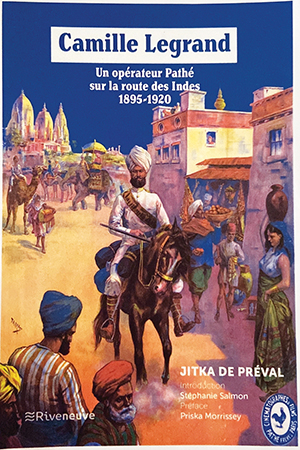
Book on the life of director of Behula
Restoring Behula
Behula, Jamshedji Madan’s silent film saw the light of day, in Bombay in late 2022. After restoration overseas, it was screened at a workshop conducted by the Film Heritage Foundation (FHF) founded and headed by producer and archivist Shivendra Singh Dungarpur. The film is adapted from a Bengali legend in the Manasa Mangal – the epic dedicated to the snake goddess, Manasa, stated a detailed note received by Parsiana from Dungarpur’s office.
The movie is about the rivalry between the goddesses Chandi, wife of Shiva, and Manasa, his daughter. The merchant Chand Sadagar is a faithful devotee of Chandi, and Manasa attempts to attract him. Rejected by Chand Sadagar, Manasa condemns his son, Lakhindar, to perish on the night of his marriage to the beautiful Behula. The next morning, Behula discovers her husband’s inanimate body after he suffers a snakebite. She sets out on a long voyage along the Ganges until she succeeds in bringing him back to life.
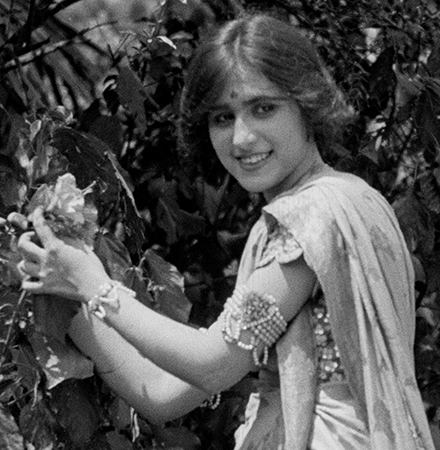
Patience Cooper Photo: Behula (Camille Legrand) © 1921 - Fondation Jérôme Seydoux- Pathé
The exterior locations echo the context in which the film was shot, with swaying cardboard sets animated by the breeze and the impromptu presence of passers-by finding their way into the storyline, stated the note.
For the movie, Camille Legrand, the director "called in one of Madan studios’ (star actresses) Patience Cooper… Born in Calcutta in 1905, her family was part of the Jewish-Iraqi diaspora… She was the best known of the Cooper sisters (Patience, Violet and Pearl), and she started out as a dancer on the stage…. Patience belonged to that generation of ‘modern girls’ whose European education and pale complexion made them more attractive to early Indian cinema.”
The seven-day workshop was the seventh of a series conducted by FHF from December 4-10, 2022 at the Prince of Wales Museum (now Chhatrapati Shivaji Maharaj Vastu Sanghrahalaya) and The K. R. Cama Oriental Institute, with screenings held at the Regal Cinema. FHF’s note stated that the aim of the workshop "was to create awareness about the urgent need to preserve our moving image heritage and to skill and train a resource of archivists.”
FHF is a non-profit organization founded in 2014. Dedicated to supporting the conservation, preservation and restoration of the moving image and develop training programs in film preservation, their projects use film as an educational tool and create awareness about the unique language of cinema.
FHF is a member of the International Federation of Film Archives headquartered in Brussels. Dungarpur has been elected an executive committee member of this international body. Their advisory council includes eminent members of the Indian and international film world including Shyam Benegal, Gulzar, Jaya Bachchan, Kamal Haasan, Kumar Shahani, Girish Kasaravalli and Gianluca Farinelli. "Our ambassador is the legendary actor, Amitabh Bachchan,” stated Dungarpur.