For the past 15 years Dr Shernaz Cama has headed
the Parzor Foundation which works to actively create
awareness about the community internationally
Feroza C. Jassawala
"I needed to stand up and be counted as one of those who would work to preserve India’s multiculturalism, hold back ethnic backlash and preserve our Indian and Parsi heritage and identity.” Dr Shernaz Cama, founder director of Parzor Foundation, a research scholar and professor at the Lady Shri Ram College in Delhi, recalls how the demolition of the Babri Masjid in 1992 and its aftermath propelled her to salvage "the close-knit Indian fabric which was threatened by this wave of destruction.” During the last 15 years when she has earned the confidence of the United Nations Educational Scientific and Cultural Organization (UNESCO), the Government of India (GOI) and the Ministry of Minority Affairs (MOMA), she has succeeded in creating awareness about and among Parsis through projects like The Everlasting Flame (TEF) Programme in New Delhi from March to May 2016 when three exhibitions were concurrently installed to showcase Zoroastrian culture in India, Iran, Central Asia.
To Cama, "India is a multicultural collage, a mosaic pattern which is intricate and yet allows each individual piece to shine. We are not a melting pot, and… have so much to teach the world.” TEF was the first scheme under the Hamari Dharohar (Our Heritage) program created by MOMA to showcase the shared heritage of all Indians. With support from the School of Oriental and African Studies (SOAS), University of London, GOI, collaboration with the National Museum, National Gallery of Modern Art, Indira Gandhi National Centre for the Arts (IGNCA) and participation from international scholars, Parzor was able to engage with the international and Indian community.
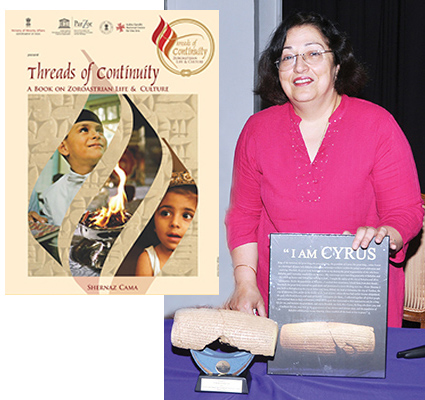
Dr Shernaz Cama at the inauguration of "Threads of Continuity" exhibition Photos: Jasmine D. Driver
"The Culture Ministry data through the National Museum recorded a footfall of 80,000 people who visited the three locations,” notes an ebullient Cama. She is particularly enthused with the reaction of school children. "The Programme’s outreach to non-Zoroastrians and those unaware of our culture is the greatest success of this project,” says Cama proudly. "The awareness of Zoroastrianism was not restricted merely to those who attended the Exhibitions, but also those who attended the Dr Cyrus Poonawalla sponsored TEF cultural events, and TEF Film Festival at the India International Centre,” she added.
One of the most interesting sessions at the "Threads of Continuity” exhibition that Cama curated was the workshop conducted by IGNCA and Yes Bank to bring school teachers, museum interns, culture connoisseurs and postgraduate students to understand Zoroastrian culture. The workshop saw participation from over 50 persons who created a "Workshop Folder” to understand the need to teach cultural protection of India’s diversity from school level onwards. Being a research scholar and professor, Cama is happy to report that a university in India is now interested in creating a chair in Zoroastrian Studies and discussions are under way to procure financial support for faculty and researchers to pursue this further.
Another crucial benefit of TEF legacy is the link established with Iran. "Over 30 objects, including national treasures of Iran, were sent out of their country for the very first time to an exhibition in India.” Dr Daryoosh Akbarzadeh of the Iranian Cultural Heritage and Tourism Organization, Mobed Mehraban Firouzgary, and personnel of The National Museum, Tehran, Khaneh Farhang O Honar Museum, Tehran and Marker Museum, Yazd, made this exchange possible. At the UNESCO Intangible Cultural Heritage conference at the Sangeet Natak Akademi held during this period, the president of the Tehran Zarthoshti Anjuman evinced a keen interest for closer ties in education, culture and linguistics between Iranian Zarathushtis and Parsis in India.
Cama was disappointed during TEF that while representatives from the Federation of Zoroastrian Associations of North America, Zoroastrian Trust Funds of Europe, World Zoroastrian Organisation and associations in Australia, Karachi and Tehran participated in the Programme, few Parsis from Bombay visited the exhibitions. "We have not been able to get the youth to attend in sufficient numbers and successfully transmit the idea of pride in our heritage to Parsi college students,” is her regret.
At the youth meet in Poona organized by the Federation of Zoroastrian Youth Associations of India last October, a film, The Everlasting Flame Diaries, showing highlights of the exhibition in Delhi, was screened for nearly 200 participants and Poonawalla’s generous support to TEF acknowledged. "He gave us complete freedom to work, while Sarosh Bokdawalla of the Serum Institute of India supported us with the required publicity material and planning,” appreciated Cama. She was grateful too for "the tremendous support of Dr Arvind Mayaram, secretary, MOMA, Dr Najma Heptulla, then minorities minister, Anurag Bajpai, director, MOMA and the director and staff of the National Museum, which was the nodal agency, as well as Shahbaz Ali, director, National Minorities Development and Finance Corporation. As requested by the diaspora, the Parzor Foundation has created a Parzor You Tube channel to feature TEF workshops and cultural events.
In the midst of all the positive feedback that she has received Cama cannot forget the reaction of a young Bombay girl who saw the exhibition being disbanded: "I thought this was its home. How can you pull it down? It must be permanent.”
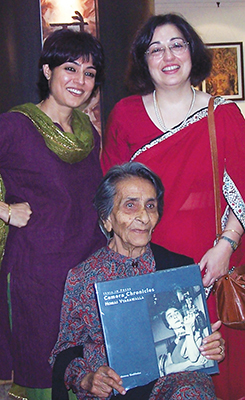
Cama at the launch of Homai Vyarawalla’s (seated) book with Sabeena Gadihoke
Cama at the inauguration of the Jio Parsi program Photo: Jasmine D. Driver
Parzor preserves
"Why are Parsis hell-bent on committing suicide?” asked C. L. Sharma of UNESCO in 1999. Director General Federico Mayor of UNESCO Paris allotted an extra budgetary funding of $ 4,500 (Rs 2,99,835) to create a project for the preservation of Parsi heritage under Cama’s leadership.
Soon, thereafter, Cama and her father, Lt Gen Adi Sethna (Retd), undertook a mission to Surat, Navsari and Bharuch to familiarize themselves with the intangible culture of our community. In the 15 years since its inception in 2002, the Parzor Foundation has succeeded in documenting the rituals of Tanka water harvesting, special embroidery, songs and folklore, the recitation of rituals and ceremonies by the priests, and most importantly, microfilming and preservation of valuable manuscripts at the First Dastur Meherjirana Library in Navsari.
Guided by patrons such as Fali Nariman, Dr Karan Singh, Dinshaw Tamboly, Minoo Shroff, Tirlochan Singh and council members such as Prof Armaity S. Desai, Dr Kapila Vatsyayan, Dadi Pudumjee, Ava Khullar, Dr Niloufer Shroff and Ashdeen Lilaowalla, Parzor draws upon their experience in the worlds of law, education, culture and management.
The Return to Roots Project, co-chaired by Cama and Aban Marker Kabraji, director, International Union for Conservation of Nature, Asia, exposes young adults from the diaspora to their Zoroastrian and Parsi ethnic roots in India. To stem the decline in the Parsi population in India, the Central Government funded Jiyo Parsi program was created and run by Parzor with the support of the Bombay Parsi Punchayet, and social scientists and counsellors from the Tata Institute of Social Sciences. "After two years of field work we have realized what the Indian Council of Medical Research had predicted, that to reverse the Parsi population decline, advocacy more than medical intervention is required,” stated Cama.
Not one to rest on her laurels, Cama will be pursuing her compilation of the collected works of Dastur (Dr) Firoze Kotwal with Firoza Punthakey Mistree and Cashmira Bengali. The Sangeet Natak Akademi Project on Parsi Theatre continues under her active leadership as does the Google Cultural Institute Online Exhibitions to spread knowledge, with the help of Vanshika Singh and Mahtab Irani. She will also be lending her expertise to the establishment of centers for Zoroastrian studies.
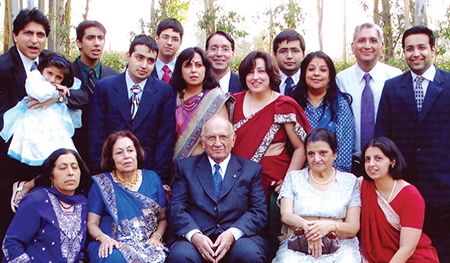
Cama with her parents, siblings and family
Cama with Jehangir
Reflecting on the religion
Born in Ahmedabad, Shernaz studied at 11 schools all over India, as she travelled on Army postings with her parents, Adi and Khorshed Sethna, her sisters, Niloufer, Rukshana and Shireen. She gives credit to her grandparents, Jollie and Phiroze Vakil of Ahmedabad and Meherji and Dollmai Sethna for instilling in her a deep and quiet faith, duty towards those less fortunate and an interest in Parsi traditions. She associates life in Ahmedabad with "the sweet fragrance of sandalwood and roses in the Vakil Agiary… the daily singing of monajats on the large verandah when the loban was taken around each evening.”
Shades of colored embroidery in the cupboards of her ancestral home led to a sensory awakening to the craft that instinctively manifested into the Parzor Foundation’s module on Embroidery Revival and Preservation. Family governess, Gulan Billimoria, taught her wards the reet-rivaj (customs and traditions) of Parsi traditions and the craft of Parsi embroidery. "I witnessed firsthand how Parsi embroidery was a source of livelihood for many women like her,” she reminisces.
Adi had set up a disciplined, multicultural and multilingual home base, teaching his family to value their country and community while also building up their individuality. Khorshed wrote for national magazines and newspapers, was a Cordon Bleu chef and had studied at the Constance Spry School in Windsor, UK learning the intricacies of floral decorations which were on display in all her homes across India. She worked actively for the Army Wives Welfare Association and had authored the seminal book Madame Cama for the Makers of Modern India Series.
Completing her BA degree from Providence College, Coonoor, University of Madras, Shernaz earned her MA and MPhil degrees from the Delhi University. In 1984, she left for the UK to undertake a comparative study on poet William Blake and the Zoroastrian tradition under Dr Kathleen Raine of the Temenos Academy and Prof Mary Boyce of SOAS. Working in the Department of Prints and Drawings at the British Museum, she discovered several plates on Zoroastrian themes, full chapters from Zoroastrian texts and even an engraving of Persepolis with Blake’s signature. This led to her PhD dissertation on "Blake and Zoroastrianism” and helped her understand the influence that the ideas, symbols and history of Zoroastrianism had on the German, French and English Romantic writers. She unravelled how this ancient religion and culture had influenced the thought and entered the poetry of Robert Southey and Byron among others. "How little we Parsis know of our own faith and culture,” she mused, as she began studying the Zoroastrian religion and culture in greater depth.
On her return to Delhi, Shernaz embarked on a teaching career at the Jesus and Mary College, and subsequently as professor in the Department of English at Lady Shri Ram College where she also teaches the Greek and Indian classics as part of intercultural courses. During her three decades in the teaching field she has served as a research advisor at the Centre for Professional Development in Higher Education, University Grants Commission, and has lectured teachers at Jamia Millia Islamia University, Ashoka University and been an advisor on Teacher Training Courses all over India. She is also on the Fulbright Research Committee as director for Zoroastrian Studies in India. Besides serving on the executive board of the International Temple of Understanding, she is a trustee of the Indian Spinal Injuries Centre.
"Striking a balance in two life paths comes with great difficulty and at the price of health and family time,” recognizes 58-year-old Cama, who when researching for her PhD was also involved in raising her infant son Jehangir. As a single mother who had to cut down on social engagements and entertainment to spend more time with her son, she appreciated the support rendered by her parents. Currently 28-year-old Jehangir works as a post-doctoral researcher at the Maxwell Centre, Cavendish Laboratories, University of Cambridge, UK. Jehangir has a PhD in the Physics of Bio-Medicine from the Trinity College, Cambridge, is a concert level pianist and Commonwealth and Goldman Sachs Scholar, conveys the proud mother.
"Teaching the Indian and Greek classics, 18th century poetry including Blake and modern mystical poets like (William Butler) Yeats and their symbolism will be a passion until I retire,” reveals Cama who also nurtures another wish — "to be a grandmother!”