A landmark salgirah of South India’s oldest fire temple
was an occasion for celebration and reflection
Farrokh Jijina
The eight clocks in the fire temple hall were synchronously and gently chiming the hour, 10 a. m. on July 31, 2022, when six mobeds led by Dastur Keki Ravji Meherjirana assembled for the jashan to mark the 175th salgirah of the Seth Viccaji-Seth Pestonji Meherji Parsi Fire Temple in Secunderabad. Chandeliers gleamed over the heads of the over 300 humdins gathered to pay homage to the oldest of three consecrated fires in the Hyderabad-Secunderabad area, and indeed in all of South India. Bouquets of red and white roses interspersed with green on the window sills added a touch of discreet beauty to the L-shaped hall. The tip-top condition of the agiary, down to the shiny door hinges was the result of a three-and-a-half-month renovation project undertaken by the Old Parsi Fire Temple Trust and included the installation of two lamassus (winged bulls) at the entrance and a ramp for wheelchair access.
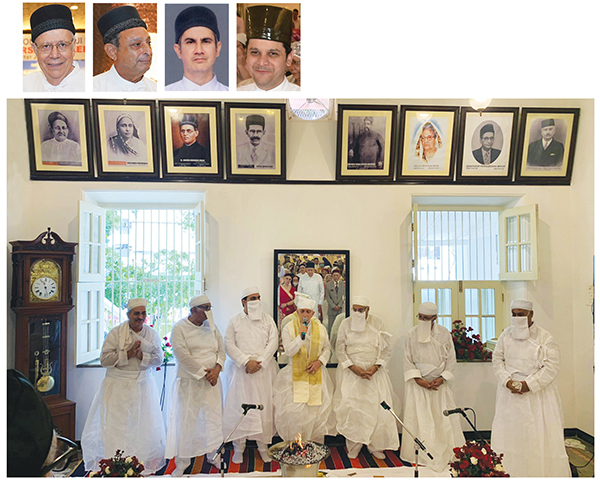
Top, from far l: Capt Kayarmin Pestonji, Cyrus Irani Photos: Charann Pallati; Zubin Viccajee, Kaizad Pestonji Photos: Dr Keki Turel;
above: mobeds after jashan, with Dastur Keki Ravji Meherjirana (center) in portrait lined hall Photo: Kersi Deboo
Seths Viccaji (l) and Pestonji Meherji
Besides the jashan, which was followed by a group photograph of all those who had gathered, and an elaborate brunch at the adjoining Parsi Dharamshala, the salgirah celebrations included a formal evening with 10 guests of honor, all high achieving community members from across the country, and a community dinner at Le Palais Royal, a party venue. The earlier evening had seen a select gathering of friends and well-wishers of the endowing family for dinner at the Dharamshala, and a tour for interested guests to see, among other monuments, the building that stands in place of the Meherji brothers’ original residence.
The mobeds who participated in the jashan were drawn from all the three fire temples of the twin cities: Ervads Jehangir and Peshdad Pilcher and Bomi Karanjia from the Meherji Fire Temple; Kerfegar Antia and Mehernosh Bharucha from the Bai Maneckbai Nusserwanji Chenoy Fire Temple and Aspi Patel from the Khan Bahadur Edulji Sorabji Chenai Anjuman Daremeher.
President of the board of trustees of the Meherji fire temple Capt Kayarmin Pestonji, great-great-grandson of Pestonji Meherji who founded the fire temple with his brother Viccaji on roz Behram, mah Aspandarmad in 1847, initiated the formal celebrations with a brief history of his ancestors. After a successful innings as pioneers of the cotton trade, laying cart roads between the Nizam’s dominions and the Bombay Presidency, they served as bankers to the Nizam and founded three fire temples and four dakhmas in places they lived in and worked. But when the brothers fell out of favor with the ruler in 1845, they had to "sell everything they owned except the agiaries and the dakhmas,” narrated Kayarmin. "I am tall,” he stated, referring to his imposing frame, "but the brothers stood taller,” he added.
The agiary trust was formalized in 1959 and Kayarmin became a trustee in 1992. Disputed property measuring 1,500 sq yards "that was practically lost” has been retrieved after protracted legal wrangling and "will be developed and used for the benefit of the community,” announced the president to applause. "I am a product of the R. D. Sethna Scholarship Fund… They gave me a loan to complete my pilot’s training…I hope to set up a similar fund….in a much smaller way.” Their board of trustees include Kayarmin’s son Kaizad, Kayarmin’s nephew Zubin Viccajee and Cyrus Irani.
Chief guest, retired Bombay High Court Justice Shahrukh Kathawalla alluded to the "power and potency” of the consecrated fire. "It fills me with pride and reverence that our forefathers fled their homeland with only one mission (to preserve their faith),” he stated. A proponent of "no priests, no religion,” Kathawalla stated we owe a debt of gratitude to our clergy, adding that they "should set the benchmark for righteousness.” Also, as an adherent of following Zoroastrian rituals, the judge said that "charity is a poor substitute for getting kriya kaam (religious ceremonies) performed... I do not agree that trust property cannot be sold,” he opined. "If there is encroachment or daunting expenses, we should be open to selling,” he stated.
Ravji reiterated that a consecrated fire was the son of Ahura Mazda. "It occupies a central position in Zoroastrian philosophy and theology,” he stated. A short history of atash behrams in India followed.
"Everyone is worried about the Parsis, except the Parsis,” quipped vice president of the National Minorities Commission Kersi Deboo, alluding to the work of Parzor’s Jiyo Parsi program that is attempting to increase birth rates in the community. He believed that the binding element for Parsis is "not the sudreh, not the agiary…but the Gujarati language.” Deboo referred to the Nizam’s confiscation of the Meherji brothers’ property. "My masi (maternal aunt) would have cursed the ruler ‘Khaatlé pari né khaajé (May you not enjoy the property while lying on a bed)’… see what happened in 1948… he lost his provinces,” indicating that the brothers were vindicated after a century!
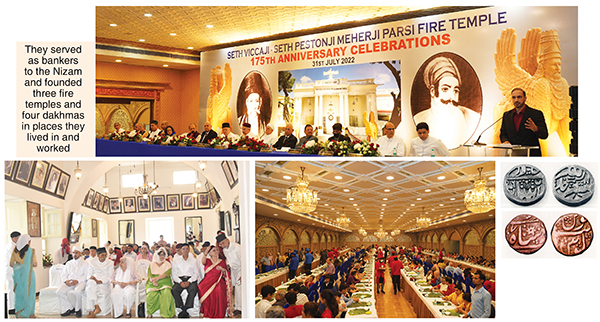
Top: trustees, well-wishers and guests of honor Photo: Charann Pallati;
above l: devotees at the jashan Photo: Dr Keki Turel;
community dinner Photo: Charann Pallati; silver and copper siccas
Lawyer Zerick Dastur believed that a consecrated fire "has an aura that attracts Zoroastrians like a magnet… Our agiaries, atash behrams and dakhmas are the pillars of our religion.” Dastur recalled recent instances of unity displayed by the community: voicing protests when a Metro line was proposed to pass under two of Bombay’s atash behrams and the struggle to obtain dakhmenashini for those who succumbed to coronavirus.
"There is a tendency (in the community) to bask in the glory of our past generations… We need to imbibe the good qualities of our forefathers… We do not find entrepreneurs in the younger generations,” believed eminent neurosurgeon Dr Keki Turel whose paternal grandfather Hormusji was a panthaky at the Secunderabad fire temple. When Turel was in medical school, 15 in a class of 25 were Parsis. Today "hardly three or four students” enter the medical field each year.
Air Chief Marshal Fali Major (retd) stated the community spirit at the evening function was "outstanding.” But in Bangalore the response of the youth to initiatives of the local World Zarathushti Chamber of Commerce Chapter is "very, very disappointing… Our community is known for philanthropy...Future generations should add to that.” The former chief of the Indian Air Force was navjoted at the Meherji Fire Temple, he noted. "It was then referred to as the junni (old) agiary.”
"I have never read a religious book in my life,” noted Maj Gen Cyrus Pithawalla (retd), an Ashok Chakra and Vishist Seva Medal awardee. "But I would like to give you a soldier’s perspective of religion…I would do aarti (light a lamp) before the deity on behalf of my battalion before an (army) operation and give thanks after its successful completion… In the army we honor the religious practices of the troops.” Referring to the credo of good thoughts, words and deeds, the serviceman said that one’s words should be those that uplift and encourage.
Entrepreneur-philanthropist Piruz Khambatta of Pioma Industries, the pioneering soft drink concentrate manufacturer, said he "felt good to be with so many Parsis... Modernity is the new wave… when it comes to religion I prefer to stick to traditions.” A resident of Ahmedabad in Gujarat state, he said he was inspired by Mohandas Gandhi. "I run my company (Rasna) as a trust… We made in India much before it became fashionable,” he said, referring to the union government’s thrust on local manufacturing.
According to World Zoroastrian Organisation Trusts chairman Dinshaw Tamboly, the community has a "brilliant past, a reasonable present and an uncertain future.” Stating that there are only 150 practicing mobeds below the age of 60 in India, he said, "What do we do about the keepers of the flame… It is a very serious situation…Footfalls in fire temples are diminishing…What will happen to these institutions 25 years down the line?” Tamboly estimated that at the turn of the 21st century, there will be less than 10,000 Parsis left. "No single institution can help us…It has to be a collective effort.”
Senior journalist and author Bachi Karkaria said she would talk about the three mantras that have guided her. The first, given to her by her journalist father Naval Kanga was, "Make your own sunshine.” It was a guideline she made full use of when temporarily "exiled to a corner of The Times of India.” She used the posting for self-development. "Be sensible…If you are flexible you do not break,” was her second guiding principle, and the third, given to her by her mentor, journalist and editor Khushwant Singh, "Take your work seriously, do not take yourself seriously.”
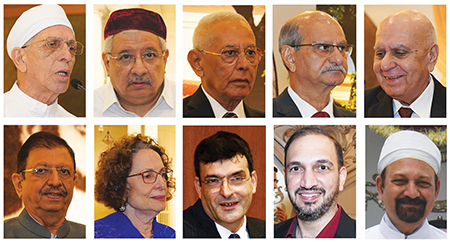
From l, 1st row: Ravji, Justice Shahrukh Kathawalla (retd); Air Chief Marshal Fali Major (retd);
Maj Gen Cyrus Pithawalla (retd); Dinshaw Tamboly; 2nd row: Kersi Deboo, Bachi Karkaria;
Piruz Khambatta, Zerick Dastur Photos: Charann Pallati; Dr Keki Turel Photo courtesy Dr Turel
Irani’s vote of thanks mentioned the dignitaries, donors, vendors, and trustees of sister trusts in Hyderabad-Secunderabad while Kayarmin made a special mention of contractor-architect Hanoz Icchaporia who fabricated the newly-installed lamassus at the Fire Temple entrance; Jehangir Bisney, trustee of the Parsi Zoroastrian Anjuman of Secunderabad and Hyderabad and his daughter Arnaz for their overall support; logistic support provider Jimmy Hormusji; Tehmasp Bharucha for his supervision of the renovation; Antia for his overall guidance; and Farrokh Patel for distribution of the souvenirs.
The event was compered with aplomb by Mehernavaz Aria whose company Star Events also planned and managed the evening. As she summed up, "Our guests are inspiring figures who wear their successes lightly.” A sit-down Hyderabadi dinner served on banana leaves followed.
Kayaramin’s parting words resounded with many present: "Memories of today will last forever… and the agiary will stand for many, many more years.”
Of cotton and compassion
"We are the first generation to go into business after Seths Viccaji and Pestonji Meherji” who endowed the eponymous fire temple in Secunderabad, narrated Kayarmin when speaking to Parsiana after the jashan.
"We were not born with a silver spoon… Our father Ferozshah was a very, very honest ICS (Indian Civil Service) officer… our parents made sure we had a stainless steel spoon…that is 10 times better….We had to earn our living,” he stated. "Crazy” about cars and motorcycles, the young Kayarmin ended up being a commercial pilot. A flight instructor for the Andhra Pradesh government, Kayarmin entered the garment business in a big way as the result of a challenge. Brother Dadafrid was in the textile business in Bombay. "He told me I could partner with him if I could sell some excess clothing material that he had landed up with.” When two truckloads of goods arrived in Hyderabad, wife Gool told him, "We will have to move out of the house to store it,” Kayarmin reminisced. "I did not have one iota of an idea how I would sell the material, but I knew 100% I was going to do it.” Sales held in the gymnasium of a nearby school with the help of students from his flying school ensured that the goods were sold expeditiously. This was the beginning of his four Cherma’s textiles stores, a portmanteux of the names of daughters Cherazad and Maniza. A range of men’s wear is named Kaijas, a combination of the names of son Kaizad and daughter Jasmine.
A national seeded motor rallyist, Kayarmin won the first Himalayan Rally in 1980 and has served as member of the Andhra Pradesh Minorities Commission 1991-94. He is also president of the Dr Nania Educational Trust which provides cosmopolitan assistance to the deserving, notes his curriculum vitae.
"You do not look at what you are going to get (out of an endeavor)… You put your heart into it…Upperwala na blessings thi baddhu thai (everything happens with God’s blessings),” believes the 73-year-old businessman.
"The corpus of the Fire Temple Trust was negative when I took over” in 1992, he stated. "I went to each tenant’s home personally and asked how much of a rent increase each could bear.” Rents of the residences that surround the agiary were then equalized, the resulting increase allowing the Trust to build new residential blocks in 1995. "When you explain the facts, people agree to your point of view…Bullying does not work,” Kayarmin opined.
"Now let me tell you about my ancestors,” stated the Trust president. Hailing from Tarapore, brothers Viccaji (1783-1854) and Pestonji (1798-1853) came to Hyderabad and went on to become renowned merchant princes and philanthropists in the 1830s (see "A memento of the Meherjis,” Parsiana, November 1997). A dadgah was first established in Secunderabad in 1839, later to be housed in a new building in 1847 on roz Bahram, mah Span- darmad, noted a brochure to mark the 175th salgirah. The duo endowed a dar-e-meher in their hometown Tarapore in 1820 and in Sholapur in 1845, both in Bombay Presidency, now Maharashtra. Dakhmas were built in Balapur (1839), Aurangabad and Sholapur (1842) and Hyderabad (1839).
Pioneering farmers and collectors of customs duties in Northern and Southern Konkan, Poona, Sholapur, Ahmednagar and part of Khandesh, the brothers shipped cotton from Berar in the Nizam’s territories to Bombay by bullock carts as an experiment. This was a tremendous success and they followed this up by erecting cotton presses and screws at Khangam and other cotton-growing districts. The trade reportedly grew from 500 bullock cartloads of cotton in 1825-26 to 200,000 cartloads in a decade.
Invited by Maharaja Chundoolal, Prime Minister of the Nizam to open banking firms in the province in 1836, within two years the firm of Pestonji Viccaji became the princely state’s principal banking house. They loaned money to the Nizam’s government for state purposes including expenditure on the military forces. "To liquidate the advances made by the firm of Pestonji Viccaji, the Nizam entered into an arrangement whereby the revenue of Berar and Aurangabad were mortgaged to them,” states a press note prepared by the Trust.
While entrusted with the Aurangabad Mint, the brothers maintained a "small armed force” and were "permitted to have their own initials and marks engraved on coinage.” The souvenir notes that over one crore Pestonshahi siccas (coins) in various denominations were minted from silver and copper between 1832 and 1842. The coins carried the Nizam’s initial, the Persian letter Noon (N) for Nasir-ud-Daula. Later, the coins had the initials of the Meherji brothers. Pestonji introduced the popular mark, "resplendent sun,” on the coins he minted. "Only a few original coins remain now… Four of them are on display in the British Museum in London.” (Replicas of the coins, mounted on a plastic stand accompanied by a bust of prophet Zarathushtra arrived at the Parsiana office along with the invitation to cover the salgirah events. The figurine was donated by erstwhile member of Andhra Pradesh State Minorities Commission member Gusti Noria and his family.)
The Meherji brothers reportedly fell out of favor with the Nizam in 1845. When Chundoolal was succeeded as Prime Minister by Raja Rambuksh, the firm was "ordered by the Nizam to relinquish and restore all assigned taluqs (provinces) held by them.” Despite a favorable settlement in appeal, with the intervention of the British authorities and sympathetically disposed nobility, "their dues were not paid… The process of ejectment resulted in bloodshed and casualties on both sides… Driven to the verge of despair, some years later a member of the family went to England and laid his complaint before the British Parliament.”