The North American Mobeds Council is striving to bring meaning to the faith
Text: Parinaz M. Gandhi Photos: Jasmine D. Driver
We are losing the market share… No one is losing as much as Zoroastrians,” observed Ervad Arda-e-Viraf Minocherhomjee, president of the North American Mobeds Council (NAMC), advocating the need for the community to "design products for the future… The younger mobeds have different expectations… The model in India doesn’t work here. The two generations have different spiritual needs. The older generation want gahanbars, jashans and religious ceremonies, the younger generation want to know the meaning of prayers… Zarathushtis born here have different values from those not born here…To make religion relevant in daily life” is the goal of NAMC. Minocherhomjee was addressing those present on the second day of the annual general meeting (AGM) of the Federation of Zoroastrian Associations of North America (FEZANA) in Orlando on May 4, 2019.
The community would better meet its religious needs if all remember that "we are Zarathushti first, not mobed/osta/behdin,” he commented. Rather than have only hereditary mobeds, "anyone should be able to become a mobed,” suggested the NAMC president. Mobedyars trained in North America come under the NAMC banner. They have been granted observer status with no voting powers.
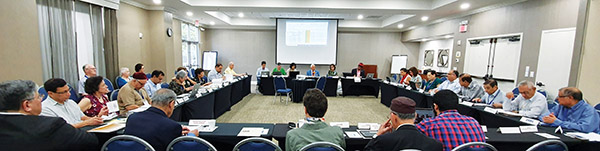
FEZANA annual general meeting in progress;
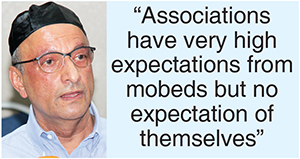
below: Ervad Arda-e-Viraf Minocherhomjee
"The younger generation of mobeds must be educated. Make sure they are provided tools,” he was insistent. Having already raised USD 50,000 (Rs 35,85,725) to provide fellowships for continuous education of young mobeds, he recommended the need to institutionalize the process. In favor of empowering mobeds, making them accountable, delineating religious and cultural functions, he added, "Young mobeds should come up with plans for the future.” Working in synergy with associations was the way forward for NAMC, he recommended. "Once we teach, you guys need to follow up” to ensure the priests best serve the community, he impressed on the association representatives.
"The product here being religion which cannot be changed,” he felt "we could change the packaging… Older mobeds can’t change. My wife has been trying to change me for 35 years… We can influence the younger mobeds. Teach them what we pray and why we pray. We can continue collaboration with scholars from India.” To explain the degree of changes required, he drew a metaphor to "a patient requiring heart surgery but is not even willing to go for angioplasty.”
Ervad Soli Dastur from the Zoroastrian Association of Tambay, Florida pointed out that there must be over 200 ordained navars in North America, 150 of them being old, and 50 young. He commented on the willingness of North American priests to face reality: "We are in a different place and don’t put our heads in the Chowpatty sands.”
NAMC being established in Canada, there should be a place in USA too where donations can be directly given, suggested Dr Behram Pastakia of Washington. Zoroastrian businessmen and professionals can even donate business travel miles as a resource to aid priests who need to travel distances to render honorary religious services, he added.
"Our generation wanted to be right with God. This generation wants to live well,” observed FEZANA founder president Rohinton Rivetna. He felt NAMC should introduce policies for mobeds as also recommend to the laity what prayers/rituals could be adopted in daily life.
"Associations have very high expectations from mobeds but no expectation of themselves,” noted Minocherhomjee, reminding Rivetna that when four mobeds visited Chicago at a cost of USD 2,500 (Rs 1,79,286), there were only 12 members of the community in attendance at the religious session. He suggested they could adopt a new slogan: "Ask not what mobeds can do for you but what you can do for mobeds.”
There are three Zoroastrian associations in Northern California with more than 1,000 families sharing one mobed, Ervad Kekobad Jamshed, stated FEZANA past president Bomi Patel. If he is traveling there is no mobed and in case of death, a priest from South California is required to take over. "If anyone is willing to relocate we could help him find a job and other facilities,” he offered.
Arman Ariane, president of the California Zoroastrian Center (CZC), recommended that music should be woven into religion, more so since "our prophet gave his message in poetry.” With the emphasis on rituals in India, and the rationale of prayers in North America, celebration of gahanbars and festivals as practiced in Iran could perhaps bridge the current divide, felt Mahrukh Motafram of Seattle. Minocherhomjee related his experience in Vancouver where the "very strong leadership of Mehraban Zartoshty and Jamshed Pavri kept us together” despite the Farsi/Gujarati language differences.
Association anniversaries
Different Zoroastrian associations in North America have reached landmark anniversaries in 2019 as reported during the FEZANA meeting. Most of the association representatives present had sent in their PowerPoint presentations earlier that were screened to give those present a visual experience of the activities undertaken.
Above (from l): Astad Clubwala, Bomi Patel, Hosi Mehta, Behram Irani, Arman Ariane, Homi Italia, Darius Captain
Clockwise from top: Anne Khademian, Katayun Kapadia, Percy Master, Jimmy Dubash;
activity reports from Pennsylvania and New Jersey; Florida; Houston and Washington
Clockwise from below l: Dr Dolly Dastoor, Ervad Soli Dastur, Houtoxi Contractor,
Afreed Mistry; activity reports from Ontario; California; Tambay; Quebec
Above, from l: Dr Behram Pastakia, Mahrukh Motafram, Rohinton Rivetna
The Zoroastrian Association of Metropolitan Washington Inc (ZAMWI) is in its 40th year, reported president Anne Khademian. ZAMWI @ 40 has planned a series of events to celebrate their history, culture, faith, traditions, community and future: Mosaics of a Zoroastrian Landscape, Appreciation Night for priests and volunteers, outdoor celebration to be followed by a grand gahanbar in November. Congressman Jamie Raskin of Maryland was present for ZAMWI’s 40th anniversary opening event. Montgomery county executive Marc Elrich proclaimed March 21 the Day of Nowruz.
At their Kamran Dar-e Mehr, they would like to complete construction of the prayer room, kitchen, storage and security in the current year. They have four standing committees coordinating their activities: the arts and performance council that was endowed with USD 40,000 (Rs 28,68,580), Dar-e Mehr operations committee, women’s group (Sazeman-e Zanan), and the youth and community engagement committee. Ervad Kurush Dastur has been appointed as ZAMWI’s first full-time mobed. He is the secretary of NAMC. Their regular events include Avesta class on every alternate Sundays and engaging with the interfaith community.
The Zoroastrian Association of Pennsylvania and New Jersey too celebrates 40 years in 2019. They have nearly 150 individuals living in this area and they are led by a "new board of young Zoroastrians,” reported former FEZANA president Katayun Kapadia. Their annual activities include a picnic, celebration of Jamshedi Navroz and Shahenshahi New Year, jashan and gahanbar, the Remembrance Day when families bring photos of their dear departed members, light a tealight candle and come together during the Prayer Class in September.
The Zoroastrian Association of Northern California with "a good, vibrant community of 500 families” will be celebrating its 35th anniversary in November 2019, noted Patel. Their regular activities include Sunday School, quiz, yoga, craft class, celebration of annual gahanbar and even a session teaching children how to make websites for after all they are located in the Silicon Valley! The sister organization, the Persian Zoroastrian Organization has over 500 families too.
The Zoroastrian Association of North Texas celebrates its 30th anniversary this year, mentioned Behram Irani, chair of ZANT’s fundraising committee. Their community comprises over 200 families and includes five mobeds. He referred to young Burzin Balsara cycling 4,500 miles from Austin to Alaska as part of the longest annual charity bike ride to express his solidarity for cancer research.
The Zoroastrian Association of Florida (ZAF) had planned a grand silver jubilee function on August 17. ZAF has 150 members, covering 85 families including 25 children, reported president Jimmy Dubash. They have five mobeds who perform ceremonies on Navroz, Shahenshahi New Year and annual gahanbar. Bingo, bowling, picnic and outdoor event for children are all subsidized by the Association. At their religion class, "we not only teach Zoroastrianism but we also follow the Zoroastrian way of life.” Once a year the Association provides wool and those attending the class weave blankets that are donated to a local children’s hospital. Blessings in a bag is another project where daily use toiletries are assembled in different bags for distribution to the homeless they encounter along the way.
CZC is the biggest Iranian Zoroastrian association outside of Iran with "different challenges and aspirations… Immigrants come with high expectations,” reported Ariane. "My association is not as connected to FEZANA and the rest of North America as the others. I am trying to change that.” He referred to the financial support and guidance of philanthropist Dariush Irani to help Iranians settle in North America. "For my religion, I will give to my last dollar,” pledged Dariush who was sitting next to Ariane. There is regular celebration of gahanbars and religious functions at CZC. At panel discussions, low attendance is a common feature whilst social functions are sold out.
The Zoroastrian Association of California (Los Angeles) covers 400 community members with diverse activities, stated president Houtoxi Contractor. Weekly humbandagis, cooking dhansak every weekend, monthly religious classes attended by 15-20 children, celebration of paravs and gahanbars, including gratitude gahanbar, second anniversary celebration of the atash kadeh, religious talks were some of the highlights. Additional activities during the year included Bone Marrow Drive, Sports Day, camping by the beach, recognition of graduates, community service, movie, chaat and bingo nites, Halloween party and community service in the form of Helping Hands initiative to assist seniors living alone or in hospitals. They were fortunate to receive a legacy donation of over half a million dollars from Dr Nergish Surti.
The Zoroastrian Association of Greater New York (ZAGNY) and the Iranian Zoroastrian Association (IZA) work together harmoniously, sharing the property and expenses of their Dar-e-Mehr that was inaugurated three years ago, conveyed president Astad Clubwala. Religion classes, youth camp, summer picnic, observation of muktads are regular events. They were appreciative of the venerated scholar Prof Kaikhosrov Irani who gave his last talk at ZAGNY in March 2017 at the age of 95, and after his demise three months later had bequeathed his assets of USD 2.6 million (Rs 18,64,57,700) to community bodies, including ZAGNY. Rather than wait for board meetings, they now take effective decisions by consulting members via WhatsApp. They are preparing to host the 12th World Zoroastrian Congress in July 2022.
For the Zoroastrian Association of Houston (ZAH), the Bhandara Atash Kadeh inaugurated this year continues to draw members regularly, stated FEZANA and former ZAH honorary secretary Percy Master. Every day a priest from their volunteer corps comes and tends the fire. Zoroastrian camps are held regularly and gahanbars continue to be celebrated with felicity by the community that numbers over 300 and has more than 20 priests. A jashan is held every Bahram roz. Zoroastrians from all over North America were invited to the next North American Zoroastrian Congress that ZAH will host in December 2020.
Seventy-seven percent of the board members of the Zoroastrian Association of Chicago are around 40 years of age, declared past president and current director Hosi Mehta. With the new board taking a fresh look at activities, a Goodness Center, meditation and yoga are some of their recent features. Under their Ava Project they installed new water lines connecting their community center to the city main line and the sanitary/sewer pipe. They have been sponsoring a lot of priests through the years. A retirement home for senior citizens and a mobed building is on the anvil once they pay off their loans.
Nearly 25 families participate in the Navroz function and picnics organized by the Zoroastrian Association of Tambay, said Dastur. As per their understanding, there are always potluck meals that the families share. At a jashan that he conducted, "10 non-Zoroastrians asked me questions, not Parsis,” he revealed. The Association conferred the Distinguished Scholar Award to Dastur and his wife Jo Ann.
The first community organization to be formed in North America was the Zoroastrian Association of Quebec, stated former FEZANA president, Dr Dolly Dastoor. Their regular events include celebration of gahanbars and jashans where Iranian and Parsi snacks are served. They also launched a food drive ahead of winter to distribute packets to needy families in their area. On Christmas and Navroz they distribute gifts to members’ children. "We are on social media,” she informed the FEZANA members.
As the second oldest association in North America, the Zoroastrian Society of British Columbia celebrated its 50th anniversary last year with Persian and Indian dances, and a sizable attendance from the community, stated former president Homi Italia. Religious programs are promoted through the Sunday School and muktad prayers are held in August. A session for seniors on the third Sunday of each month involves exercise, fun and lunch. The 123rd Vancouver Zoroastrian Scouts was launched last year.
In a year the Zoroastrian Society of Ontario uses its Darbe Mehr for 210 days, mentioned executive vice president Afreed Mistry. To save electricity costs they installed LED lights on the premises. Their weekly and monthly activities include seniors’ events, Avesta and religion classes, choir practice and music class, celebration of gahanbars and New Year according to Fasli and Shahenshahi calendars, food fairs, games and karaoke nights, yoga and scouts activities. Some of the young girls donated their long tresses for charitable causes.
The four-year-old Sacramento Zoroastrian Association inaugurated its Darb-e-Mehr in 2017 and its Center in 2018, noted director Darius Captain. The Association’s bid to host the 2020 FEZANA AGM was accepted.
The FEZANA AGM report will be concluded in a forthcoming issue of Parsiana.