Once a commercial hub for Parsis, the islands
off Africa now have only one family living there
amid vestiges of the past
Khursheed E. Eduljee
Five thousand kilometers southeast of Bombay on a Zanzibar island stands the quaint Tembo Hotel — a hotel that once housed the offices of the Cowasjee Dinshaw Brothers of Aden. It is located in the old capital of Zanzibar now called Stone Town, the present old quarter of Zanzibar City. The islands of Zanzibar are situated off the central-eastern coast of Africa.
According to Prof John Hinnells, the first Parsi to do business in Zanzibar was an agent of Seth Kamani. That was around the year 1830. On arriving in Zanzibar, Kamani’s agent was so appalled with the Arab slave trade that he promptly left the island. Kamani’s business went bankrupt. Rather than accepting charitable help, Kamani sold everything he owned and dutifully paid off all his creditors. The Muslim Sultan of Oman, Seyyid Said, who had just moved his capital to Zanzibar from Muscat, then ruled Zanzibar which had been a onetime colony of Oman.
Entrance doorway (ext right) to the Tembo Hotel (left) Photos: Jimmy Master
The records of Hoshang Kased, secretary of the Zoroastrian Anjuman of Zanzibar, chronicle that the first Parsi to take up residence in Zanzibar was Maneckji A. Mistry, a member of the Wadia family and a trader from Surat. Mistry arrived in Zanzibar around 1845, not as a trader or professional, but as a fugitive from the law. In Surat, he had hit his European senior at work, an offence for which he would have been executed had he not escaped in one of the Sultan of Zanzibar’s ships. Now in self-imposed exile, Mistry built up a business in Zanzibar and eventually brought over his wife and children.
In his 1857 book Zanzibar (published in 1872), Sir Richard Burton (1821-1890) wrote, "The late Seyyid Said was so anxious to attract Parsis who might free him from the arrogance and annoyance of white merchants that he would willingly have allowed them to build a Tower of Silence, and to perform, uninterrupted, all the rites of their religion.” (According to Hinnells, the Tower of Silence was never built and the Parsis used a cemetery instead.)
Following Said’s death in 1856, his sons disputed who should rightfully succeed their father. The elder brother Majid prevailed and exiled his younger brother Barghash to Bombay. There, Barghash made his home amongst Parsis on Parsi Bazaar Street in the Fort district. Barghash got to know the Parsi community fairly well, including notables such as K. R. Cama and Maneckji Cursetji. The former was a sethia who had financially supported the creation of the Rahnumai Mazdayasnan Sabha, a progressive Zoroastrian organization with Dadabhai Naoroji as its secretary. This association between a wannabe Sultan and the Parsis would result in some strange bedfellows: a Muslim ruler working closely with — and seeking the professional assistance of — Zoroastrian Parsis.
Sultan Barghash with his ministers
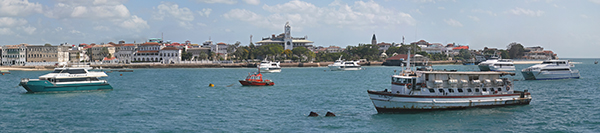
Clockwise from top left: An old castle in Zanzibar; a narrow alley in Stone Town;
a street in the city during the early 20th century (Photos: Wikipedia)
The Parsis’ association with Zanzibar began in earnest when Barghash became Sultan of Zanzibar following the death of his brother Majid in 1870. Barghash brought over a number of Parsi professionals to help him modernize and build Zanzibar into a robust trading and commercial hub.
While Zanzibar had been growing in this manner with Parsi assistance, another trading and commercial hub some 2,000 km north was being transformed with Parsi assistance as well. That was the port of Aden.
Not long after the British established the colony of Aden in 1839 CE Cowasjee Shavaksha Dinshaw (1827-1900, later surnamed Adenwalla and originally from Surat and Bombay) "arrived in Aden in 1845 and soon transformed the port of Aden into a facility capable of accommodating steamer traffic between the Indian Ocean and Europe.” Cowasjee’s son Hormusji Cowasjee Adenwalla (1857-1939) expanded the family shipping business to East Africa, including Zanzibar.
With the expansion of the Adenwalla shipping routes to Zanzibar, in 1884, the trustees of the tiny Zoroastrian Anjuman of Zanzibar invited the Adenwallas to establish a branch office there — which the Adenwallas did in the following year nearly 200 years ago — some 50 years before Adenwalla, set up their office. For this purpose, it appears that the Adenwallas purchased a building that had been the US consular offices in Zanzibar — the same building that is now the Tembo Hotel. A doorway to the hotel still has "Cowasjee Dinshaw & Brothers 1885” set in relief on the exterior wall above the building’s main entrance.
According to the 46-room Hotel’s web page, "Between 1834 and 1884 it (the building) served as the American Consulate in Zanzibar then passed on to become the trading offices of Cowasjee Dinshaw and Partners. Their headquarters were in Aden and with trading posts in most of the British Protectorate areas it became the largest trading company in the Indian Ocean.” The African Mecca Safaris site goes a step further, stating "…Cowasjee Dinshaw and Partners (was) the largest commercial company in its time.” Given the size of the East India Company, we are not sure if these claims in the superlative can be sustained. However, what they tell us is that the intercontinental Adenwalla enterprise was large by any standard. Going back to the paper written by Indian ambassador Dr Sayeed, we read that in Aden, "by 1846, the Parsis began to move into the gum, hides and coffee trades, and they seemed to be the only members of the commercial community with large enough capital to buy the cargoes of American ships.”
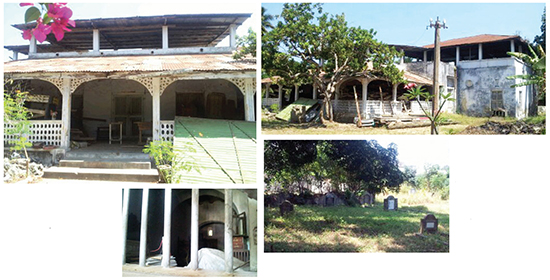
Clockwise from top left: erstwhile agiary in Zanzibar, Zoroastrian cemetery tombstones and view of
interior of structure Photos reprinted with permission from farahbala.wordpress.com
The Tembo Hotel website continues: "Mahatma Gandhi, stayed here a few weeks with the Dinshaw family on his journey back to India from South Africa in 1930. As a rising new star in the British and the world music scene, Freddie Mercury and his family used to retreat to what is now ‘Marashi’ apartment (a suite in the hotel) whenever they came back to Zanzibar on holidays. Next to Tembo House Hotel is what used to be the British Consulate, where in 1874, Dr Livingstone’s body was brought before embarking on its long journey back to England.”
The Tembo Hotel’s interior furnishings remind us of an old Parsi home. The beds are similar to the style of beds with mosquito net post and frame used by Parsis of yore. We can imagine that for many Parsis visiting a place like this would be nostalgic, bringing back a flood of memories. Even the sight of ornately carved wooden balconies overhanging the narrow streets of old Stone Town, or the old wooden doors of two-storey homes sandwiched together make the place seem vaguely familiar.
Who knows how long these vistas will last before the march of time tramples them and the memories they induce underfoot?
As for what remains of the Zoroastrian population of Zanzibar, in a July 22, 2012 blog, Farah Bala informs that on a visit to Zanzibar City that year, she met the last remaining Parsi/Zoroastrian family in Zanzibar: Diana Darukhanawala and her then 83-year-old father (her mother had passed away in 2011). The Agiary of Zanzibar (not far from Stone Town) had been sold to the Muzammill family who owned high end appliance stores in Zanzibar and who were using the dilapidated Agiary building for storage. The Agiary property had included a home for a priest and his family. The Zoroastrian cemetery, attached to the old Agiary property bears the names of pioneers on its headstones.
Can this heritage be reclaimed, or is it already too late?