Career in conservation
"While field work can be physically and mentally exhausting at times, I have had no other experience that is as incredible and humbling. My research camp does not have running water or electricity and consists of several wooden huts which are located in a very remote part of the rainforest [in the Central African Republic (CAR)], allowing one to really integrate with nature,” wrote 24-year-old Anahita (Ana) Verahrami. A research assistant for the Elephant Listening Project (ELP) conducted by Cornell University, she was responding to Parsiana’s request for details on her work. To collect data she needed to daily walk through the forest. "While I have done this walk many times, I still find myself blown away each time from the incredible beauty of the forest, its sounds, and its inhabitants,” she noted.
ELP’s observation site is at Dzanga Bai ("bai” is a local word for a natural forest clearing) that has been maintained by generations of forest elephants and other species who, through a combination of digging and trampling, have thwarted much of the vegetation from growing, leaving an opening in the middle of the rainforest where these animals come to access the rich mineral water flowing underground to supplement their diets with critical nutrients.
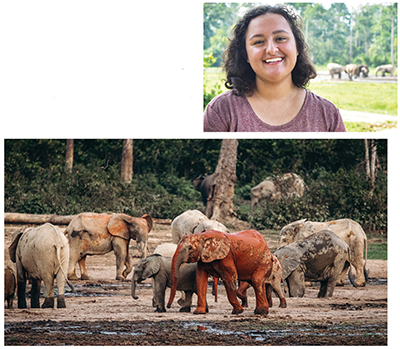
Anahita Verahrami (above) studying forest elephants in the Central African Republic
She referred to ELP’s acoustic recording work that seeks to manage and protect the species by monitoring forest elephants for changes in their behavior and exploring how these changes might relate to anthropogenic disturbances in the area caused by human activity like poaching and logging. Motivated by her environmental concerns, Verahrami has participated in presentations made by the Federation of Zoroastrian Associations of North America at conferences convened by the United Nations.
"As I pursued this career in conservation and was offered my first opportunity to fully immerse myself in nature as a field assistant at Dzanga Bai for four months in 2018, I quickly recognized the similarities between my involvement in conservation and the (Zoroastrian) religion’s teachings of respect for nature. I grew more and more humble. I had learned previously, of course, that humans are just one part of an ecosystem. But from experiencing this balance in practice, without the unfair advantages of technology and concrete to ward off and control natural ‘intruders,’ I soon understood how little of a say I had in how the natural world would impact me. All I could do was adapt,” related the gutsy environmentalist who returned to the forest at the beginning of this year until Covid played spoilsport and forced the research team to summarily evacuate in late March.
Facing terrifying thunderstorms from the confines of her rickety wooden hut, running from charging elephants, or vacating sleeping quarters as thousands of painful driver ants invaded from all directions, she has been emboldened by her experiences. "These moments served as opportunities for me to reflect on my place in the natural world which ultimately reinforced my respect for its beauty and power and my desire to protect it, a desire that parallels well with the Zoroastrian worship of natural elements,” she acknowledged.
One of her projects required her "to spend the night alone on a wooden observation platform in the middle of the rainforest” every three days. Using a thermal camera she would observe the nighttime activity and behavior of forest elephants gathering at Dzanga Bai. When disturbed by sounds of gunshots in the distance, she would resort to praying Ashem Vohu and Yatha Ahu Vairyo and calm her mind with pleasant memories of her Avesta class where the values of good thoughts, words and deeds were instilled in the youngsters, she reported.
"While I must admit that I currently fall on the ‘minimally-practicing’ side of the religion’s spectrum of involvement, the religion and its practices have always held special meaning for me. My Zoroastrian roots have largely informed the professional decisions I have made throughout my pursuit of higher education as well as in my career. From an early age, I was taught by both my parents as well as at the bi-weekly Avesta classes I attended to respect nature and its elements. This combined with the three main tenets of the religion, or what I view as ‘lifestyle choices,’ made it seem like a simple choice to pursue a career that reflected this respect,” stated Verahrami who had initially planned to qualify as a veterinarian until she "stumbled into the fields of ecology and conservation biology and found myself hooked” when taking classes at Cornell University. She is currently completing her Masters in ecology at Colorado State University.
Valuing family fortification for her conservation work she referred to her discussions on signal processing and acoustics with father Farhad Verahrami who is a principal engineer with Viasat, a global communications company. Mother Shehernaz Joshi Verahrami, who is director of Graduate and International Programs at the George Washington University Law School, helped with her supply of international contacts when Ana and her field team had to be evacuated from CAR. Sister Roksana, who graduated this summer from the George Washington University Elliott School of International Affairs where she majored in Economics and International Affairs, encourages Ana to be more involved in the communities where she works, rather than solely focus on the science.
"While my family has been supportive of my work, they have also understandably felt very worried by it. So far, my field work has been conducted in CAR, a magnificent country that is filled with rich natural and cultural beauty, but one that has and is still experiencing the associated hardships from civil war and unrest. As international media continue to mostly highlight stories of violence and war, it is easy to see where my family’s concern stems from as their view of CAR is very different from the one that I have experienced for the most part. As my work in the region continues, I hope to help ease my family’s concerns and continue to utilize the values, knowledge, and wisdom they have instilled in me to catalyze the protection of species and engage in scientific discovery,” she added.