An intensive course in Europe trains participants to teach
Zoroastrian theology, rituals and philosophy
Dorian Gordon Bates
The two-week introductory Hirbadi course to train priests, held in Europe for the first time, was attended by a dozen students. It was intensive and conducted under the directorship of Dr Koorosh Niknam, a scholar and respected community leader in his hometown Yazd, and in Tehran.
The students taking the course were young Iranians living in different European countries (most of them in Germany), a Kurdish scholar from Iran and I. A son and a daughter of Niknam were also taking the course and, if all goes well, his daughter will become the first woman priest in Europe. We were also visited by Shahin Bekhradnia, honorary secretary, World Zoroastrian Organisation.
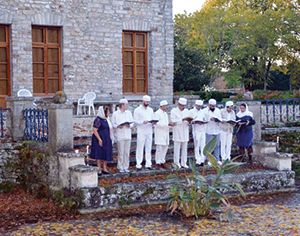
Dorian Bates and two other participants with Mobed Koorosh Niknam
The morning sessions would commence after breakfast. We would begin each study session with our kusti and gah prayers; likewise for the post lunch sessions. Niknam made us learn all the daily prayers of the Khordeh Avesta by heart, the Din-dabireh (Avestan) alphabet and we would read and recite verses from the Gathas. Although he gave explanations about the Vendidad and what it contains, we focused more on the holy Gathas, Yasna and Khordeh Avesta during the two-week course.
As part of the course, Niknam gave long talks on the philosophy and spirituality of the Gathas, explained the significance of the gahanbar ceremonies and how to perform them. He stressed that a gahanbar, an important thanksgiving ceremony held six times during the year, aims to bring people of all walks of life together to share a meal with everyone regardless of their beliefs or social status. He also explained how to perform the initiation ceremony (sedreh pooshi or navjote), gavaah-giri, which is the traditional Zoroastrian wedding ceremony and how to recite the Atash Nyaish. Every morning, he would interrogate us on the lessons we had learned the previous day and asked us to recite the prayers by heart.
We also celebrated the festival of Aban on the Aban day of the Aban month (according to the Fasli calendar). We went to the nearby pond and prayed by the water, throwing milk and flower petals into the water in honor of the water angel, Aban or Anahita. It was a beautiful ceremony.
We were asked to give presentation on a topic of our choice related to Zoroastrianism. It was very hard for me because it was supposed to be in Persian, but I was able to give a presentation in broken Persian on the initiation ceremony and its ritual significance and symbolism, as well as the differences between the sedreh pooshi and the navjote. Other presentations were on the festivals of the Zoroastrian calendar, the life of Zoroastrians in Islamic Iran, Zoroastrian mysticism and the concept of God in our faith.
During the course, we were fortunate to listen to a few lectures by Ervad Kamran Jamshidi who has performed numerous navjotes in various European cities over the years. He gave talks in Persian about Zoroastrian philosophy and asked us to share our own views on different philosophical and theological concepts in Zoroastrianism. Thanks to modern technology, we were also able to interact on Skype with one of the senior dasturs in Iran, Mobed Mehraban Firouzgari, the mobedan mobed of Tehran.
It was a beautiful experience for me to have lived with fellow behdins, although it was sometimes difficult for me to follow due to my low level Persian. Being a 29-year-old English teacher, I am currently studying Persian at the University of Tehran to gain a better understanding of Iranian Zoroastrian culture. Of British and French Origin and a Zoroastrian by choice I converted to Mazdayasna a few years ago.
Niknam believes that it is essential to have a hirbad of non-Iranian origin like myself to show the world that Zoroastrianism rejects racism and is a modern and tolerant religion, and to teach the religion to non-Iranians who may be interested in it. I hope to contribute as best as I can to Mazdayasna and to behdins living in Europe. I hope to build a bridge between Iranian and Western Zoroastrians who are converts like myself, as well as those Iranian Zoroastrians born in the West.
Niknam used to be a representative of Zoroastrians in the Iranian parliament and now divides his time between Iran and France where he serves the Zoroastrian communities of Europe. He is a strict and demanding teacher whose goal is to revive the Iranian Hirbadi tradition that had stopped in the Safavid period. Normally, Zoroastrian priesthood is hereditary. But one problem that the Zoroastrian community faces in modern times is a lack of priests and religious teachers. This is why Niknam took the initiative to train ordinary Zoroastrians living in different European countries to become hirbads, who are junior priests (below the mobed) and teachers or preachers of the religion. While a mobed has an important ritualistic role, the duty of the hirbad is to teach people the theology, rituals and philosophy of Mazdayasna. It is unfortunate that there are few priests in the West and, like Niknam, I believe that by creating a new generation of priests and preachers, Mazdayasna will be strengthened and more organized. It will help unite behdins living in the West, particularly in Europe.
The course could not have taken place without the generosity of Dr Abtin Sassanfar, a wealthy Iranian philanthropist and the founder of the Zoroastrian Anjoman in Paris which organizes regular religious and cultural activities throughout the year. The Anjoman holds celebrations for Iranian festivals such as Norooz, Mehrgan, Yalda and Sadeh, as well as the religious gahanbars (whenever a mobed is available). Sassanfar was kind enough to let us stay at his serene residence, a superb French chateau surrounded by a beautiful park with a pond, in the quiet rural town of Melun, not very far from Paris for the two-week introductory training. It was an ideal place to study and meditate on the Avesta.
I have since heard from one of the participants of the course, Dariush who lives in Germany. He says that he has learned a lot of the Khordeh Avesta, and is learning the Din-dabireh, I am also learning as much as I can, and try to combine prayers from the Parsi liturgy that don’t exist in the Iranian one (such as the Kerfeh Mozd prayer) with prayers from the Iranian liturgy that Parsis don’t recite (such as Berasad).