s we celebrate our work, we must also continue to think ahead. We are at a juncture where we should be able to ‘dare mighty things,’ make progress by leaps and bounds towards our objectives," remarked Homi Gandhi in his presidential remarks on the last day of the annual general meeting (AGM) of the Federation of Zoroastrian Associations of North America (FEZANA) at the Wingate hotel in Orlando on May 5, 2019.
Appreciative of the efforts of member associations to promote hamazori within the community and spread awareness of Zoroastrianism beyond, Gandhi referred to the building of "new community centers and atash kadehs all across our continent. Our smaller member associations are not letting their size deter them either! They are continuing to lay the groundwork for their centers and places of worship, and we will continue to support them!"
(From l) Homi Gandhi, Dr Dolly Dastoor, Bomi Patel, Rohinton Rivetna
On the third day of the FEZANA annual general meeting in Orlando
In the interfaith arena, their work has "increased awareness of FEZANA and our community in the outside world. Our participation here, especially in the United Nations Commission on the Status of Women and annual nongovernmental organization meetings must not stop at advocacy (hukhta). It should be followed up with action (hvarashta)."
To establish strong relationships between various Zarathushti groups, Gandhi stressed on the importance of communicating "in our common language – English – if we truly wish to build bridges within our culturally diverse global community." He did however commend the efforts to pass down cultural identity through the teaching of Gujarati and Farsi.
To support the efforts of academics and archeologists interested in unearthing "new knowledge about our ancestors and our religion" by studying sites along the Silk Road, he was in favor of extending meaningful support through funding, saying, "No other community is going to do that! We have to take the lead."
To pursue its vision "FEZANA and member associations are not just benefitting from membership dues, but also large legacy donations – an indication that we are doing good work that individual Zoroastrians appreciate and value!" commented the president. In his concluding remarks he noted, "When I observe a small corresponding group like the Central Florida Zoroastrian Community successfully host not one AGM but three events [the other two being global AGM of the World Zarathushti Chamber of Commerce (see "Creating an environment," Parsiana, June 7-20, 2019) and meeting of the Global Working Group (GWG, see "A second arm," Parsiana, May 21-June 6, 2019)] at the same time, I am reassured that our ‘can do’ attitude is very much alive and well! It’s in our DNA!"
Human face of
FEZANA
In the half-hour slot specified on the AGM agenda for "Reflections by past presidents of FEZANA," the second president Dr Dolly Dastoor and the sixth president Bomi Patel, shared insights of the years when they helmed the organization. As highlighted at the time of FEZANA’s silver jubilee celebration in 2012, founder president Rohinton Rivetna drafted FEZANA’s first constitution, Dastoor initiated a 10-year strategic plan to give structure to the vision of FEZANA, Framroze Patel introduced professional accounting standards and practices, Firdosh Mehta led the Time Capsule Legacy Project, Rustom Kevala’s emphasis on infrastructure building led to the establishment of the FEZANA office in Chicago and Patel’s technical expertise improved the association’s website with an electronic directory and enhanced communications with a monthly FEZANA Bulletin that supplemented the news carried in the quarterly FEZANA Journal. Patel was succeeded by Katayun Kapadia, a certified internal auditor and fraud examiner, who handed over the reins to Gandhi in 2016.
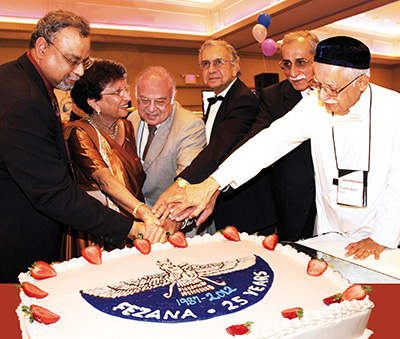
Above, from l: Past FEZANA presidents Patel, Dastoor, Firdosh Mehta,
Rustom Kevala, Rohinton Rivetna, Framroze Patel at the 25th anniversary
30th anniversary Parsiana cover design
"It is quite lonely to be a president. There is a tremendous responsibility to be a role model and not do anything wrong," admitted Dastoor. Alluding to her experiences as president from 1994 to 1998 she confirmed the exposure gave her "a broad outlook and built me up." When she took over as president, following in the footsteps of Rivetna, the community was "polarized between the ultra-orthodox and the ultra-modern where never the twain could meet," she recalled. The Parsi-Iranian divide then impeded FEZANA harmony. "I hope I have left the community more united," she added.
Happy that "we have a much stronger community now," she advocated the need for a good "public relations team to respond to events in a timely fashion," to keep clean the FEZANA name that is sought to be tarnished on social media with "vilified attacks by unjust mullahs." There is also a need to build capital for infrastructure needs, she recommended.
"Make FEZANA relevant to the community," was the advice given by Shahriar Shahriari of Vancouver to the floundering novice. "That became my driving force." To help people associate "FEZANA with a human face, I visited each and every association; met the boards to understand what people wanted." In her second year, FEZANA came up with a 10-year strategic plan delineating the Association’s vision for the future.
The Strategic Planning Committee she considered one of the legacy programs of her four-year tenure. A syllabus for religious education, the FEZANA Directory, a Sports Committee to organize the annual sports meet over the July 4 weekend each year, and the UN – NGO (United Nations – nongovernmental organization) status being conferred on FEZANA were the other highlights during her presidentship.
She had to encounter turbulence too. There was pressure on her to withdraw the invitation to Ali Jafarey of the Zarathushtrian Assembly at an event in Kansas. On another occasion the then co-chair of the Welfare Committee called for her impeachment. Dr Farrokh Mistree who was parliamentarian at that meeting put the motion to vote and Dastoor stood vindicated. In fact, Mistree and Bella Tata served as two sounding boards for her, she acknowledged.
One of her greatest accomplishments was winning the FEZANA bid to host the Seventh World Zoroastrian Congress (WZC) in Houston in 2000. "Over 2,500 attended, a record not matched by any Zoroastrian Congress before or after. There was real partnership between FEZANA and the host association. At that Congress every region had a role to play… Pakistan looked after the women’s program and Zoroastrian Trust Funds of Europe (ZTFE) the books" on the community and religion.
Widening the Federation fold
Serving as the sixth president of FEZANA (from 2008 to 2012), over a decade after Dastoor, Bomi Patel stated that he "had the privilege of following more presidents. I enjoyed a very amicable tenure." His term drew to an end in 2012 at the Sixteenth North American Zoroastrian Congress in New York when the silver jubilee of FEZANA was ushered in and he handed over the reins to Kapadia. During his four eventful years, he considered himself privileged to strengthen the Infrastructure Committee and inaugurate the FEZANA administrative office in Chicago, work on which had been initiated by his predecessor Kevala.
He had represented FEZANA at the Ninth WZC in Dubai in 2009. "Everybody from FEZANA advised me not to speak more than asked," recalled Bomi of his first experience attending a meeting of the Coming Together Roundtable (the precursor to the GWG) during this Congress. Allaying common misapprehensions, he confirmed, "My experience at GWG has been very different. It was made very clear at the outset that all demographies are very different and no one could interfere in each other’s internal working."
He was happy to report that FEZANA in fact enjoyed the confidence of other federations too and at one meet when the ZTFE representatives could not attend, he was given the proxy to vote for them. In 2011 he had been invited by ZTFE to attend their sesquicentennial celebrations and felt privileged that he had an audience with Prince Philip.
Whilst considering Homi Davier of Houston as his mentor, Bomi’s active involvement with FEZANA was thanks to Mehta, the fourth president of FEZANA, who guided him on "how to do different things." During his term, he endeavored to "bring small groups into the Federation fold, setting up a separate committee for that" and valued the assistance of Mahrukh Motafram in this task. In addition to 26 Zoroastrian associations, 14 small groups in the USA and Canada come under the FEZANA banner. "Smaller groups tend to get left out and people are not aware of these Zoroastrian pockets," he added. He further commended the efforts of "subsequent presidents for improving on my work."
Operate with respect
"We need to commend ourselves, the way we operate with respect and harmony," summed up Rivetna. Appreciating the democratic functioning of the community in North America, he added, "This wasn’t the case before. It is due to everybody here. That is not the case in the rest of the world. It behooves us to share our experience with the world outside. If one of our arms fails, it is important that the rest of us are effective. Be mindful..."