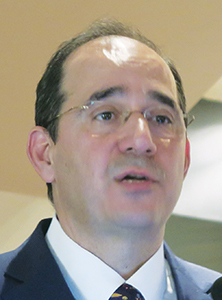
The first liver transplants at the Apollo Hospital in New Bombay should be performed in the next two months said Dr Darius Mirza (pictured), head, department of hepatobiliary (connected with liver, gall bladder and bile) and transplant surgery at the Hospital, consultant at Queen Elizabeth Hospital and Birmingham Children’s Hospital, UK, and professor of hepatobiliary and transplant surgery at the University of Birmingham. He was addressing the Mid-Town Rotary members on February 8, 2017 at the Taj Mahal and Palace Hotel.
The formalities for the liver transplant unit are almost over and Apollo has allotted 26 beds for the transplantation program. The 500-bed Apollo Hospital is described on the website as a "multi-specialty tertiary care Hospital (which offers) comprehensive and integrated super specialty services.”
 The cost of a liver transplant in India is around Rs 25 lakhs (USD 37,394) to 35 lakhs (USD 52,352) as versus one crore rupees (USD 149,577) in the UK and two crore rupees (USD 299,154) in the USA, states the surgeon. Of those seeking a liver transplant, one in five is a child. People used to question whether it was worth transplanting a liver in a child. But Mirza pointed out that some of these children are now 16 years old, and hence the transplant has served its purpose.
"Liver transplantation is not new. People who have been operated have survived over 50 years,” said the doctor who was recently elected chairman of the British Liver Transplant Group. He noted that in India "around 1,500 liver transplants are performed per year of which 75% are from live donors.” The surgeon approximates that India needs "around 10,000 liver transplant per year.”
Transplanted livers are obtained from deceased persons or living donors from whom a liver section is removed. Both the transplanted section and remaining portion are able to regrow to a normal size. Whether a full or part liver is transplanted "there is no difference in results...
"Probably 70-80% of those listed in India die before a cadaver liver becomes available — hence the reason why live donor liver transplantation is so important for India till we have a growth in cadaver transplantation,” notes Mirza. From the 1960s to 1980s liver transplants were "not so successful.” Now, with new techniques and technology, the results are better. "Patients live longer, though one in five dies while on the waiting list.”
The UK National Health Service website (www.nhs.uk) states "more than nine out of every 10 are still alive after one year. Around eight in every 10 people live at least five years and many people live for up to 20 years or more.”
The incidence of fatty liver disease "is more common in the East,” even among people who do not consume alcohol or drink minimally. In the West "approximately 20 to 25% of people have some degree of fatty change in their livers. The figures in India are likely to be higher.” Liver disorders being largely a result of lifestyle, Mirza estimated that 40 to 50% of those present at his talk would have fatty livers. He recommended exercising and keeping weight in check. He noted that obesity was one of the primary sources of liver disorders.
The liver is "a fantastic organ,” the doctor said, and even if two-thirds is surgically removed what remains "is good enough to function.” One can remove a portion and transplant it in another person. Thus a father or mother can donate a portion of the liver to an ailing child. The liver constitutes only two percent of the body weight but "receives 20% of the body’s blood supply. It has one of the richest blood supplies in the human body.”
Mirza shuttles between Birmingham and Bombay where his parents, dentist Firoze and mother Elinor reside. Introducing the speaker, the Club’s director of youth services Jamshed Patel mentioned that Darius had studied at St Mary’s School, St Xavier’s College and completed his MBBS from G. S. Medical College in Bombay. He has studied and practiced in Vienna, Edinburgh and Glasgow.