The travels of Pirojshah Meherhomji in the
1860s are narrated in a Gujarati book now translated into English
These extracts from Travels in America translated from the Gujarati Meherhomji ni Musafari by writers Tulsi Vatsal and Aban Mukherji are reproduced in Parsiana courtesy the translators.
At 8 o’clock in the evening on July 11, 1862, a Parsi industrialist, Pirojshah Pestonji Meherhomji, along with his friend Dosabhai Faramji Cama, and their servant, arrived in New York. They checked into Hotel Fifth Avenue.
For the next two months they made a whirlwind tour of the cities of eastern North America. Meherhomji kept an account of this tour, which was published as America ni Musafari by the Daftar Aashkaaraa Press in 1864. His diary is peppered with delightful (though often frustratingly brief) vignettes of their American experiences.
The American Civil War had started, and the two gentlemen not only visited tourist sites but also attended war meetings and made it a point to talk to the local people about the war. (They were often mistaken for officers of the Union army!) The well-connected travellers were given special permission to visit, among other places, a military prison (Philadelphia), the arsenal (Pittsburg), and were even granted an audience with President Abraham Lincoln.
They seem to have been especially interested in educational institutions and were most impressed by those for the visually impaired, the hearing impaired and the differently abled, and bemoaned the lack of such schools in India.
Given below are three short extracts from Meherhomji’s diary.
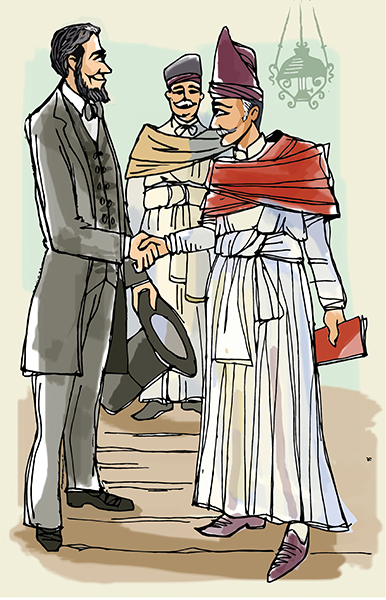
Illustration by Farzana Cooper
August 9
In Davenport, a crowd had gathered to watch two elephants as they drank water from the river. Nowadays, exotic animals are taken from place to place to be exhibited on payment of a fee.
There is a swing bridge between Davenport and Rock Island, and it can be raised for passing ships. Logs are transported over large distances, by being tied together to form huge rafts. The rafts have small huts where the raftsmen can live during the journey. It is remarkable how even humble folk want to keep track of political events in their country. Whenever our steamer passed a raft, the raftsmen would ask eagerly for news and plead for a copy of the newspaper. When passengers threw a newspaper across to them it would be received with cheers and everyone would cluster around to read it.
The common folk seem to have some degree of literacy. We were told that when an English lord visited a cotton manufacturing factory nearby he was astonished to find that all the workers actually signed their names in the salary register. When he expressed his surprise to the manager, the manager said, "Not a single American in my factory is illiterate.” Soon after, however, when a worker put an "X” where he was supposed to sign, the lord pointed out, "Well, this man is not literate.” The manager replied, "I said that not a single American in my factory is illiterate. This fellow is an Englishman!”
August 19
We had been given a letter of introduction to Fredrick Steward, Assistant Secretary of State. This young man was the son of (William) Steward, the Secretary of State. We requested an audience with President Lincoln, and assured him that we were not at all desirous of taking up the President’s time at this juncture, but had been urged by people in New York and other places to meet him and see for ourselves his unassuming ways. Steward asked us to wait while he sent a message to President Lincoln at "White Hall” (White House). President Lincoln replied that he could not say when he would be free from his other commitments, but would be happy to meet us whenever we came.
Steward escorted us personally to the President’s house. There were neither any police nor any watchmen outside the door; only a single man stood there whose job it was to show visitors to the stateroom where the President met the public. Unlike in other countries, here public funds are not wasted on unnecessary security measures. Outside the President’s room, a number of military officials and other gentlemen were waiting their turn to meet him. When we arrived there, there was someone with the President, but Steward asked us to wait and went in himself. As soon as he went into the room the visitor came out and Steward opened the door and ushered us in. We had alerted Steward that to keep on our pugrees was a sign of respect. He said that he understood, and that our good intentions were all that mattered.
The President stood up as we entered, and Steward introduced us. The President shook hands with us, asked us to be seated and sat down himself. He had a simple desk and the room itself was of a modest size. He exchanged a few pleasantries with us and said that there was nothing very special to see here, only the prairies, that is vast expanses of flat lands. "I don’t know whether there are similar lands in Russia or other places,” he said. He asked us how long it was since we left our country. We replied and then said that we didn’t want to take up more of his time and took our leave. He rose from his desk and shook hands with us, and before leaving we wished him success in all his endeavors, to which he replied, "Thank you.”
Our opinions had undergone a sea change. We had thought that to get an audience with such an important personage in these times of war would be impossible, but it had turned out otherwise. In one part of the world, it is almost impossible to meet even the lowest official, while in another we were easily able to meet the highest official of the land. The President is very tall, slim, and simply dressed.
August 23
Last night we made the acquaintance of a gentleman named Nassau who was a Freemason. He said, "I am very happy to meet followers of Zarathushtra.” He offered to show us around and we agreed.
We went to visit the Penitentiary where prisoners of Pennsylvania are kept. Though the walls of the Penitentiary were high and solid, within was a garden full of flowers. The interior of the jail is unusual. One can see the entire prison from a central area where the guards stand. Each prisoner is held in an individual cell, and the women prisoners are housed on the floors above. Each cell opens out into an 8 x 10 ft space where prisoners are allowed to walk for an hour every day. Every prisoner is assigned work as a cobbler, a carpenter, and so on, and if they achieve more than their target, they are paid extra. One prisoner had extracted dyes from pieces of colored cloth and had painted patterns on the wall.