The Cercle Franco-Parsi was once the hub of
Parsis enthused with the French language and culture
Firdaus Gandavia
Tucked away on the second floor of a beautiful art deco building in a shady and picturesque road in the Kala Ghoda precinct is the Cercle Littéraire — the Dinshaw Petit Library. With a vast and valuable collection of French books, the bibliotheca is scenically situated: from the windows one can see the stately Jewish Synagogue, the magnificent dome of the Prince of Wales Museum of Western India and the iconic Jehangir Art Gallery. Nearby are the stately buildings which house the Elphinstone College and Bombay University.
"The library, which is the oldest and probably the only private French library in India, offers its readers — French professors, students, translators and Francophiles — an immense and varied collection of books on French literature,” states Aban Davar, a member of the managing committee. "The collection comprises 3,600 novels, books on French philosophy, collections of poetry, travel writing, memoirs, historical and critical works,” she mentioned. There are rare editions of the writings of Jean-Jacques Rousseau and Voltaire, outstanding philosophers of the 18th century. Of special interest are French versions of the Rig Veda, the Bhagvad Gita, the Koran and particularly the Zend Avesta.
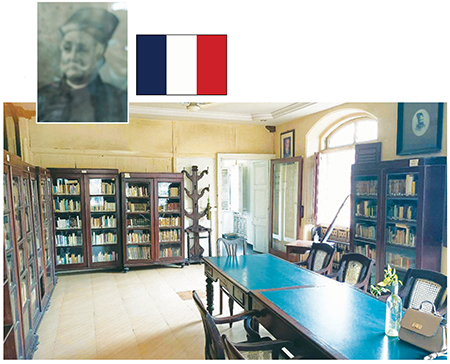
The Cercle Littéraire; inset: Sir Dinshaw Petit, 1st Baronet Photos: Firdaus Gandavia; flag of France Photo: Wikipedia
Portraits displayed in the library (from l): Nusserwanji Maneckji Petit, Edul Davar, Phiroze
Bharucha, Fr Pedroza, Fr Duhr
Rare volumes Photo: Jasmine D. Driver
Managing committee member Mangala Sirdeshpande feels that the Cercle is a small island that preserves intact the poetry of the past. As one enters, one realizes that there is a charmed atmosphere and quality of timelessness about the place. Impressive portraits of former presidents and dignitaries adorn the walls; well-thumbed books in French are preserved in handsome old teak wood cupboards. As you sit there in the 21st century, you see in the mind’s eye several Francophiles emerging from the mists of the past. In fact, the Cercle Littéraire has once been the center for the lectures of famous statesmen like George Clemenceau (who was twice the Prime Minister of France); philosophers and authors like Pierre Loti, Michel Tournier, Catherine Clement (several of whom had won the Prix Goncourt, the most prestigious award for literature in France, possibly comparable to The Booker Prize in the UK) and J-M-J Le Clezio, who won the Nobel Prize for Literature in 2008. It is in this hall that several Parsis enacted French plays.
Davar informs us that the Parsi connection was present from the very beginning. "Before it was a library the Cercle Littéraire was called the Cercle Franco-Parsi. It was mainly a meeting place for the Parsis who were very friendly with the French as they had a profound interest in the French language and culture. They would meet regularly to discuss political affairs, cultural matters and books.” Then, two Frenchmen, Anquetil du Perron and Eugene Burnouf, who came for a scientific study of the Parsis, brought books pertaining to Zoroastrianism culture, religion and history to Bombay. They lit the flame in the elite Parsi youth to study the French language and literature. As a result, the Parsis were very keen that French should be included as a subject in the University of Bombay.
In 1886, Sir Pherozeshah Mehta and Justice Triambak Telang passed a motion in the University Senate to this effect. It is thanks to their efforts as well as the persistence of a Spaniard and two young Parsi women, Ratanbai and Meherbai Ardeshir, that the first French Department was established at Elphinstone College and Sir Dinshaw Petit thought it was the appropriate time to create a French library. The Cercle Littéraire was started with a donation of 10,000 French Francs (Rs 1,23,200) which was a generous amount at that time. Though the donor did not know any French, he was very proud of his French name of Petit, a nickname given to his grandfather who was probably short and small built. At the inception, most of the library members were Parsis, the others being the French living in Bombay, a few Jews and Portuguese. The Muslims and Hindus joined much later.
Loti wrote in 1900 that "one of the best memories of our trip to Bombay is the visit to the Cercle Littéraire. We were surprised and charmed to find such a fine center of French culture here. We were particularly overjoyed at the thought that the French influence, both intellectual as well as convivial, is present here without compulsion or coercion.”
The Cercle Littéraire is managed by a managing committee and a treasurer who work tirelessly and without remuneration. President Dara Mehta joined the Cercle in 1974. At that time, his knowledge of French was quite rudimentary. So he joined the Alliance Francaise de Bombay and obtained two diplomas in both commercial French and French literature. "During the Second World War, the Cercle’s address was used by the France Libre movement as the place of publication of their newsletter,” said Mehta. "Alas, we have no record of this newsletter.”’
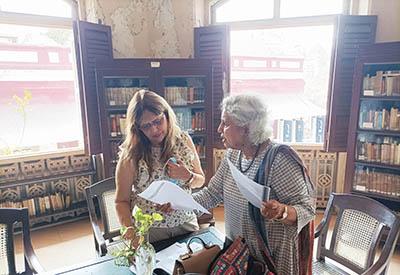
Managing committee members Aban Davar (l)
and Meenal Kshirsagar Photo: Firdaus Gandavia
At present the institution is facing several problems. Gone are the days of glory when the library was buzzing with activity. Finances are extremely limited. Annual membership is just Rs 300 and life membership is Rs 5,000. The main source of income is from a grant by Sir Dinshaw Petit, great-grandson of the founder, and contributions from the French Translators’ Association. In spite of the difficulties with finance, Vidya Vencatesan still feels, "Being the treasurer is a deeply satisfying experience. The Cercle is my haven of peace. I have met so many new ideas, great writers either in person or through their works. I owe so much to the Cercle. I’m trying to get younger people involved so that there is some young blood in the organization.”
Though French visitors come, admire and praise the library, no financial help is forthcoming. Davar says, "The French Embassy was of great help once upon a time. They helped the Cercle by donating books, newspapers and magazines. But now the stands are empty and visitors are few and far between.” In an interview with Downtown Plus, a supplement of The Times of India dated September 5, 2008, Patrik Mendoza, the librarian-in-charge, revealed that "the bulk of the members are students of the Alliance Francaise classes who study the French language” (see "Petit’s French library,” Events and Personalities, Parsiana, March 21, 2009). The relationship with the Alliance Francaise tends to depend on the director. There was even a proposal to merge the libraries of the Cercle and the Alliance Francaise but the committee felt that the Cercle would lose its identity.
Managing committee member Meenal Kshirsagar recalls the time when she was a student at Elphinstone College. "I would just walk across the street and spend a long time reading which helped me tremendously. Now, the French department at Elphinstone College has closed down and even students from St Xavier’s don’t seem to visit the library. Most colleges only have basic language courses, and literature is a thing of the past. Students seem to be only interested in commercial French or translations which would bring them money.” Secondly, with the advent of the internet, libraries all over the world are facing the problem of dwindling numbers.
The Cercle needs to be revitalized, lectures and conferences should be held, plays put up. Kshirsagar feels that "we need to debate the future of heritage institutions and their place not only in Bombay or India but in the world. What part do they play in your country? If you recognize that they are important then you have to support them to keep them going. Some individuals need to sponsor them to keep them active.”
Faisal Devji, professor of Indian History, University of Oxford who spent much of 1990-91 in Bombay, doing research for his PhD dissertation, in an email to Parsiana recalled his days at the library. "Shuttling between Khilafat House in Byculla, the Maharashtra State Archives at Elphinstone College, and the library of Bombay University, I eventually discovered the Cercle Littéraire and took to spending my afternoons there either reading through photocopied documents for my research or, increasingly, spending my time looking over its collection (including an 18th century collection of Voltaire’s works) and settling down with a French novel, philosophical treatise or book of poetry. Sitting there felt like being part of a more leisurely period going back to the late 19th century. It will always retain for me the memory or sense of urban civility at its finest.”