The Bai Ratanbai J. Chinoy Parsi High School in Secunderabad
provides quality education with affordable fees
Beyniaz Edulji
The only Parsi school in South India The Bai Ratanbai J. Chinoy Parsi High School (BRJCPHS) in Secunderabad celebrated its centenary with a grand function on January 19, 2019. During the four-hour program former principals, teachers and alumni were felicitated while the audience was regaled with dances and skits. A. K. Khan, advisor to the government on minorities welfare was chief guest; guests of honor were Mohammed Qamaruddin and Telangana State Minorities Commission (TSMC) member Gusti Noria and Member of Parliament (Lok Sabha), Bandaru Dattatreya who addressed those present in Hindi, Telugu and English.
Founded by Jehangirji Chinoy in memory of his beloved wife Ratanbai on January 19, 1919, the School is a charitable institution catering to children of the economically disadvantaged. Run by Jehangirji’s descendants, what was initially a co-educational Parsi minority institution later opened its doors to children of all communities.
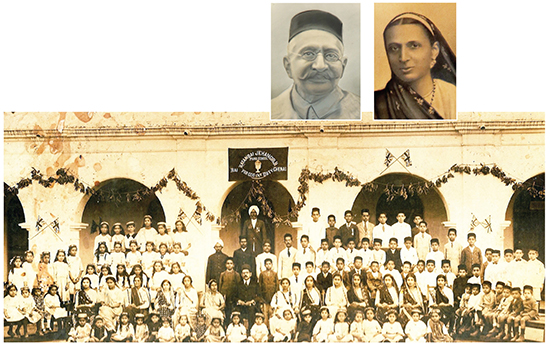
Inset: Founder Jehangirji Chinoy and wife Ratanbai;
above: School function in 1925 with first principal Framroze Hirji Khurshed
Frontage of new School building
After functioning as a primary and middle school on the founder’s private property in Parklane, Secunderabad, with Parsi students and teachers, it was upgraded to a high school in 1930. In 1933 the Nizam’s government gave it recognition. The English medium School was extended to grade VII and became an upper primary or elementary school. When the inspector of schools accorded permanent recognition and affiliation to the State Board of Secondary Education, the BRJCPHS became a high school in 1952.
The current student strength is 1,050 with 150 in the pre-primary, 486 in the primary and 414 in high school. Despite a low fee structure, the school maintains a 1:25 teacher to child ratio, with qualified and well trained faculty. The trustees have always striven to provide sound infrastructure and have upgraded technological teaching aids.
The School follows the syllabus prescribed by the Telangana State Board of Secondary Education and for the past seven years has achieved 100% results in the school leaving board examinations. Co-curricular activities include the NCC (National Cadet Corps) and Scouts and Guides. The management pays for the expenses of the NCC and Scouts and Guides.
School president Gulbanoo Chenoy recalls she was "inducted as a trustee of the BRJCPHS in 1952 at the age of 22 by my father Noshir Chenoy. It was during my first year as trustee that the momentous decision was taken to admit children from all communities as the Parsi students had dwindled to a minuscule number. The initial response was not very encouraging but the numbers steadily grew along with the reputation of the school. From the initial 50 or 60 children the School has grown to the current strength of approximately a 1,000 students. But several hurdles were encountered and overcome along the way. As the numbers of students grew, so did the need for more classrooms, more faculty and more facilities. In 1995, the old school building was torn down and a new, more spacious and larger facility constructed. The principals at the time, Thrity Bapooji and Shernavaz Baria worked tirelessly and selflessly to achieve this objective. The years have flown by and it is hard to imagine that my association with the School in now in its 66th year.”
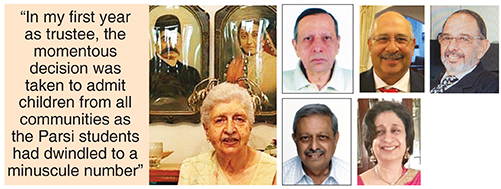
Clockwise from l: President Gulbanoo Chenoy, trustees Mehernosh Chenoy,
Saam and Nadir Chinoy, secretary Ashish Chinoy and trustee Homi Chinoy
Former principals Thrity Bapooji (far left) and Shernavaz Baria
Chief guest A. K. Khan releasing brochure presented by trustee Saam Chinoy (r)
Trustees Mehernosh Chenoy, Homi Chinoy and Saam Chinoy note they are proud to be associated with the School. Saam, great grandson of Jehangirji Chinoy recollects, "I was just out of college when I became a trustee in 1978.”
Trustee Nadir Chinoy, says, "The School provides merit scholarships, most of which are sponsored by the trustees and some by the grateful alumni. Fatherless children are given free education. For the academic year 2017-18, freeships were given to 13 students and 50% scholarships to 42 students. The School proposes to start a ‘sponsor a child’ program over a 12-month period.” The annual fees charged for pre-primary class students are Rs 17,610, for primary Rs 19,585, and high school Rs 20,910, he notes. "Our income from fees is just about enough for the staff salaries and the day-to-day maintenance.
"In the centenary year we realize that there are many things we would like to do: a facelift for our building, upgrading of computer labs, class furniture, sports facilities, etc.”
Secretary Ashish Chinoy thanked donors Feroza Vatcha, Nazneen Bapooji, Hilla Singh, Hilla Divecha, World Zoroastrian Organisation, Sorab Chenoy, Zarir Byramji, Sorab Engineer (great-grandson of the founder), Cheera Satyanarayana, B. N. Srinivas, P. N. Srinivas, Madhusudan, Yeshala Parvathi, Manish of A.S. Enterprises, Natraj, Sunil and Kerfegar Antia who presented a generous cheque on behalf of The People’s Co-Operative Credit Society Limited.
Former student Lt Col Sohrab Vakil (Retd), now 91, shares memories of his first school where he studied from the age of five to seven: "I used to attend along with my older siblings. It was a co-educational school but girls used to sit on one side of the classroom and boys on the other. I learnt tables up to 40 times in Gujarati. We had to say our tables backwards and forwards in the open air and I still remember them! We were taught English in cursive handwriting right from the beginning. The three Patel sisters taught us. Meherbanoo taught English, Khorshedbanoo prayers and Frenybanoo took the infant class. Purshottam Sir was the Urdu master. Mehtaji taught the first standard.” Vakil has very fond recollections of Veerbanoo Cooper who he claims "was my best teacher… We used to gather at the assembly for prayers and were taken from there to the Chinoy agiary on festive occasions. There were cooking classes for the older girls and we were all allowed to sample their dishes. My school fees were only Rs 2 a month.” Vakil’s classmate Roda Mistry went on to become Minister for Women and Child Welfare in undivided Andhra Pradesh and a Member of Parliament, representing Andhra Pradesh in the Rajya Sabha.
Anaisha Vakeel, who works at Google as a vendor operations lead, studied at the School from 1991 to 2003. "For a kid growing up, school life is what matters the most,” she recalls "engraved in your memory for life. I had the privilege of having women like Bapooji and Baria as principals. This is probably why I’m so motivated in my professional life and feel so strongly about women giving their best to their careers. I was a very quiet kid, with not many friends. I remember loving going to school each day. The School and the books were my best friends. I would strive to be one of the best performing students. Somewhere deep inside I’m still the shy person who the School helped nurture into a confident woman.”
"I joined as a grade three teacher in 1990 and was upgraded to class 10 later,” shares Dr Ssonu Irroni who wrote her doctorate thesis on community schools. "I worked for 12 years in the School; this was my stepping stone as an academician as I later became principal in other CBSE schools.”
The present School building was constructed about 12 years ago, replacing the old residential buildings that belonged to the founder. It is a double storied structure with 54 spacious rooms for children from nursery to class X with three sections in each grade. The school also has a science laboratory and two computer labs with 12 computers in each. There is a language room for the primary section on the first floor. On the second floor, library space is shared with the language room. The NCC room on the first floor houses equipment, records and uniforms of the students. The inner arena of the school is generally used for cultural activities like dancing, singing, art and craft competitions. The playground with stadium seating is used for sports activities, morning assembly and other School functions. Interactive classrooms to facilitate online teaching and audiovisual lessons cater to high school classes. A solar power plant and fire extinguishing equipment have also been donated by some well-wishers.
School fees are the main financial resource of the School, but as they are kept low they do not cover all the requirements. The trustees, mainly from the Chinoy family, contribute to the finances in the form of scholarships for deserving students. As the School completes its centenary, it needs further upgrading of the infrastructure and a facelift for the building. More rooms are required, class furniture needs to be replaced, teachers’ salaries require to be enhanced.
The management welcomes donations to expand their endeavors. Cheques in the name of: "Trustees B. R. J. C. Parsi High School,” may be sent to 119, Parklane, Secunderabad 500003. Phone: +914027843733. For online transfers, the details are: State Bank of India, Sarojini Devi Road Branch, Secunderabad 500003, Bank Account No: 54025016885, IFSC: SBIN0040227.
Cotton ginning
The Chinoy family has produced great entrepreneurs and philanthropists like the school’s visionary founder Jehangirji. During the rule of Mehboob Ali Pasha, industrialization was concentrated in a few areas mostly around Hyderabad, the capital city. Jehangirji ventured into the hinterland and in the area around a village called Bhainsa, in the Nizam’s dominions, he saw the potential for growing cotton. He introduced the crop to the locals in what was until then a backward area. Once the crop was established, there arose a need for ginning and pressing facilities. It took Jehangirji about four years to transport the machinery and set up the factory. He later established factories in Palsi, Chondi and Dharmabad, bringing prosperity to those regions. The company he established was named after his younger brother Darabji who had passed on at the age of 29.
Jehangirji then concentrated his energy on philanthropy, establishing in January 1919 a charitable dispensary in memory of his mother, Bai Rattanbai Jamshedji Chinoy, which provided medical services to the needy free of cost. For the Parsi community he built the Jamshedji Chinoy Hall and the Edulji Chinoy pavilion, within the precincts of the Dharamsala. To this day, navjotes, weddings and other functions are held there. The facilities are available to community members at reasonable rates. He donated funds to form trusts to assist the disadvantaged Parsis and for religious ceremonies as well.
The missionary-run schools at the time preferred European students and the Mahbub College for Boys and Key’s High School for Girls were run by the Mudaliar community. This cultural lacuna was sought to be overcome by establishing a school for Parsi children wherein Parsi traditions and ethos could be inculcated. For more than five decades the BRJCPHS remained the first option for Parsi families of the twin cities of Hyderabad and Secunderabad.
Perviz Bhote, niece of the first headmaster Framroze Fardoonji Hirji Khurshed (he was her fua or father’s sister’s husband), says, "He was the headmaster of the School from 1919-1952, and on his watch the emphasis was on providing a sound foundation of religious and cultural education, coupled with modern learning. A scholar, his interests spanned a wide swathe of learning — philosophy, logic, history, English and Gujarati literature. His personal library contained books on all subjects, and the entire collection of The Encyclopedia Britannica. He knew nine languages and was fluent in French. His dedication to the School and its students went beyond the call of duty, for he tried to inculcate the finer aspects of life in his students. A religious-minded man, the students were indoctrinated in the Avestan prayers that were recited during morning assembly. He was well-versed in Ferdowsi’s Shahnameh, and would reconstruct the stories into musicals in the Gujarati language for students to enact on the School’s annual day. So perfect was the training imparted to the young thespians that often the audience experienced a cathartic effect and was left sniffling.” In this educator, the fledgling BRJCPHS had a man totally dedicated to seeing young minds blossom with the light of learning, along with a good grounding in Parsi culture, ethics and ethos.
Irene Reporter, retired vice-principal says, "The School has a glorious past which has attracted admiration and respect. We are very proud of our well-developed School with good amenities in the very heart of Secunderabad city. Let us all hope that the tradition and motto of the school, ‘Truth, Labour and Service,’ is held aloft for many years.”
For Thrity Bapooji, "It has been my privilege to serve as the principal of BRJCPHS. I took over in 1968 and for the next 27 years the School was my life until my retirement in 1995. During my tenure, the management and my team of dedicated teachers assisted me in taking the School from a primary school to a higher secondary school and increasing the number of students tenfold. It gives me immense satisfaction to see that principals who have taken over after me have continued the traditions imbued in us since the past 100 years.”
Shernavaz Baria, former principal adds, "Let us all celebrate the accomplishments of the previous years and anticipate a bright future,” while current headmistress Vyjayanthi shares, "In my life’s journey as a teacher, trainer and headmistress in different schools, one of the most memorable experiences is the 10 years that I have been with the BRJCPHS.”