Retired scientist Adi Mountvala’s first exhibition
of paintings reflects his
lifelong interest in art
Text: Firdaus Gandavia Photos: Jasmine D. Driver
What makes a person who has a postgraduation degree from the University of California, Berkeley, who has spent his entire working life in the field of scientific research and development, turn to art post-retirement?
But then, art has always been a passion for Adi Mountvala whose paintings were exhibited at the Jehangir Art Gallery from November 29 to December 4, 2022. His family were among the top designers of jewelry in Bombay until the early 1990s. Even during his extremely arduous and time-consuming professional life, he never lost interest in art. Whether travelling for work, or on holiday, he would never miss an opportunity to visit museums and art galleries and view with awe and admiration the beautiful paintings which adorned their walls.
Above: Adi Mountvala and his paintings
Post-retirement and during the pandemic, the octogenarian turned to painting, choosing acrylic paint as his medium. His work is generally full of vibrant colors and cheerful themes except for a few dark images, where the situation so demands. He is a self-taught artist and has, in fact, never learnt art formally but is very comfortable with the medium of his choice.
Though Mountvala considers Maqbool Fida Hussain his favorite contemporary Indian painter and is extremely fond of Pierre-Auguste Renoir, Paul Gauguin’s paintings of Tahiti, Pablo Picasso in his blue period and the later works of Vincent van Gogh, he has his own unique style and content. His first cousin, Adi Davierwala, who was older than him and whom he visited often to see his sculptures did not influence Mountvala’s work but taught him to focus on art, artists and technique. Would he ever take up sculpture? "I did think of sculpting but I wonder if at my age it would be advisable. However, if I had to sculpt, I would certainly choose wood. I think that the wood work of Davierwala has a lot of grace and simplicity.”
He firmly believes, "When you are interested in art and spend a lot of time going to galleries and exhibitions and seeing other people’s art, it just seeps into you and how you distill it is a different matter and it is the distillate that comes down to the painting.”
Mountvala has always tried to represent narratives in his paintings. How does he select these for his paintings? "I watched the film, Mississippi Burning, based on the 1964 murder of three civil rights workers by the Ku Klux Klan (KKK) and the next day I decided to paint a picture of two people hanging and two members of the KKK in the periphery. But sometimes ideas come from what is happening around me.” A painting, Indian Penal Code 354, dealing with rape and molestation of women inspired a very powerful and vivid portrait of a man trying to take advantage of the virtue of a woman.
Several of his paintings have religious themes. In The Last Temptation Mountvala represents Christ shunning the devil, holding out his hand to avoid temptation and send the devil on his way. His The Last Supper is an interesting variation of the original. The disciples and Christ are seated not at a table but on a colorful floor. There is a lot of controversy in the original painting over whether the figure on the right of Christ is John the Apostle or Mary Magdalene; Mountvala does not leave this to conjecture and chooses to portray the latter. The painting includes a representation of Judas with the blood money at his feet and the rooster which was supposed to have crowed three times before St Peter disowned Christ. The colors are striking with vivid blue, yellow, orange and white which stand out against the pink background.
It’s not only Christian imagery which interests Mountvala. In both The Redemption of the Rishi and Salvation of the Maiden the subjects seem to be facing a conflict. However, whereas the maiden seems to be depicted as oblivious to the temptations of the world with a serene and contemplative look on her face, the expression on the face of the rishi, who looks more like a Catholic priest, shows that he seems to be battling temptation.
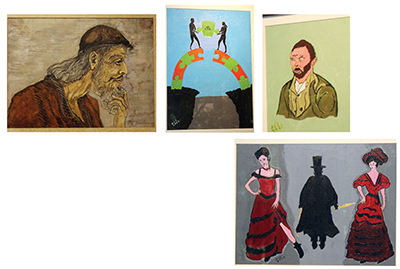
Clockwise from top, l: Doon School 1950; Bridge of Harmony; Vincent van Gogh; Jack the ripper
"My favorite is the Bridge of Harmony,” Mountvala says and it is no surprise that he has chosen this painting to appear on the publicity material for the exhibition. A colorful arc composed entirely of jigsaw puzzle pieces extends across a chasm. One critical piece which joins the two ends is missing and can be seen in the hands of two figures. It carries the word "Aum.” But not all his work is serious; he has several paintings in a lighter vein like his depiction of Jack and Jill or the March to Freedom.
Did he ever regret not taking up art as a career? "No,” he says emphatically. "I had a lot of interest in science. I was a senior scientist at the IIT (Illinois Institute of Technology) Research Institute in Chicago where, in addition to directing research and development projects, I was associated with NASA’s (National Aeronautics and Space Administration) Apollo space program. After I returned to India, I was engaged in consultancy and technology of CBRNE (Chemical, Biological, Radiological, Nuclear, Explosive) threat and vulnerability assessments, detection and identification and protection systems.”
When he was in Doon School, his proficiency and talent for art was noticed by his art teacher, the late Sudhir Ranjan Khastigir, himself a renowned artist from Shantiniketan. On his leaving school, the teacher asked Mountvala about his future plans and was not only disappointed but furious to know that he planned to abandon art to make his future career in science. If Khastigir were alive today, he would have been very pleased to see Mountvala’s return to art and his success in the field.