"I look for connections that are different,” stated columnist and journalist Meher Marfatia, speaking at the launch of her book Once upon a city: Making the little stories of Mumbai matter in the gardens of the David Sassoon Library on February 8, 2020. The volume is a compilation of 50 of her fortnightly columns on Bombay’s neighborhoods that appeared in mid-day over the last four years. While the book has its share of "baronets and other South Bombay folk,” Marfatia was appreciative of lesser known people who shared their personal reminiscences and opened their doors to her while she was researching material for the columns. Those she spoke to have a "deep sense of pride in their history... They were aware of their arrival into the city... could talk knowledgeably about their socioeconomic history, communal politics, the plague epidemic (of the last decade of the 19th century), the textile strike.” Also included in the book are helpful maps and oral anecdotes from personal histories that had to be dropped from the column due to space reasons or which came to light subsequently.
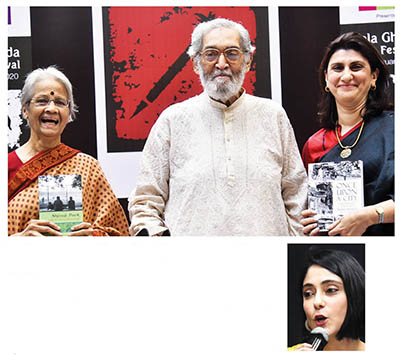
Top l-r: Shanta Gokhale, Gerson da Cunha, Meher Marfatia;
above: Tinaz Nooshian Photos: Pradeep Dhivar, mid-day
The book was released by veteran stage actor and advertising guru Gerson da Cunha on the penultimate day of the nine-day Kala Ghoda Arts Festival. Marfatia shared the stage with writer Shanta Gokhale whose monograph Shivaji Park Dadar 28: History, Places, People on the eponymous mid-town locality was also released by da Cunha. The nonagenarian said he was "overwhelmed and excited” at the release of "two important books on the city.” The launch of the books was followed by a discussion between the authors and Tinaz Nooshian, editor-in-chief of mid-day.
While the history of Bombay is well documented for the most part, and more so thanks to the proliferation of social media, what role do books on the city play? Nooshian asked. Admitting that there are "fantastic” books on the city, Marfatia said, "what (she) missed as a reader of books on the city, (she) wanted to do as a writer,” acknowledging the role that personal stories play when she writes about a city precinct. "Never assume that the person on the street does not know his history,” she said. When writing about the Dongri area of central Bombay, Marfatia met the last of the bhishtis (water carriers, identifiable by their goatskin leather bags) that still remain in the city. He knew the exact year of his ancestors’ arrival to the fledgling town of Bombay – 1819. The persons she spoke to "knew all about the new grand buildings that were going up in the city... Never underestimate the power of the softer, relatively unknown sources of history,” she cautioned.
Marfatia takes a practical view: "City history should not only be about the past... We should not get carried away by the fuzzy warmth of nostalgia... You have to look at local history... It is dying before our eyes. The Cavel fish market in Dhobi Talao was dismantled just a fortnight after she was first told about it by a local fisherwoman, bemoaned Marfatia.
"Bombay is overwhelming... There are inner city areas that we know so little about...Once people know about your interest in their stories, or their areas, interest grows,” commented Nooshian. Writing about Wadala, for instance, was a challenge for Marfatia. "People would tell me ‘Why Wadala?... It is known only for its schools.’ But I kept looking.” The result was a column on that central Bombay area which encompassed "historic dargahs, cemeteries and shrines, weav(ing) a fine patchwork of faith and fervor,” she explains in that column. "I am happy offering new insights to long-term residents to their own areas,” stated Marfatia. While the richest sources of her stories "are on the streets,” she stated that she corroborated her facts with at least one other source. mid-day has never had to carry a corrigendum on any of Marfatia’s stories, affirmed Nooshian.
In response to a question from a member of the audience, Marfatia stated that she had "total carte blanche” from the newspaper to write on any city area. "That is very liberating...I pick up areas that interest me.” She tries to alternate between the well-known and the not-so-well known; between precincts in the island city and those relatively far off.
"I wish I was like Meher...she has a natural warmth,” complimented Gokhale. "I am exactly her opposite... I cannot approach an unknown person and say, ‘Tell me your story.’” Gokhale said she would rather observe, say to her herself "that looks interesting,” and then go home and read more about it.
"Whenever I hear of the municipal corporation’s beautification drives, it scares me out of my wits,” commented Gokhale, who lives in Shivaji Park. She wanted to "gouge out” the orange slabs and faded green artificial trees that surround the Park. "I hope I will be around to see them fall off naturally,” stated the 80-year-old.
Despite Shivaji Park being among the earliest planned districts of Bombay, books on the city have "generally stopped (their narration) at Malabar Hill...some are written about the (erstwhile) Parel island,” mused Gokhale. "Brought up as a liberal,” with her staunchly Hindu grandmother a fan of the serenity that a nearby chapel offered, the writer sees traces of casteism in the area even today. Unlike other residents of the area who shut their houses to move to other parts of the city to avoid "invasion” by followers of Dalit icon Dr Babasaheb Ambedkar, she "treasures the experience of different languages and dressing styles” and appreciates "the soft shuffling of feet.” (A two-day annual event in December marks the passing of Ambedkar when his followers come in very large numbers to pay respect at his final resting place near Shivaji Park.)
Veteran radio compere Ameen Sayani who was in the audience stated that he was waiting for Marfatia’s book to "sell and sell and sell... She writes about a genre close to my heart.” He referred to her earlier publication Laughter in the House, a coffee table book on Parsi drama. The 87-year-old, whose voice has lost very little of the timbre it was known for, even recited a ditty from an Adi Marzban play! Kala Ghoda Arts Foundation chairman Maneck Davar stated that he was delighted that the books were published and released in time for the Festival.
As concluded Nooshian, Bombay is as much about the bhishtis as it is about music maestro Zubin Mehta. Taking pride in "our multiple identities is now more relevant than ever,” she said, a reference to the recent wave of right wing thought sweeping the country.