The Federation of Parsi Zoroastrian Anjumans of India debates a draconian amendment to the Bombay Public Trusts Act which could undermine Parsi trusts
Arnavaz Mama
"The national Press is writing about Parsi trusts. It is giving an excuse to the government to take over community trusts. All that our forefathers accumulated will go down the drain,” warned Bombay Parsi Punchayet (BPP) chairman and Federation of Parsi Zoroastrian Anjumans of India (FPZAI) president Minoo Shroff. He was registering his distaste for the recent acrimonious public exchange regarding the proposed development of a housing complex in the Dadysett Atash Behram grounds which was played up on the front pages of the national Press.
Shroff’s fears were endorsed by others as the executive council of the Federation discussed the proposals of the 13th Maharashtra Law Commission regarding the amendment of the Bombay Public Trusts Act (BPTA) at its meet at Bombay’s Indian Merchants’ Chamber on June 12 and 13, 2004. The BPP trustees are charged with representing the community when public trusts interface with the government.
The executive council in session
Despite heated debate, the formation of a world body is still nearly a year away. It may now see birth at the Eighth World Zoroastrian Congress scheduled for London in 2005. Though all kinds of criticism, based on hearsay, was flung at Shroff and Federation honorary secretary Keki Gandhi, the fact emerges that the constitution of the International Zoroastrian Organization (IZO) has not been finalized. The IZO is the umbrella enabling the proposed World Council of Zoroastrian Federations (WCZF) and the World Zoroastrian Organisation (WZO — a body of individuals) to function together as one world body instead of two.
The marketing of Parsi institutions within the community was a source of concern as prime properties like the B. D. Petit Parsee General Hospital (PGH) continue to incur losses because of insufficient patronage of paying patients. Other Parsi institutions like schools and technical institutes not only survive but prosper thanks to non-Parsi patronage.
Guest speaker Dr Armaity Desai, former director of the Tata Institute of Social Sciences (TISS) who is masterminding socioeconomic and health research on the community under the aegis of UNESCO and Parzor, enlightened the delegates of its scope and purpose and sought funds to continue and preserve the findings.
Are Parsis prepared to encourage the talents of their children at the cost of academic studies? The question arose as the elders bemoaned the absence of community representatives in sporting events at the national level, notably in cricket where we had once sported a substantial presence.
The delegates mourned the death of the community’s senior-most high priest Dastur (Dr) Hormazdyar Mirza and of the former president of the Surat Parsi Panchayat and Federation vice president Dr Sam Bhacca. Others who had passed away in the preceding six months included the former municipal commissioner of Ahmedabad Rustom Anklesaria whose yeoman service to the community as Chief Executive Officer (CEO) of the BPP and treasurer of the Federation was fondly recalled. Telecommunications pioneer Dinshaw Joshi and industrial engineering consultant Dr Minu Dastur were similarly remembered.
The next meeting of the executive council will be hosted by the Ahmedabad Parsi Punchayet on December 18 and 19, 2004.
New legislation
A proposed amendment to the Bombay Public Trusts Act has been suggested by 13th Maharashtra Law Commission. The recommendations include the appointment of a government officer to monitor the administration, monetary activities and functioning of any charity/trust whose annual income exceeds five lakh rupees. The virtual governmental CEO would have unbridled powers to override the decisions of trustees. Additionally, every trust will be required to draw up a constitution based on the amended Public Trusts Act which would override the provisions of the original trust deed. Trilok Ramanlal Kavi, secretary of The Prime Association of Charitable Trusts, further notes in his communication to member trusts that "the proposal pending before the law and judiciary department seems directly aimed at boosting a bankrupt government.”
Clockwise from left: Guzder, Minoo Shroff, Gandhi, Golwalla, Khambatta, D. Irani, Mogrelia and Sethna
Hoshang Wania from Nargol who explained these provisions to the delegates at Shroff’s invitation, also noted that the Maharashtra government is proposing to drop the relief of poverty as an objective of charitable trusts. The sanctity of the donor would also be eliminated with no family trustees allowed and each trust board including 60 percent of elected members of the public. Sale of trust properties too would be constricted as "no charity commissioner will give permission without formalities like advertisements, etc. Even if one person objects, the sale would be null and void,” noted Wania, according to whom there are about 350,000 trusts in Maharashtra with an income exceeding five lakh rupees per annum.
The BPP trustees have been empowered by the Federation to deal with the issue and Shroff is already on the core committee formed by various trusts to make their representation to the government. "The lead is taken by the Jains but our per capita endowments are the largest,” he noted.
The council feared a situation akin to the one faced by the Hyderabad-Secunderabad anjuman where a clash of egos had led to the Andhra Pradesh government appointing an administrator to oversee the affairs of the trust. The anjuman has been fighting a legal battle and the case is still sub judice. The Maharashtra situation is more detrimental, explained Wania, as the Andhra Pradesh legislation empowers government action only with regard to Hindu charitable trusts and therefore the Zoroastrians have a better chance. In Maharashtra the BPTA covers all trusts.
(Gandhi clarifies: The Andhra Pradesh Charitable and Hindu Religious Institution and Endowments Act 1987 applies to all charitable institutions and endowments other than wakfs governed by the provisions of the Wakfs Act 1954.)
With fears of a "back door” passage of the bill through an ordinance after the legislature is dissolved prior to the assembly elections, Shroff, who says he is spending three-fourths of his time on community issues, urged the assembled delegates to curb the public criticism of trustees of the community in the secular Press. This had recently occurred in a particularly drastic form with front page articles regarding the development of the Dadysett Atash Behram property, "making a mockery of the community among non-Parsis...People sitting in judgment!”
Khojeste Mistree of Zoroastrian Studies (ZS) who represented the Belgaum anjuman sprang to the defence of the critics whom be termed the "ginger group.” He asked, "If trustees don’t respond to letters what alternative does the community have? The issue is transparency... The trustees have to be sensitive, let the community know. If all data is not put out, conflicts arise. (The critics) say that the Parsi Press is not giving them a fair say.” According to Mistree, a letter to the Dadysett trustees signed by over 200 persons had been ignored. "We don’t know the tone and language of the letter signed by 200 people,” pointed out Gandhi. But Mistree maintained, "Even if the correspondence is offensive, the trustees should come down from their high horse and answer.”
The community needs and appreciates a "ginger group” but not to publicly criticize the working of trusts, noted BPP trustee Burjor Antia. He hoped they would concentrate on constructive activities like raising funds for housing, preventing out-marriages, looking after the aged...
BPP trustee Dinshaw Tamboly added that much of the BPP board’s time is wasted in "fire-fighting” because of uninformed criticism. Gandhi asked, "Why not ignore the criticism and do constructive work? Why get involved in fire-fighting?” But BPP CEO Behram Dastur countered, "If an issue is taken to the charity commissioner, we cannot ignore it.” "In law silence amounts to acceptance,” added Poona Parsee Panchayat (PPP) president Dara Irani. He suggested the need to set up arbitration/conciliation panels within the community.
Shroff suggested that Dastur and FPZAI treasurer and Jamsetji Jejeebhoy Charities CEO Farrokh Rustomji explore the possibility of bringing all Zoroastrian trusts under an umbrella body so that the community can speak with one voice in answer to the proposed amendment to the BPTA.
World body
When Hushang Vakil of Dahanu accused the BPP of signing the constitution of the IZO, he cited paragraphs from a letter written by Tanaz Parakh and another addressed to Shroff. The letter also attacked Gandhi and when some delegates applauded the letter’s content Iranian Zoroastrian Anjuman’s Behram Irani chided them. A miffed Shroff stated he was "amazed that Vakil whom I have never met has got a privileged communication! How do I respond when there is no tangible progress?”
Providing a quick resume of recent events concerning the formation of a world body Shroff said he was pushed into the role of coordinator at the Seventh World Zoroastrian Congress in Houston in 2000 by then fellow trustee of the BPP Rustom Tirandaz. The aim has been to create a pyramidal structure of Zoroastrian federations in conjunction with the WZO formed in 1980. Acknowledging the WZO’s assistance to Iranian Zoroastrians fleeing Iran after the Islamic Revolution, and their work in rehabilitating rural Indian Zoroastrians from near penury, Shroff noted that there had been no substantive change in the constitutional drafts of the proposed body since 1996-97 though there have been frequent interchange of ideas with North American Zoroastrians on the net and when they come here to meet their families. The more insistent among our communities world wide have even indicated that if the Indian Federation and the BPP don’t take the lead, they’ll form a body of their own without India, said Shroff. "A little give and take is necessary. We are governed by our own rules regarding entry in fire-temples, navjotes, etc...Keki Gandhi and Rohinton Rivetna are the progenitors of the concept. What is the world body without India or Bombay?...We are trying to ensure that the office bearers are Parsi Zoroastrians.” Shroff said he would not sign a document of affiliation to the world body unless he was personally convinced about India’s role being protected.
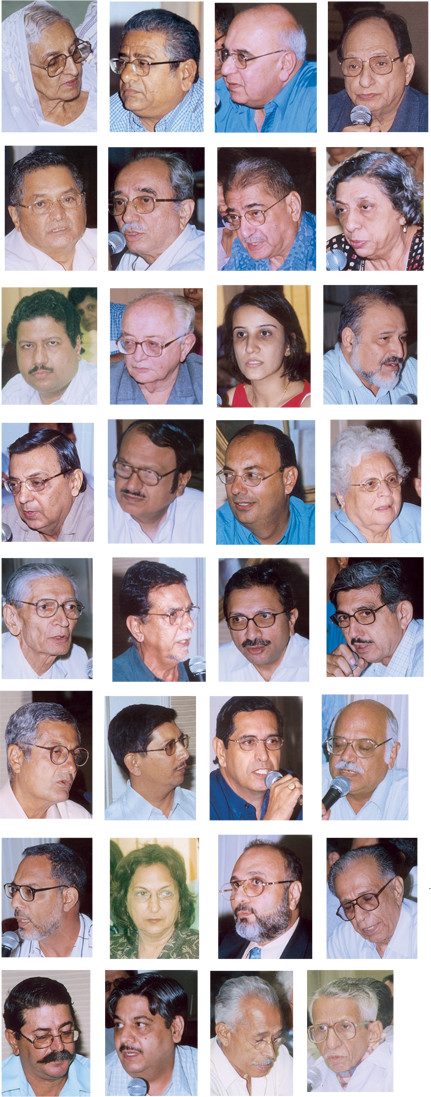
1st row: L to R: Kavarana, D. Mehta, Tamboly, D. Engineer ; 2nd row: Antia, M. Engineer, Dastur, Master ; 3rd row: Colah, Dotivala, P. Daviervala, Mistree ; 4th row: Wania, Avari, Karanjawalla, Clubwala ; 4th row: Masani, B. Irani, Rustomji, Cama ; 5th row : Mohta, P. Mehta, Paghdiwalla, Cursetji ; 6th row : S. Ginwalla, P. Ginwalla, Vakil, Jokhi ; 7th row : P. Irani, Daver, Jalnawala, R. Daviervala
While Bardoli president Jamshed Mohta supported Shroff and Gandhi unequivocally, stating "they can’t function if you keep on suspecting everybody... the allegations are frustrating,” Mistree continued to question, "How does it help Parsi Zoroastrians to be a part of the world body if (its definition of) who is a Parsi (or Irani) is different from what it is in the context of the BPP/Federation?...In North America there is a move to (accept) whoever is interested in becoming Zoroastrian. I strongly believe that the BPP has to be the strongest body in the world. It has the institutions, funds, infrastructure... How is the world body going to help us? Are we going to get help from the UN if Iran is attacked? What will they do that the BPP can’t do?”
Gandhi explained that the existing WZO and the proposed WCZF whose constitution was formulated in 1995-96 are two autonomous bodies. The demand for a single world body with a bicameral setup has been met by instituting the IZO with representatives from both bodies. It is meant to be only a consultative body without executive powers. When the presidents of four Zoroastrian federations met in January 2004, they were authorized to draft the IZO’s constitution. "Till today it has not happened. Now there is talk of putting the world body in place at the Eighth World Zoroastrian Congress in London in 2005... The world body will ensure autonomy to its members. No one will have the right to interfere in the internal affairs of its members...The punchayets, their temples and charities are bound by their trust deeds. Hence the BPP benefits can only go to born Parsi Zoroastrians... The definition of who is a Zoroastrian is relevant only where individual membership is involved (but) we have nothing to do with the WZO. There is no question of Parsi women’s children or converts in our bodies. These are unnecessary fears.”
But Mistree insisted, "You have not given us a reason to join. We can’t influence North America but they can influence us...Federation of Zoroastrian Anjumans of North America (FEZANA) had appointed a high power committee to examine a variety of models. They don’t want any one area like India to overpower the body on the basis of population... They should come and do sahebji salaam to us and not us go to them to do sahebji salaam. The BPP is becoming a second fiddle... We are giving our entire future into the hands of just one person.”
"The model recommended by the FEZANA working group was rejected in January 2003. If this happens in London we won’t accept it,” assured Gandhi. "I have had collaborations with multinational corporations much stronger than Parsis, worked with sharper committees!” noted Shroff, a little put off by the aspersion on his capability. Citing the example of a historically neutral Switzerland opting to join the European Union, Shroff noted, "We have to influence the community at the world level.”
Tamboly who is a member of the WZO international board as well as trustee of the BPP stated that the WZO "has agreed to this dialog rejecting all other models. The autonomy of the federations is to be respected and the autonomy of the WZO is to be respected in turn.”
When Mistree persisted, "What if one of the two organizations want to change the constitution?” Gandhi drew an analogy: "If the WZO or FEZANA change their constitution how will it affect us? If one of our anjumans changes its constitution will it affect the Federation?”
Tamboly: "India alone is out of the world (body). If you think India is numero uno you’re living in a fool’s paradise. The greatest tragedy is we cannot coexist, live and let live.”
Intervening in the debate Antia noted, "The discussion over the last 20 years has been based on wrong presumptions. If in the UN the communists and others can sit together, why can’t a few Zoroastrians sit together? Today you are saying what benefit will Bombay Parsis get by joining the world body. I put a counter question what benefit has India got by joining the United Nations?” When Mistree continued to cavil about the lack of the ‘Parsi’ prefix to the Zoroastrian in the usage of the world body, about joining a body "which has a different definition of Zoroastrianism,” Antia asked him why he had named the body he founded "Zoroastrian Studies? Why not Parsi Zoroastrian Studies? Your points are presumptive. Wait and watch for the next 10 years.”
Gandhi mentioned that Iran has, of the present, not agreed to join the world body (but subsequently Gandhi clarified that Iran may be persuaded to join.)
1st row: L to R: Dick, Wadia, Panthaki, D. Debara; 2nd row: A. Debara, Dahmubed, Gowadia, Bharucha; 3rd row: Sanjana, Maharukh Shroff, Khurshid Mistry, Palkhiwala; 4th row: Behafrid Patel, Talati, Raika Guzder, Sherezad Irani; 5th row: Zenia Motiwalla, Nanavatty, an unidentified youth
Parsi institutions
When Shroff reiterated for the nth time that "no Parsis are coming forward to be technicians,” he was referring to the case of the Patuck Management Institute at Vakola which has 2,600 inmates, all non-Parsis. A lot of Parsi children go to non-Parsi schools. The PGH remains half empty and makes a two crore loss while the Masina Hospital makes a profit, he added. These statements led to a discussion on the marketing of Parsi institutions to the community.
"The brand name of the equity does not match others’,” opined Mistree. "The PGH is half empty (because) its image doesn’t match the image of the Breach Candy Hospital. Doubts about the community’s survival have made Parsis timid, hesitant to exhibit Parsipanu,” he added, ascribing the malaise to a lack of optimism. "Education levels in Parsi schools leave much to be desired.” Despite "all my commitment to Parsiism, I did not feel that I could bargain my children’s education in a school which perhaps did not give the same facilities...” admitted Mistree. He advocated that Parsi institutions should become first class institutions, capitalizing on the "small is beautiful” theme.
Contrary to the Bombay experience, the new medical center instituted by the Bardoli anjuman is said to be doing well with an increase in the number of patients availing of the facility.
Dastur felt that the marketing skills were low-key because of "massive indiscriminate charity.” He spoke of the applicants for accommodation at the boys’ hostel at Bombay’s Gamadia Colony where with one or two exceptions the majority had a low percentage of marks.
Tamboly objected to Dastur speaking about the community’s youth on the restricted base of admissions to the Gamadia hostel, citing the example of the girls from rural and disadvantaged homes who are admitted to the Bai Avabai Petit Girls’ School in Bandra. By the time they finish school they are a far cry from when they were admitted. But the BPP’s school counselor Pareecheher Daviervala’s report was not a particularly optimistic one. Davierwala counsels children at the Girton, Cowasjee Jehangir and Lady Engineer Schools. She spoke of learning difficulties among some of the Parsi and non-Parsi children but their parents remain in a state of denial. With both parents working there is lack of communication in the family and often the parents do not attend counseling sessions with their children, even when specifically called. Though the children seem more inclined towards activities like elocution, sports or karate, the parents keep insisting on studies. "There is a lot of infighting, divorce and lack of motivation.” The men have lost their jobs so the women need to work but the fathers don’t want to look after the children, averred Daviervala.
"The men are not growing emotionally unlike the women. The children are often victims of hassles created by the parents... The attitude is permeating into the children,” agreed Mistree whose ZS caters to the religious education of Parsi children in five Parsi schools. He advocated adult counseling at the parental level.
Reporting on the activities of the Jamsetji Jejeebhoy Charities, Rustomji noted that there were sanatoria, dharamshal2as, agiaries, baugs and community properties within their jurisdiction but their principal thrust was on education with five schools in Bombay and eight in Gujarat, two of them with English medium in Navsari, 80 percent of students being non-Parsi. The pressure for admission from other communities has helped the trusts maintain the properties, provide scholarships, loans and financial assistance for higher education in India and overseas. On the same lines, if the PGH’s 50 percent vacancy can provide facilities for non-Parsis it would help the institution better cater to its own community, he suggested. "Our Parsi students study virtually free of cost. They were very laid back because everything was free. Now our policy is to provide freeships only if the student achieves a certain percentage of marks.”
A move to create a council of trusts for optimum utilization of the community’s resources is afoot with Yezdi Bhagwagar, CEO of Petit Charities and Dastur taking the initiative. Shroff informed the gathering that the two chief executives had already prepared a flyer to send to the various trusts. If the long-standing idea materializes, it will open a new chapter in the implementation of Parsi charities in the state.
A Supreme Court ruling of 1991 permits 50 percent reservation of seats in an educational institution for the founding minority community which continues to manage it. Accordingly Lt Gen Adi Sethna, Zoroastrian member of the National Commission for Minorities and president of the Delhi Parsi Anjuman (DPA), impressed on the gathering that the management of any new institutions created by the community should be maintained in our hands. "Today, one still in our hands is the Gherda College of Commerce and Science in Navsari,” said Sethna, wondering how long it would remain so.
The BPP has currently dropped the idea of setting up a college of management. However the Ruby Hall Clinic in Poona is said to be expanding with a cancer institute. BPP PRO Godrej Dotivala noted that there is a chance that the VJTI in Bombay, founded with Parsi funds may become a deemed university.
Anjumans’ reports
"Reports from anjumans can come in writing and be published in the minutes (of the executive council meet). Everyone can bring up problems, but the same things again and again is a waste of time,” declared Baman Cama of Baroda. In agreement with his view or otherwise, few anjuman representatives labored on the same old histories. Parsiana reports here the more noteworthy comments.
The DPA has opened six rooms in its Mengusi Dharamshalla for the use of non-Parsis belonging to a Zoroastrian organization or recommended by a member of the Anjuman. This would increase the Anjuman’s income, reported Sethna. They have also created a rotating fund to help families through medical crises, he added.
With 53 adults and 13 children the Ahmednagar anjuman has 70 acres of land which the government of Maharashtra and the local municipal corporation have earmarked for public purpose, said Col Khusro Jalnawala. He appealed to Parsi corporate houses to find use for it so that the property remains in the community’s hands. The community there also sought the Federation’s help in finding a priest. Maharukh Shroff related how a farm donated by the N. M. Wadia Trust in 1910 is being developed into a stadium. Bearing survey number 198, the "money spinner scheme” for the land envisages also a shopping complex. In her effort to retain the N. M. Wadia name Maharukh Shroff said she had approached the Trust to take up the matter with the Ahmednagar municipality, the collector or the charity commissioner but "they say they have no records.” Sethna recalled how a similar situation had arisen in Nagpur where there was a proposal to change the name of the convocation hall which had been donated by Jamsetji Tata. The move was stayed when Ratan Tata took a personal interest and dug up all the trust deed, etc.
Thana reported six weddings, nine deaths and 14 births in the six months preceding the meet. In the same period the approximately 1,000-strong anjuman celebrated the 225th anniversary of their agiary as well as the establishment of a branch of the Zoroastrian Co-operative Bank. Its president Rustom Cursetji also informed the gathering that the Divecha Trust had sold its land, where there were two structures for Parsis, to a developer. There is no guarantee that they will be retained for Parsis, he noted.
Bardoli’s Mohta noted happily that their new medical center was being increasingly patronized and earned the appreciation of all communities. Though cross funded from their educational fund, there had been a deficit of Rs 35 lakhs. They had collected Rs 17 lakhs towards it so far. BPP chairman emeritus Jamshed Guzder, BPP trustee Dadi Engineer and Minoo Shroff proffered personal donations of Rs 30,000, Rs 10,000 and Rs 20,000 respectively. When Behram Irani remonstrated that "Parsi money was going to non-Parsis,” Gandhi reminded him, "Our reputation for charity grew because our forefathers did secular charity. Today our community is looking inward, becoming selfish. What about your children going to Christian schools?” Mohta intervened to say that a lot of non-Parsis had contributed generously to the medical center. "We have prospered here, been taken care of by them in the past. We continue to maintain our (status) at the mamlatdar’s office...”
Nargol boasts of an atash dadgah almost 1,000 years old but the community that once owned nearly 100,000 acres of land is now said to be down to 140 individuals with two schools (set up by Parsis, circa 1907) but no school going children among them, noted Farroakh Govadia. The surrounding community had tried to deprive them of their land at doongerwadi amounting to over 23 acres but the anjuman won it back via the High Court in 2002, he added. A mango orchard they have planted there helps to defray the anjuman’s expenses and they have been able to build a bungli, sagdi and manager’s quarters there. While Rs 25 lakhs were donated by former residents the trustees decided to increase the corpus to Rs 50 lakhs to make up for the low interest rates. Five lakhs rupees have been donated by Sylla Vatcha and Rs 25 lakhs by NarYman Dubash, Govadia noted. Their annual jashan/gahambar draws about 300-450 Parsis but none of them would come without the "jaman,” he admitted candidly.
Canals of dirty water from overflowing septic tanks flow on both sides of the main street in Sanjan where stand the Parsi Dharamshala, the Stambh and the WZO Sanatorium. "There are encroachments on both sides of the road and the polluted water flows towards our institutions,” complained Rohintan Daviervala.
The Davier agiary has no mobed because there are no funds for paying a salary, noted Marazban Wadia. There are nine rooms behind the agiary which need nine lakh rupees to repair, he added.
The Ahmedabad Parsi Punchayet (APP) has planned to construct 36 shops on leave and licence basis on its doongerwadi land. The idea is to preempt encroachment which has been the bane of mofussil anjumans, Porus Karanjawalla told the assembled delegates. A pavilion that the APP had set up at the invitation of the Government of Gujarat had been visited by chief minister Narendra Modi and industrialist Ratan Tata among others and was adjudged the best at the exhibition meant to showcase the entrepreneurial facilities in Gujarat. The Ahmedabad chapter of the World Zarathushti Chamber of Commerce (WZCC) has been launched and a Parsi Yellow Pages released in the first half of 2004. A data base of eligible individuals has been compiled in the interest of matrimony within the community.
When Ronny Dick of Jhansi complained about the lack of funds to repair the 10 rooms of their 100-year-old dharamshala where the roof leaks and the flooring is broken, he was advised to take the permission of the charity commissioner to sell the dharamshala and use the funds to buy a flat to house visiting mobeds, etc.
The 60 individuals who now comprise the Mhow anjuman have found the name of their Parsi founded school obliterated, as noted the anjuman’s president Dr Behram Masani. Committee member Phiroze Illava who has been diligently pursuing rain water harvesting programs told the gathering that the water table had receded from 50 feet to 500 feet and in Gujarat was as low as 1,000 feet. The Mhow anjuman is said to have created a capacity of 50,000 litres and recharged four or five wells. Their eight acres at doongerwadi are being used to recharge these wells. "We are the only ones doing it. Unless others also do it, our well water would be drawn by others!” worries Illava.
L to R: Limathwalla, Commissariat, Katrak, Tantra: 400 Indian members
Poona’s Dara Irani reported 87 deaths and 21 births in the preceding six months. The project to set up a medical college in conjunction with the Ruby Hall Clinic was proceeding until the government recently introduced a new requirement: 25 acres of land. It is believed that this disqualification is to protect existing institutions from competition. The PPP is currently involved in constructing a three storied ownership building on Mahatma Gandhi Road. They had initially wanted to create blocks of 300 square feet for young entrepreneurs but the Poona Municipal Corporation has sanctioned only non-commercial use. The PPP is also contemplating the provision of an old peoples’ home. Many students in medical and engineering colleges keep asking for accommodation, said Irani but though the PPP has 40 acres of land, the problems with the urban land ceiling department is giving them pause.
As against 10 deaths and zero births at Hyderabad-Secunderabad, Nagpur registered three deaths and eight births in the past six months. A solar panel installed at the dakhma in Secunderabad was broken by miscreants, reported Aspi Debara.
WZCC
New chapters of the WZCC have been established in Poona and Ahmedabad, noted its chairperson Kersi Limathwalla. Minoo Shroff indicated that there are 675 members all over the world of whom more than 400 are from India. For those who wanted to know how membership of the chamber helps, Limathwalla enumerated the benefits: showcasing on the WZCC website, a ready list of exporters, the opportunity to display products and disseminate samples at its monthly meetings, exchange of business cards and the opportunity to advertise at a small fee on the WZCC website to its world wide list of members, join trade delegations to other cities — one national, one international, according to current plans. Earlier this year Edul Katrak had led the trade delegation to Dubai when 21 businessmen and professionals from information technology, aluminium manufactures, textiles, chemicals, foodstuffs, fitness and tourism et al had participated, noted WZCC secretary Yazdi Tantra who has created its website (www.wzccindia.on-lyne.com). The interaction led to the export of school uniforms from India to Hongkong, he added. Tehran may be the destination next year.
Illava: water harvesting in Mhow
As for finance, "if the project is viable, more than one person may be ready to finance it, but if the entrepreneur is not confident, presents a half-baked project, no one is prepared to back it,” said Limathwalla adding, "presentation is very important. Finance is necessary but is not the be all and end all.” President of the Borivli anjuman Noshir Paghdiwalla, speaking from his experience in the Zoroastrian Co-operative Bank, endorsed this "lack of enthusiasm among Parsi entrepreneurs for presenting proper paper work.” Limathwalla noted that the Chamber gives assistance and guidance.
The demand for soft loans was also a source of distress to Shroff who has been trying to inculcate a corporate attitude among new entrepreneurs seeking help from the BPP’s venture capital (VC) scheme. "Today they don’t want to corporatize,” he noted. Unless the new businesses agree to equity participation, the VC fund has no way of exiting from earlier projects to help newer ones, Shroff explained.
Concerned at established Zoroastrian enterprises falling apart because of family feuds, the WZCC wants to make its assistance available in sorting out the differences "while they are still simmering, not when the breakup has already occurred when solicitors and chartered accountants hold on to their ground,” said Limathwalla. Former Thermax chairperson Anu Aga’s suggestion to provide mentoring as is being done by the Confederation of Indian Industries has also been accepted.
L to R: Desai, Narain, Parekh, Sivaraju
Community sportspersons
The announcement by Nagpur’s Dinshaw Mistry of a donation of Rs 50,000 from perfumer Dadi Balsara to institute an award for best sportsperson of the year prompted Dastur to inform the gathering that the BPP had allocated five lakh rupees for a training camp for athletes at Rustom Baug. This led Behram Irani to note that "professional coaching is not enough, you need influence in the selection committees” for any sportsperson to be selected for national and international teams. Tamboly responded that BPP trustee Dinshaw Mehta’s son had been "appointed captain of the Maharashtra basket ball team without a sugar daddy.” Paghdiwalla referred to his nephew, a potential football and hockey star who was invited the join the super league by Mahindra and Mahindra. Though the financial offer ran into six figures when he faltered in his studies "we discouraged him,” said Paghdiwalla. Others reported similar cases.
Citing the instances of cricketers Polly Umrigar and Rusi Modi and others, Shroff noted they all had corporate sponsorship. "Spot the talent and tell us, " he advised. "Vispy Kapadia (karate), Shiamak Davar (dance) were determined to make their career in other areas. It’s a question of passion. The emphasis on academics is misplaced when the child hasn’t the aptitude for it.” Gandhi felt "there is no point in collecting public funds for part-time sportspeople. The point is, will they pursue it as a career?”
Cama referred to a potential cycling champ in Baroda who needed the right kind of cycle to be able to participate at the national level and was told that the BPP trustees had already sanctioned Rs 1.25 lakhs for it.
Addressing the issue in broader perspective Antia suggested that our small community "live like a joint family. Adopt not only the aged but the young and the talented. Let the community look after them, see that they come up in life, make them independent to their dying day. Institute a system to find them.” The proposal got immediate response from Mistree: "Wouldn’t it be wonderful for the Federation to form an ad hoc sports committee? There is talent, but how do we channelize this talent?... Promote them not only as Parsi sportspersons but as national sports people.”
The acceptance of his suggestion led Antia to propose a panel of eminent persons to resolve the community’s internal disputes, prevent the public washing of community linen. The idea was endorsed by others but did not fructify into action.
Guest speaker
Former chairperson of the University Grants Commission Desai addressed the gathering on the research work being done under the aegis of UNESCO-Parzor, the project which seeks to document the history of the Parsis in India. Economic, social, attitudinal and health aspects of the community are currently under study with five of the modules supported by Sir Dorab Tata Trust and two by the BPP. Under the microscope is today’s Parsi family, children and youth, their socioeconomic conditions, their direction for the future in terms of marriage, careers, identity issues, the problems they face, the marital and socioeconomic profile of the family with comparative studies in urban and rural areas, the aging community with probably the highest percentage of the elderly in the world. What does the community need to do? What are the health problems they are likely to face? Addressing the issues are teams led by professors from TISS: Dr Shalini Parekh, head of the department of family studies; Dr Lata Narain, a specialist in the child and youth department; Dr Sivaraju from urban studies.
Desai spoke of the Parzor involvement with the success of the census in 2001. Besides, "the census commission is very keen on collaborating on the study on aging.” Dr Nadir Bharucha is following up on an earlier study he had done on peripheral neuropathy in the community; Dr Narendra Joshi of the Tata Cancer Research Institute needs more samples for his research on breast cancer to which the community is substantially prone; Dr P. K. Gadhia of the University of South Gujarat is working on a hemotological/biological study on 50 families in Surat; Dr J. V. Undevia, well known for his study on G6PD among Parsis, is putting together a review of genetic studies on the Parsis of India. These studies look at family geneology over three generations, document the age at marriage, the number of children, the diseases that beset each generation, the causes of death, etc to look for any trends that might emerge, said Desai.
"Parsis have the habit of not cooperating with researchers. We want them to feel that the study is by us, for us,” emphasized Desai, promising anonymity as she urged community members to get in touch with Sivaraju at TISS (phone:25563290; e-mail: sivaraju@ tiss.edu).
Desai also made a strong pitch for an archival center that Parzor wants to set up where "researchers can find all studies without scouring different libraries.” They also have a collection of blood samples which needs to be maintained and for which Antia, in his capacity as Masina Hospital trustee, has offered space at the Hospital, she noted. Large funding, beyond the Rs 56 lakhs provided by Sir Dorab Tata Trust and Rs 16 lakhs by the BPP, is required, said Desai.
Mistree wanted to know how the researchers will identify Parsis. Noting that only the blood samples of "pure Parsis” will be taken, Desai invited him to provide a definition for the benefit of the research teams. Mistree agreed to mail to Sivaraju the definition given by a high priest over 120 years ago. In response to the concerns of the delegates Desai said that information about the studies will be published in the Parsi Press as well as national dailies like The Times of India and The Indian Express. Notices will also be put up on the notice boards in agiaries. Rustomji endorsed the need for a realistic study "so that we know how to use the trust funds.”
Narain wanted to know the community’s definition of ‘youth:’ "It is 20 to 35 years in my study but the Parsis say up to 40 is a youth.” Family planning stalwart Avabai Wadia, who was a guest at this meet, found the definition of youth as between 20 to 35 years "peculiar.” She advocated the inclusion of adolescents: "The younger generations are the future of the community. We can’t neglect them.” But Desai noted that adolescents are "not quite clear about their future.” Hence she stood by the decision to gather concrete data from the age of 20 onwards. "We may do an adolescent study separately,” she added.
Miscellaneous
During the past six months three Parsi youths have joined the armed forces, announced Sethna. Two belong to families with a history of service in the forces; the third is a girl from Poona.
The Poona youths’ "meet and match” group has been able to get four couples committed to matrimony, noted their president Mabrin Nanavatti.
The Zoroastrian Co-operative Bank’s deposits, advances and investments have all risen substantially and the Bank’s capital adequacy ratio is much higher than the Reserve Bank of India requirement, informed Paghdiwalla. Their Borivli and Thana branches have been fully computerized. With assets at 300 crore rupees they wanted to declare a dividend of 20 percent but were restricted by the authorities to the upper limit of 15 percent. Though Baroda and Ahmedabad would like to have branches of the Zoroastrian Bank, they are restricted to the three permitted districts in Maharashtra.
The BPP has been pursuing a community mediclaim policy. Tata-AIG, with whom the most recent parlays have been proceeding, has asked for the mortality rates and demographic profile of the community in Bombay and Thana which the Punchayet has not been able to provide, noted Dastur.
Dastur Khurshed Dastoor of Udvada advised by the Rizvi College of Architecture is part of the committee set up to oversee the Foundation for Development of Udvada and Pavitra Yatra Dham project. A draft resolution has been put to the collector to designate the Udvada precinct as a heritage area to stall demolition of existing structures, said Tamboly. On the cards is a Parsi museum and the creation of a pedestrian plaza outside the Iranshah Atash Behram. The repair/installation of a proper sewage system is also being envisaged as the wells in the area are getting contaminated, he noted. With the Government of India grant of one crore rupees and a contribution of 25 lakh rupees from the Government of Gujarat, there are plans to institute an annual Udvada day when people would congregate as well as establish a tourist circuit of pilgrimage to all the sites that the holy fire had occupied in the course of its long history.
The perennial question of reservation for Parsis in professional educational institutions was debated in passing, with former member of parliament Gev Avari of Nagpur suggesting that the Federation/punchayets pursue it with the government.
The Fed Newsletter which currently is well endowed and does not require more donations, was in the eye of the storm. Gandhi’s publication of relevant sections of the Davar-Beaman judgement of 1908 dealing with the definition of a Zoroastrian was criticized by Dr B. P. Jokhi of Vyara-Songadh as the use of the newsletter for the propagation of anti-Zoroastrian sentiments. He was supported by Mistree and other conservatives but the majority in the house was averse to wasting time on a non-issue. Behram Irani has volunteered to translate the newsletter into Gujarati.
Those attending the Federation meeting were: Dolat Debara from Agra; Areez Khambatta and Porus Karanjawalla from Ahmedabad; Col Khusro and Yasmine Jalnawala, Maharukh Shroff and Hamavand Shroff from Ahmednagar; J. J. Mohta, Pervez Mehta and Kersi Sanjana from Bardoli; Baman Cama, Bomi Talati and Farhad Wadia from Baroda; Khojeste Mistree from Belgaum; Sarosh and Pilloo Ginwalla from Bharuch; Jamshed Guzder, Minoo Shroff, Silloo Kavarana, Dadi Engineer, Burjor Antia, Dinshaw Mehta, Dinshaw Tamboly, Maneck Engineer, Behram Dastur, Godrej Dotivala, Sheroo Master, Mehli Colah, Pheroze Patel, Pareecheher Daviervala and Gool Kias from Bombay; Noshir and Jennifer Paghdiwalla, Marazban Mehta, Yezdi and Zarin Motiwala, Percy Adajania and Zenia Motiwala from Borivli; Hushang Vakil from Dahanu; Marazban Wadia from Davier; Lt Gen Adi Sethna, Brig Adi Sahukar and Keki Gandhi from Delhi; Sarosh Palkhiwala from FOZYA; Farrokh Rustomji from FPZAI; Parvez Irani, Sohrab Dahmubed and Behram Irani from Iranian Zoroastrian Anjuman; Ronny Dick from Jhansi; Nariman Mogrelia from Madras; Behram and Dolly Masani and Phiroze Illava from Mhow; Dinshaw Mistry, N. B. Daver, Gev Avari and Shernaz Daver from Nagpur; Hoshang Wania and Farroakh Govadia from Nargol; Dara Irani, Tehmasp Bharucha, Navaz Palkhiwala, Mabrin Nanavatti, Behafrid Patel and Sherezad Irani from Poona; Rohintan and Bapsy Daviervala from Sanjan; Yezdi Panthaki from Saronda; Aspi Debara from Secunderabad and Hyderabad; Mani Clubwala from the south zone; Rustom Cursetji, Gustad Vaghaiwala, Pervez Bhesania, Kaizad and Havovi Billimoria, Zaver Sidhwa and Arnaz Watcha from Thana; Keki Lakdavala and Soonoo Vesuna from Vesu; Dr B. P. Jokhi from Vyara-Songadh; Kersi Limathwalla, Kersi Commissariat, Edul Katrak, Yazdi Tantra, Homi Mullan and Dogdo Mehta from WZCC. Dr Aspi Golwalla , Avabai Wadia, Dr K. B. Grant, and Dr Armaity Desai were special invitees. The Press was represented by The Bombay Samachar and Parsiana.