The intervention of a sympathetic police
officer helps a dreaded criminal reform
Sam D. Patel
In 1993, a notorious criminal, wanted for committing many crimes in Jogeshwari, a northern suburb of Bombay, was apprehended by the detection staff of the Jogeshwari Police Station. While being escorted to the police station he gave the policemen the slip. Jerking his arm to loosen the grip on him, he ran away, with the policemen in hot pursuit.
The accused entered a tailor’s shop, pushed the tailor aside, took hold of a large pair of scissors and proceeded to injure himself on the head. The policemen arrived hard on his heels, caught hold of him, dislodged the scissors from his grasp and took him to the police station, with several spectators in tow.
The rogue, Raghunath Valli, also known as Siddhu (name changed), was taken to J. J. Hospital where his self-inflicted wound was stitched, brought back and confined to the Jogeshwari lockup. When I enquired whether the rascal was still at the police station or had been taken for remand, the staff informed me that he was about to be taken to court.
I spoke to the detection officer, senior police inspector Thakur, who instructed the staff to bring the accused before me in 10 minutes. Taking my service revolver out of the holster, I removed all the six rounds which had been loaded and placed them in the drawer. I asked Thakur to stand near the entrance with our district staff and gave orders that the accused be brought in. The officers and men were advised to be vigilant as I was about to interrogate the accused after having his handcuffs removed. I noticed the staff exchanging bewildered glances, wondering what I was up to.
I glared at the criminal for half a minute and then said: "Badmash (rascal) Siddhu, you thought that by injuring yourself you could tell the court that the police had assaulted you... Right?” The rogue shook his head, saying, "Saheb (sir), I wanted to kill myself.” "Oh, I see, you want to commit suicide?” I asked. "Ji saheb (Yes, sir),” was his reply.
I rose from my seat and approached Siddhu reassuring him that I was his friend and said: "The tailor’s scissors would not have killed you. But since you say you want to commit suicide, I am handing my service revolver to you. Just one bullet will kill you and you will die without suffering.”
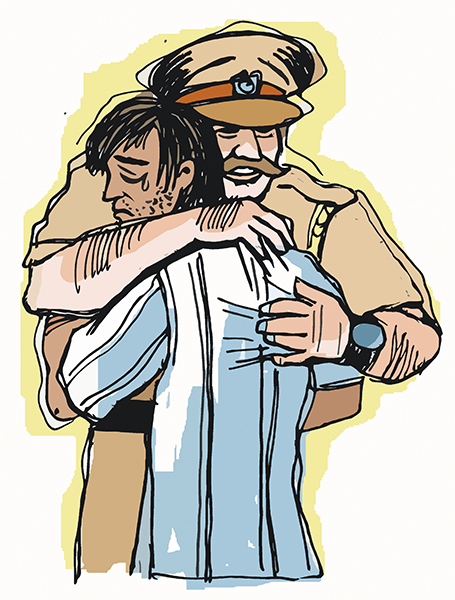
Illustration by Farzana Cooper
Siddhu began to cry aloud, "Saheb mujhé maaf karo. Mainé bahut galti ki. Mujhpar méhérbani karo (Sir, please forgive me. I have made many mistakes. Please have mercy on me).” I once again offered him my revolver, whereupon he fell at my feet and catching hold of both my legs tearfully pleaded, "Saheb méhérbani karo mujhpar. Mai kabhi aisi galti nahi karoonga. Mujhé maaf karo (Sir, please have mercy on me. I will never make such a mistake again. Please forgive me).”
Convinced that the rogue had acknowledged his fault I dismissed him, instructing Thakur to alert the policemen inside the lockup to be very vigilant as Siddhu was desperate and capable of doing anything. I ordered all the staff to return to their respective posts.
Thakur later confided that they had all been amazed at their Saheb’s guts in offering his revolver to a dreaded criminal at great risk to his own life. I showed him my revolver and removing the six rounds from the drawer re-loaded it.
I told them that I believed in the "hot and cold” technique. Realizing that hammering and abusing the culprit would be of little consequence, I decided to adopt this method. It made criminals realize that they could fool some people some of the time, but not all the people all the time.
During subsequent visits I would see Siddhu in the lockup and exhort him to give up his lawless ways. "This will not bring you any solace in life. You are still young and can reform in order to lead a better life,” I counselled him. I reiterated this advice for the five days that Siddhu remained in the lockup before he was finally charge-sheeted. While being taken to the court, he bowed when he saw me and said, "Saheb I have come across many officers during my arrest, but I have found solace only in you. I shall follow your advice and lead a better life.” I replied, "God bless you,” and he was taken to the court where he pleaded guilty. The Andheri court sentenced Siddhu to eight months’ rigorous imprisonment.
Two years later, in April 1995 the duty officer came to say that a Buddhist monk wished to meet me. I wanted to know why and was told that the man said he would not leave until he had seen "Sham Patel Saheb.” I was curious that a monk should know my name and agreed to see him.
As soon as he entered the monk bowed and touched my feet, revealing "Saheb I am Siddhu.” I was stunned, as were the duty officer and staff!
He narrated that while incarcerated in Arthur Road Jail another inmate had attempted to kill a policeman with a knife, but he overpowered the offender and saved the policeman. He felt happy that he had done something worthy and recalled my advice: "If you help people in difficulties, God will reward you.” He then vowed that when he was released he would lead a meaningful life.
After he had served his term in prison and was relased, he sat on the footpath for two days without food or drink. A passing monk saw him and inquired what was the matter. Siddhu related that he had not eaten anything for two days and confessed he was a criminal.
The monk hugged him and took him for a meal. Siddhu remained with the holy man for about a month and confided that he wished to repent. The monk was glad and ordained Siddhu a monk.
Siddhu wanted to see and bless me for guiding him to lead a better life. I was gladdened to see the change in him. I asked him to sit and ordered tea. Declining the tea, he said, "Saheb, mai aapka aabhari hu. Saheb, aapka koi kaam hoga tau safal hoga. Bhagwan aapki raksha karéga aur kaam mé bhi sahayata miléga (Sir, I am grateful to you. May you be successful in all you do and may God guide and protect you).” After blessing me, he left.
The officers and staff who witnessed the incident were stunned to see the transformation from a dreaded criminal to a holy man. I was thankful that I had been able to guide him and bring about a change. What more can one ask for in life?
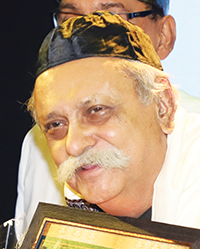
Sam D. Patel is a retired assistant commissioner of police. Patel is trustee of the Phirozshah Ardeshir Patel Dare-Meher in Andheri and an elected delegate on the Parsi Chief Matrimonial Court.