The Do-Good Cookbook published in 2025 by the Lions Club of Byculla, website: https://www.lionsclubofbyculla.org, email: dogoodcookbook24@gmail.com. Pp: 225. Price: Not for sale, available against donations.
With 254 recipes in different categories, this book is one "where nostalgia dances to the flavors of your childhood,” as stated on the cover. The recipes have been contributed by the Cookbook Group of ladies who toiled for two years to produce it. The layout of the hard cover volume has been done by Sarvesh Rane of Shree Laxmi Prints while the cover designs are by Word It Well. The book has been meticulously proofread, a plus point for readers.
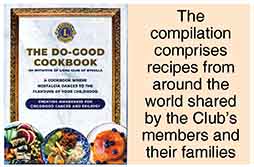
Every recipe in the book is doable, presented in a format with ingredients listed in a panel on the left and the method explained alongside in easy steps. Each contributor has been acknowledged along with the recipe. Many pages carry helpful hints as well as nuggets of food related trivia. For instance, "In ancient Sparta, the rite of passage for a boy was to steal cheese from a household without getting caught;” "The credit for introducing the peanut to India goes to the Jesuit fathers who followed Vasco da Gama to India;” "There are 8,000 varieties of rice which can be classified as short grained, medium grained and long grained;” "A mix of sugar and curd is a very ancient sweet dish.”
A detailed table of contents, marked as Index, lists recipes as per category, such as Bread, Salads and Soups, Dips and Starters, Snacks, Sides, Mains — Middle Eastern and South East Asian, Indian: Traditional and Modern, Parsi, Continental, Sweets and Desserts, Syrups, Jams, Pickles, Preserves and Masalas. Each section is demarcated with a cutely illustrated page. Excellent information has been shared in the introductory pages, explaining what distinguishes cinnamon from cassia bark, bedgi chillies from Kashmiri red chillies, Indian chai from Parsi choi. A helpful Bibliography has been appended.
So, if readers wish to indulge in exotic dips like baba ganoush, muhammara, or mutabel, breads like focaccia or bagels, Parsi delicacies like bhakhras, karkariyas and doodh pak or simple home-style food, this would be a good go-to book. As well as a do-good one. S. V.