Died: Savak Sohrab Tarapore, 79, former deputy governor of the Reserve Bank of India (RBI) on February 2, 2016 in Bombay, following cardio-respiratory failure.
As executive director of the RBI at the time of India’s economic crisis in 1991-92 and as deputy governor from 1992 to 1996 Tarapore had worked closely with the RBI governor Dr C. Rangarajan through the balance of payments crisis and the financial reforms that followed. The Rangarajan-Tarapore combine gained fame for steering India’s monetary policy during one of the most difficult periods in India’s economic history and is considered to be the prime architect of the financial sector reforms which opened up the Indian economy.
Savak Sohrab Tarapore: financial reformer
Few have highlighted Tarapore’s contribution better than Percy Mistry, senior financial authority who headed a committee to make Bombay an international financial center who in his preface to a collection of Tarapore’s speeches wrote: "Indians at large owe Dr Rangarajan and Mr Tarapore more than we realize for their wisdom and tenacity during a difficult period…They made a contribution – to re-establishing economic stability and encouraging economic recovery – of a magnitude which few people have the privilege of making in their lifetimes.”
Dr Manmohan Singh, then India’s finance minister had implicit faith in Tarapore’s abilities having worked closely with him when he was governor. Successive governors from the time of I. G. Patel onwards sought his advice even though he was a comparatively junior officer at the time. Former governor Y. V. Reddy, who is famous the world over for saving India from the global financial crisis of 2008, referred to him as his friend and guru while erstwhile RBI deputy governor Kishori Udeshi described him as an "exemplar of intellectual integrity.”
He did not mind being branded a hardliner when it came to being a crusader against inflation and for his strong belief in the independence of the RBI. He was convinced that inflation is the most cruel tax that any society can inflict on its poor and warned that the checks for controlling the fiscal deficit in India were becoming lax in a climate which was becoming increasingly populist. He felt that it was also the duty of the RBI to check fiscal profligacy and was part of the team in 1994 which worked out the details that ended automatic monetization of the fiscal deficit through ad hoc Treasury bills.
A few months before his demise Tarapore had published a slim volume on the Financial Sector Legislative Reforms Commission Report. The Report has made far-reaching recommendations and Tarapore warned that it was "premised on a morass of anger, confusion and hatred of the central bank of the country.” Major financial reforms, he said, could not be based on such a bias.
Tarapore was against loose credit, a fear which has been amply justified by the epidemic of non-performing assets across the banking sector. But despite his strong views on a variety of subjects no one could accuse Tarapore of being dogmatic. All those who knew him will attest to his sense of fair play and openness of mind. He remained, above all, the epitome of grace and dignity.
He was also a man of unimpeachable integrity. When he retired he chose to take a cab home rather than use the official car. Despite having been a deputy governor he didn’t mind standing in line like an ordinary customer at his bank. In fact Tarapore never referred to himself as a former deputy governor, preferring to call himself an economist, and this is how his columns identified him. After retirement he became a champion for the rights of customers and battled relentlessly for the common man advocating higher deposit rates, better service and more transparency. He was fond of recounting how he once went dressed shabbily to a bank and was treated equally shabbily.
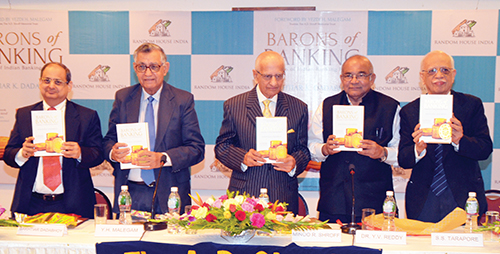
(L-R): Bakhtiar Dadabhoy, Yezdi Malegam, Minoo Shroff, Y. V. Reddy and Tarapore at the launch of Barons of Banking
If Tarapore was famous and respected when he was in office, the esteem the financial sector held him in only escalated after retirement. Almost immediately he was appointed to head the committee on capital account convertibility, now known as the Tarapore Committee. His recommendations which were published just as the Asian crisis hit the world economy in June 1997 (and which took a heavy toll on economies like Thailand which had an open capital account) were that India should move to capital account convertibility gradually after ensuring fiscal consolidation and controlling inflation and bad debts to below five percent. It must be remembered that the International Monetary Fund (IMF) was advocating full convertibility at the time and it is only now, almost two decades later, that managing director Christine Lagarde has acknowledged the wisdom of retaining some capital controls. Tarapore in this sense was one who was truly ‘ahead of the curve.’
Quick to praise, Tarapore touched many lives as a mentor, career counselor and friend. When this writer was researching and writing Barons of Banking, he had the privilege of having Tarapore as his mentor and intellectual companion. The book gained immeasurably from his advice. In fact it was he who first drew this writer’s attention to the fact that a treasure trove of confidential papers of former RBI governors Sir Osborne Smith and Sir James Taylor were available for reference at the RBI archives. Knowing Tarapore opened doors for me at the RBI as if by magic. The book was the first to bring before the general public the famous spat between Osborne and his deputy Taylor. Fulsome praise from Tarapore came this author’s way at the book launch at the Cricket Club of India where naturally he was a guest of honor!
A delightful raconteur he had a treasure trove of anecdotes which he would share with a cheerful twinkle in his eyes. For a man who had made the dismal science his career, and who was labeled as rigid and unbending to boot, Tarapore had an impish sense of humor. His wife Farida and this writer being second cousins, he would mischievously make a dig at ‘your side’ of the family.
A career central banker, he had joined the RBI as a research officer in 1961 after completing his BA (Hons) in Economics from Sheffield University and his MSc in Economics from London University. He was seconded to the IMF (1971-79). His alma mater Sheffield University recognized his stellar contribution when it conferred an honorary degree of Doctor of Laws on Tarapore. Even after retirement, Tarapore continued to render yeoman service to his erstwhile employer. The RBI appointed him to chair a number of official committees/boards including the Advisory Board on Banking, Commercial and Financial Frauds, Discount and Finance Houses of India and the Committee on Capital Account Convertibility. He was also a member of the Banking Sector Reforms Committee, better known as the Narasimham II Committee. Additionally he had served on the Court of Governors of the Administrative Staff College of India, Hyderabad, was a distinguished fellow of the Skoch Development Foundation, New Delhi and a member of the Gold Advisory Board of the American Principles Project (Washington DC, USA). Tarapore resisted the many lucrative directorships of companies that came his way since retirement, proving his exemplary integrity and adherence to principles.
After retirement, Tarapore embarked on his second equally successful career — as author, columnist and public speaker. He wrote successively for the Business Standard, the Financial Express and Divya Bhaskar. At the time of his death he was a columnist for the Hindu Business Line and also ran his own multi-language syndication with his column "Common Voice” being simultaneously published in a number of languages. His book A Commentary on India’s Financial Policies was published to much critical acclaim in 2013. His next book Interpreting Financial Policies for the Common Person was also very well-received. His last book, Unified Financial Code: Is India Ready? published a few months before his passing, revealed his concern for the proposed total overhaul of legislation regulating India’s financial sector and argued the need for a detailed examination and debate before implementation.
Those who have heard him speak will testify that the same erudition and elegance of style which informed his writings was also on display in his speeches. He was an exemplar of the adage ‘simple living and high thinking.’ Self-effacing and humble, in fact at times annoyingly so, Tarapore never actively sought the limelight — his work spoke for itself and needed no advertisement. But that said, projection is necessary in a world where self-praise is often a good recommendation. That a Padma award eluded him may never have occurred to him, but the glaring omission hurt many of his well-wishers for here was a recipient who would have lent great dignity to the award.
He departed as he had lived — with a minimum of fuss, and was cremated as per his wishes. No prayers were recited. He had also made a living will stipulating that he did not want to be kept alive by machines and hence was kept on a ventilator for just a few hours.
The national asset who left his imprint on the banking fabric of the country is survived by his wife Farida (‘my biggest support and source of inspiration’) and his two daughters, Zarine and Anjalee.
Bakhtiar Dadabhoy is the author of Barons of Banking and five other books.