The discussions at the 11th World
Zoroastrian Congress explained the value of thinking anew
Text: Parinaz M. Gandhi Photos: Jasmine D. Driver
"We have to think of ourselves as a community without borders; think of uniting the community in our individual way,” commented Dr Behram Pastakia, chair of the Information Receiving and Disseminating Committee of the Federation of Zoroastrian Associations of North America (FEZANA), when moderating the session on "Global organizations working for a better tomorrow” at the 11th World Zoroastrian Congress (11WZC) at the Crown complex in Perth in June 2018. Joining him in the discussion were Neville Shroff, non executive chair of the Global Working Group (GWG), Edul Daver, global president of the World Zarathushti Chamber of Commerce (WZCC), Firoz Pestonji, Congress chair who represented the newly formed Federation of Australian Zoroastrian Associations (FAZA), Homi Gandhi, president of FEZANA, Viraf Mehta, trustee of the Bombay Parsi Punchayet (BPP), and Malcolm Deboo, president of the Zoroastrian Trust Funds of Europe (ZTFE).
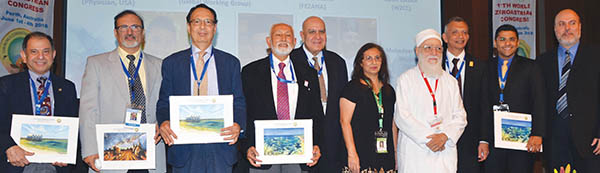
From l: Edul Daver, Firoz Pestonji, Neville Shroff, Homi Gandhi, Dinshaw Tamboly, Mahrukh Pestonji,
Ervad Asphandiar Dadachanji, Dr Behram Pastakia, Viraf Mehta, Malcolm Deboo
Above (from l) Farida Irani, Farzana Khambatta, Nergish Udwadia,
Shahpoor Kalantary, Godrej Engineer, Dr Shorsh Ali Ahmad
From l: Behroze Daruwalla, Dr Dolly Dastoor, Katayun Kapadia, Dr Delara Javat, Tanya Balsara
"The GWG addresses global issues, keeps attention on what matters in the global community. We work in harmony and unison so that we can move towards actively finding solutions,” stated Shroff. He described the informal body as being constituted of leaders of communities around the world, meeting once a year to discuss global issues. "It is an inclusive, progressive, decision making body” that determines the venue of prospective WZCs and youth congresses, and evaluates the nominations for awards.
WZCC that encompasses 14 chapters from eight regions around the world strives to "add value and make the world body sustainable with youth involvement,” said Daver. The informal sessions in Bombay of "Coffee with WZCC” have resulted in the formation of active WhatsApp groups for promotion of business among themselves. This concept has been adopted in London and will hopefully be taken up in other cities too. He further referred to their plans in collaboration with the World Zoroastrian Organisation Trust Funds to give interest free loans varying between five to 25 lakh rupees to youth seeking to launch their business.
"Combining the best of other federations and with the wonderful support” of member associations, FAZA representatives had their first meeting on May 31, reported Pestonji. The Zoroastrian Association of New Zealand too evinced interest in joining FAZA. Hoping to use the surplus from the Congress for the newly formed Federation, Pestonji alluded to their plans to establish a community center in Perth, "to have something in Perth to call our own.”
FEZANA as "an umbrella body” supports community members who work hands on, briefed Gandhi. "We are part of the United Nations as a nongovernmental organization… The Federation is recognized by the Department of Public Administration,” he added. A short video gave a visual account of FEZANA’s many activities.
The BPP as the "custodians of funds and properties does its best to help the community from birth to death,” stated Mehta. Formed nearly 300 years ago to "protect dakhmenashini, it has progressed to meet the education, housing and other needs of the community.” On issues like inclusion and universalization of Zoroastrianism, "the Parsis in India are disconnected from Parsis in the rest of the world,” he observed.
"We have a universal outlook and participate nationally. As a worldwide community we must aspire to make ourselves represented nationally and internationally,” stressed Deboo. When ZTFE was established in 1861, it was with the intention of serving the Zoroastrians of Europe. He referred to their first president Dadabhai Naoroji approaching Queen Victoria to emancipate the Zoroastrian community in Iran and how the Trust approached the home department last year on behalf of a Zoroastrian family that needed assistance.
Subsequently Shroff gave insights into the working of the Zoroastrian Charity Funds of Hongkong, Canton and Macao where the five trustees realize "the need to work together in harmony without tarnishing the image and reputation of the worldwide community… When there are differences, we respect each other’s opinion, and resolve issues with tolerance… We are very inclusive and broadminded while respecting our traditions. We are adaptable and will change when it is absolutely necessary.”
Pastakia impressed on the global bodies to make the Zoroastrian scriptures relevant by respecting the natural elements of earth, water, fire, air. He further advocated the need "to work with (our) Iranian brethren.”
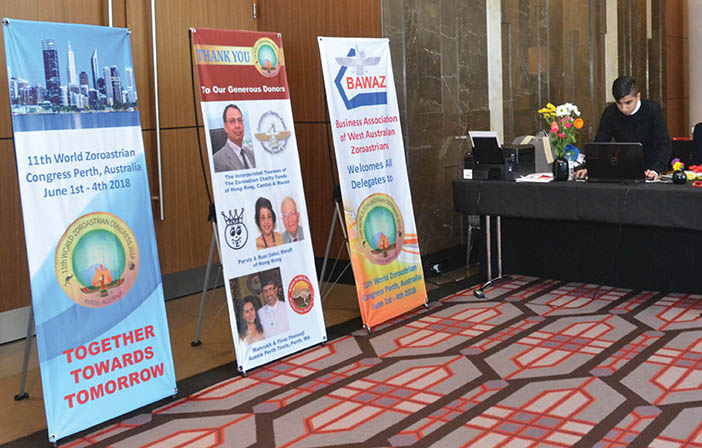
Poster standees at the Crown complex
Activities in Australia
The first panel discussion at the Congress dwelt on the activities of the newly constituted FAZA members with insights being offered by Farida Irani of the Australian Zoroastrian Association (AZA) of Sydney, Farzana Khambatta of the Business Association of Western Australian Zoroastrians (BAWAZ) in Perth; Nergish Udwadia of the Zoroastrian Association of Victoria (ZAV) in Melbourne; Shahpoor Kalantary of the Zoroastrian Association of Western Australia (ZAWA) in Perth; and Godrej Engineer of the Zoroastrian Association of New Zealand (ZANZ).
AZA in Sydney has around 1,200-1,400 paid members from the total count estimated between 2,500 to 3,000. They have been running the Sunday School for the last 40 years, conducted regularly on the first Sunday of the month on their five-acre AZA House in Annangrove. This activity was originally conducted at the Unitarian Church Hall when it was initiated in 1977. A series of fund-raising events with major donations from Arbab Guiv and the Zartoshty Brothers resulted in the AZA House. The third Sunday of the month is reserved as Seniors Day and the fourth Sunday for the "working bees.”
Akhtar Ostowari is the matriarch of the community. "Parsis and Iranians stand together as united brethren.” Coming together for festivals and other celebrations, Irani commented that they are "a very united/inclusive community.” They initiate the children of outmarried Zoroastrian men or women, she stated, receiving a resounding applause from the audience.
BAWAZ is keen to establish a community center "where the children can grow up together; families can spend time,” declared its secretary Khambatta. Referring to their "deep commitment to the next generation,” she felt that the "goal of having a place of our own seems attainable now that we have Yaz Mubarakai (the first Zoroastrian member elected to the Legislative Assembly of Western Australia) on board.”
"Perth has got factions,” admitted Kalantary, chairperson of ZAWA who will be stepping down from the position after his third term. He regretted that ZAWA did not participate in organizing this Congress, although on a personal level, Kalantary’s unequivocal support was acknowledged at different times during the Congress. Wary of the "problem of fragmentation and groupism” in Perth, he was keen to promote unity. He also alluded to the "wicked problem” of shutting the fire temple doors to the non-Zoroastrian spouse. He told the assembly of his son’s refusal to visit a fire temple (in Bombay) where his wife is not welcome. "As a community we must have one flame burning for everyone,” he recommended. Coming from a maintenance background, he cautioned those who wanted to raise funds to build new temples: "It is very good but we must also keep in mind the cost of future maintenance when we know that dadgahs in India are falling back” for want of devotees and upkeep.
Udwadia referred to their fastest growing numbers in the smallest state and their dream to establish their own dar-e-meher so the count of the fire temples in the world rises by one although there is concern whether there would be sufficient numbers in the future generation to maintain a community property.
The Yasna Zoroastrian organization that represents the Kurdish Zoroastrians of Melbourne was also keen to join the Australian Federation, as announced its director Dr Shorsh Ali Ahmad.
"The Parsis of the Gold Coast and Brisbane have been meeting regularly on a social level for the past 20 plus years (but)… due to lack of numbers currently we do not have a Zoroastrian association in Queensland,” noted an advertorial in the Congress brochure. They invited new families and individuals moving to Queensland to contact them on their website qldparsi.webs.com
Accepting spouses and children of interfaith marriages, ZANZ believes in being "inclusive in religious and cultural aspects,” stated vice president Engineer amidst cheering from the audience. The community strength is believed to be over 1,200 in NZ. Besides conducting classes on culture and religion for the youth and children on the second Sunday of each month, the youth are encouraged to participate in impromptu dramatization of mythological tales where the children love to enact the roles of heroes/heroines and villains. The Zoroastrian story of creation was presented as a sound and light show. From their scholarship fund, youngsters pursuing university and higher studies are given financial encouragement. The members were also involved in fund-raising to assist a Zoroastrian youth who was keen to play on the New Zealand football team at a world meet in Barcelona.
Wonder women
"Moving into the 21st Century: Zarathushti Women, The Power Unleashed!” was the subject explored by the panel moderated by Behroze Daruwalla, chairman of the Women’s Entrepreneurs wing of WZCC. The other ladies on the panel were Dr Dolly Dastoor and Katayun Kapadia, former presidents of FEZANA, Farzana Khambatta, chemical process engineer in Australia, Tanya Balsara, founder of Computer Center for the Blind in Bombay and Dr Delara Javat, basic physician trainee at the Royal Perth Hospital.
"In a world where we face gender discrimination, Zarathushti parents tend to treat kids equally,” appreciated Daruwalla. Successful women are able to lay "a firm foundation and build beautiful houses from bricks thrown at them.” A society develops: morally, ethically and spiritually when women are allowed to play their part and are not stifled; materially, when women contribute to business and commerce; culturally when womanhood is not stifled; politically when women leaders take charge, pointed out Daruwalla.
Dastoor who did her PhD at 60 years of age, mentioned how she needed to "retool” herself when she relocated from Nigeria to Montreal. From being a senior research fellow on a World Health Organization project on schizophrenia, her new job as a research assistant in geriatrics required extensive study and development of programs on dementia. She commented on "the resilience of the human spirit and brain” that permits an individual "to smile despite facing physical, financial and sexual trauma.” Realizing that she is privileged in a world where women face gender discrimination, she asked of herself "What can I do to give back?”
Javat who has a passion for medical research and has published papers in interventional cardiology mentioned that when she was initially addressed as "nurse it didn’t bother me.” But then she began to "assert” herself. Having a mentor helps one channel one’s energies in the right direction, she has learnt.
With a global exposure during her career in audits, Kapadia respected diversity and teamwork, commenting on how the French walk into meetings with papers in hand, the Germans with piles of books, and the Americans with phone in hand. While the Germans like to follow the agenda, the French are more innovative, and the Americans like to revisit items on the agenda. In terms of community service, she has been active in the Zoroastrian Association of Pennsylvania and New Jersey, FEZANA, and currently is the global WZCC treasurer. "Opportunities are available. If you don’t take it, others will,” she observed. The support of her late husband and her family, and her Zoroastrian values and skills learnt as a girl guide helped her face all obstacles including three layoffs, she revealed. Three Zoroastrian ladies from North America who were her role models were Dastoor, Roshan Rivetna and Khorshed Jungalwalla, she stated. To her, "Men and women are equal if they adopt a ‘can do’ attitude.”
In the engineering domain, Khambatta referred to the three main things she has learnt: find the right balance without being too timid or too bossy, speak up if you have something to say, be adaptive in different situations. Pursuing her determination to do something new and different, she stated, "If you have a dream, go for it.” She appreciated the support of her husband Ross who is her "best friend and sounding board.”
Balsara acknowledged that teaching and learning is a concurrent exercise —she picked up Hindi from her students whilst imparting English language skills. She was able to surmount her visual handicap thanks to the support of "a wonderful family. Dad (Sam) always gave me a push. Without a push I could not have gone anywhere.” Mentors in one’s life she considered absolutely important. Her next goal is to start more centers in Bombay and around India with the help of socially committed individuals.
Summed up Daruwalla, "Women are angels but when someone breaks their wings, they simply continue to fly, on a broomstick! That is the flexibility that they have!”
Other panel discussions concerning entrepreneurship and the youth will be featured in the next issue of Parsiana.