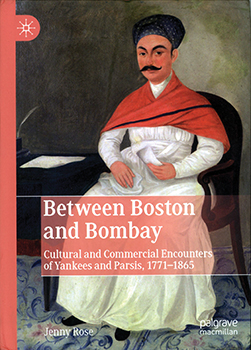
Between Boston and Bombay: Cultural and Commercial Encounters of Yankees and Parsis, 1771-1865 by Jenny Rose. Published in 2019 by Palgrave Macmillan an imprint of Springer Nature Swizerland A G, Gewerbestrasse 11, 6330, Cham, Switzerland. Pp: xx+328. Price: US $ 84.99/€ 72.79.
Jenny Rose’s (pictured) book opens with a tantalizing question: were American Pilgrims and Puritans consuming spices from India in the early 17th century? The answer is yes: at least by 1629, less than three decades after the establishment of the English East  India Company (EIC) and nine years after the voyage of the Mayflower, Indian pepper, cloves and cinnamon were being shipped all the way to Massachusetts.
With this discovery, Rose — a professor at Claremont Graduate University in California — threads together an intricately detailed narrative of connections between Americans and Indians, focusing specifically on Bombay Parsis and Yankee merchants from New England ports. These interactions began in a very remote fashion: scholarship on Zoroastrianism and ancient Persia, for example, finding its way to colonial American libraries via the recommendation of figures such as Benjamin Franklin. By the end of the American Civil War, however, deep and abiding friendships stretched across the seas, linking together the counting houses (offices or buildings where the accounts and money of a person or company were kept) of Northeast America and Bombay and speaking of an "unparalleled degree of intercultural trust and transnational commercial partnership.”
Any map of an American port city will attest to a largely forgotten history of seafaring trade with the subcontinent: New York, San Diego, Boston, Providence and San Francisco boast an India Street, India Basin or India Wharf. The "East India trade” was particularly critical to New England in the years between the American Revolutionary and Civil wars. Recent books, such as Susan Bean’s Yankee India, have done much to recover this history. By focusing only on Bombay Parsis and Yankees, Rose provides a more fine-grained narrative — yet this focus allows her to better illuminate broader aspects of relations between colonial India and the young American republic. Rose documents striking similarities between these two elite mercantile communities. Both the Kisseh-i Sanjan and William Bradford’s Of Plimoth Plantation — founding narratives of the Parsis and Pilgrims, respectively — were penned within decades of one another, in an era of unprecedented European seafaring expansion (the Kisseh, of course, was based on far older oral traditions). Parsi-Yankee interactions facilitated a much wider intellectual exchange in the first half of the 19th century. New England’s finest thinkers and writers — Ralph Waldo Emerson, Henry David Thoreau, and Herman Melville — dabbled with Zoroastrian themes around the same time that Bombay Parsis confronted and debated with Christian missionaries, some of whom hailed from New England towns.
 Reconstructing this history is a difficult task: while American libraries have immaculately preserved the papers and mementos of Yankee merchants, 19th century mercantile correspondence in India has largely turned into dust. The Wadia family, which features prominently in Rose’s book, had a collection of historical papers through at least the 1960s but nothing seems to remain today. Any resulting narrative, as Rose admits, is invariably one-sided: American voices predominate, and there are certainly no voices of Parsi women (who were rarely allowed to interact with American visitors).
Despite these limitations, Between Boston and Bombay paints a vivid portrait of the lives of elite Parsi merchants. These were men who, having mastered English and taken on the functions of cultural intermediaries, brokered lucrative trade between India and America while caring for the smallest details of the lives of visiting Yankee merchants. Parsis provided them with accommodation, furniture, household supplies, Parsi servants (including palanquin bearers, cooks, and someone to carry their umbrellas) and Parsi guides for navigating Bombay. Strong kinship networks between Parsi traders, provisioners and servants ensured that American dollars kept on circulating through the community. Merchants such as Nusserwanji Maneckji Wadia, the first Parsi broker to American traders, kept up ties of friendship long after their American colleagues had sailed home. In the very early 1800s, Nusserwanji dispatched to John Johnston, a New York merchant and later a founder of New York University, a carton of mangoes and even "a very large he-goat.” Gift-giving between Parsis and Americans indicated "a relationship that was one of perceived equals,” Rose argues.
Goats and mangoes point towards surprisingly diverse US-India trade. Yankee merchants originally dropped anchor in Bombay harbor in search of raw cotton and textiles, much of which was from Gujarat. In return, they offloaded a variety of goods from New England and ports in-between: chocolate, beef, cod, salmon, mackerel and copious amounts of alcohol. Parsi merchants would then sell these goods to Bombay’s European residents and an increasing Indian clientele. Over time, items of exchange ballooned in quantity and variety: New England merchants arrived carrying olive oil from California’s Spanish missions, sperm whale oil candles, tobacco and pots of pickled oysters; they left with hulls filled with "Bombay blackwood” furniture, elephant tusks and thousands of buffalo horns (carved into combs, snuffboxes, buttons and other household goods). Cashmere was a particularly vaunted Indian luxury item which, for some strange reason, Yankees insisted on calling camel’s hair.
Two goods, in particular, defined Bombay-New England trade. The first was ice — block upon block cut from frozen lakes around Boston and shipped, improbably, halfway around the world to relieve tropical torpor. At the ice trade’s outset in the 1830s, only one-third of this frigid cargo melted before being offloaded in India. Along with ice came New England apples, which were in such demand in Bombay in the 1860s that an American merchant had to arm himself with a club to keep customers at bay. The ice trade, Rose details, allowed for ice cream and ice-based desserts to be widely sold on Bombay streets by mid-century. And it also tied Bombay closer into global political and economic networks. The city’s ice-hungry denizens, for example, were rudely inconvenienced by the California gold rush: with so many Boston ships being commandeered to transport Forty Niners to San Francisco, the ice trade dwindled to a literal trickle in the early 1850s.
The second item of trade was, of course, opium — the drug upon which so much of 19th century Parsi wealth was built. Parsis were critical facilitators to the Americans: as Salem or Boston merchants lost access to Indian cotton due to British competition, Parsis directed their attention to the lucrative drug trade, providing Malwa opium in Bombay and access to the Chinese market through Canton. American firms partnered with Jamsetjee Jejeebhoy and numerous other Parsis to circumvent the EIC’s monopoly on opium and the Chinese government’s ban on its import. In return, Parsis channeled some of their profits into Chinese tea shipped to New England.
One of the book’s key strengths is how it uncovers Parsi and Yankee perceptions of one another. We are provided with glimpses of early cosmopolitan figures: a Salem native, for example, who visited the Wadia family’s palatial residence in Parel, Lowji Castle, and directly compared it to one of the grandest homes in the distant Massachusetts town of Newburyport. The patriarchs of both houses, he conceded, were remarkably similar — similar enough for him to believe in "the transmigration of souls.” Such observations tempered Western attitudes of racial and cultural superiority.
Some Americans, no doubt reflecting on their own recent history, empathized with the Indians’ colonial predicament. Thomas Roberdeau Wolfe (a Louisiana native, not a Yankee) advised the EIC on cotton cultivation in Bharuch in the early 1840s but harbored scathing opinions about British colonial rule. He welcomed the development of the Indian Press, an "organ of liberty” which, he hoped, would terrify the "hitherto fearless Lords of Leaden Hall St” in the Company’s London headquarters. But omissions can be as revelatory as the accounts themselves. While he railed against "foreign oppression and slavery” in British India, sanctimoniously priding himself on being from a more "progressive” country, Wolfe completely avoided any mention of how actual slavery drove the economy of his home state and the rest of the American South.
Rose ends her book with the American Civil War, a moment that collapsed distances in global economic and political relations. The first known Parsi visitors to America, Ardashir Cursetji Wadia and his male Parsi servant, arrived a decade before the War. At least three Parsis toured the country while hostilities raged. Here, too, we find a remarkably cosmopolitan cast of characters. The Parsi visitors sympathized with the Northern cause against slavery — some of their fellow Bombay merchants had even raised funds for a Union army hospital — and one might have written a letter of sympathy to a New York paper after Abraham Lincoln’s assassination. Parsi opposition to American slavery, Rose presciently observes, developed alongside Parsi assistance to their impoverished co-religionists in Iran and Parsi participation in calls for sustained political reform in India. In the crucible of war (albeit a geographically distant one), leading Bombay citizens began developing a strikingly global outlook on rights and remedying injustice.
Today, there are lingering reminders of this earliest chapter in US-India relations. Re-enactors at Plimoth Plantation demonstrate to tourists how Pilgrims cooked their chicken with Indian spices. The Peabody Essex Museum in Salem — not far from the town’s India Street — contains a magnificent collection of 19th century Parsi artefacts, trundled back to New England’s frigid shores by mariners who built up a repository of knowledge of the societies with which they traded. Rose’s Between Boston and Bombay provides an insightful voyage through these networks of knowledge, commerce and friendship. New England ice and Gujarati cotton long ago disappeared from Bombay’s streets, but an Indian version of this book, hopefully out in the next year or so, will allow Bombayites to rediscover the first moment when America dawned on their city’s horizons. Dr DINYAR PATEL
Patel is assistant professor of History at the S. P. Jain Institute of Management and Re-search in Bombay. He is the author of Naoroji: Pioneer of Indian Nationalism, published by Harvard University Press in 2020.