Our country has a rich heritage of music and many maestros have dedicated their lives to its dissemination. Indian music has many forms. Classical music is sonorous in both its forms, Hindustani classical music from the northern parts of the country and Carnatic music from the southern parts. Both these have evolved over time and are still evolving into newer forms. The same Indian music helped give rise to a great singer in the Western world. Though the singer passed away a long time back, western society still feels the impact of his music. He was Farrokh Bulsara, also known as Freddie Mercury.
In the 1970-80s, the Western music world in Europe and America was dominated by Mercury and his band Queen in England. Their music and lyrics appealed to both the young and the old. Their popularity was such that there was no doubt in anybody’s mind that Mercury was the greatest singer of the century. It has been 28 years since he passed way, but even today people are captivated by his enchanting and magical music.
 Freddie or Farrokh was a student at Panchgani’s St Peter’s School in Satara district for eight years. During this time, whenever he played Elvis Presley’s songs on the school piano, the valleys of Panchgani would echo with the music.
Farrokh was born on September 5, 1946 in the British colony of Stone Town, in Zanzibar, Tanzania, Africa. His father Bomi Bulsara hailed originally from Valsad in Gujarat and worked as a cashier in a British colonial office. Like any father, he wanted his son to get a good education steady job and at one time even dreamt of making him a boxer. To achieve this and to inculcate culture in him, like many other Parsis, he admitted his son to St Peter’s School. The 158-year-old School, renowned in Bombay Presidency, had been established by a British Officer J. Chesson in 1861 and has nurtured many greats. It proved to be a turning point in Mercury’s life, which he often acknowledged. It was during his years at St Peter’s that he truly started loving music. The teachers worked hard to train him to become an expert pianist and also taught him as many western string instruments as possible. It was probably because of these efforts that Mercury was able to make a mark in Western music.
Even today, some of his former schoolmates in India share their memories of Mercury with the media. Whether it be the 20 km bicycle rides from Panchgani to Mahabaleshwar or boat rides in Venna lake at Mahabaleshwar, the Malcom locality (the present day Mahabaleshwar-Panchgani area) still bears the imprint of Mercury’s childhood stories. While at Panchgani, he and his friends had founded bands like The Hectics and Covered Rock and Roll. One can see signs of these bands at St Peter’s School.
Mercury remained at the School till the age of 12. Following the revolution in the British colony of Tanzania, the Bulsara family relocated to England and Mercury had to curtail his education at Panchgani midway. In England he was admitted to a school at Middlesex and later attended Isleworth Polytechnic (now West Thames College) and Ealing Art College. He then started working at Heathrow Airport and even sold clothes in the by-lanes of London. But his ingrained love for music did not allow him to be content with what he was doing. He visited the local bands and musicians seeking a chance to showcase his talent. Finally, he got a break in 1969 when he started his career with a Liverpool band named Ibex-Wreckage which performed at various clubs.
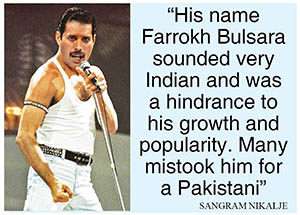
In April 1970, guitarist Brian May and drummer Roger Taylor came together to form a band named Smile which he joined. (Bassist John Deacon joined them in 1971.) The singer’s popularity was increasing by the day, but he soon realized that his name Farrokh Bulsara sounded very Indian and was a hindrance to his growth and popularity. Many mistook him for a Pakistani. Fearing this might have an adverse effect on his career, his co-musicians changed his name to Freddie Mercury. Thus, was born the star! His popularity and that of the band increased manifold. Newer songs were written and composed which became the rage with listeners. Many recording companies gave a red carpet welcome to the band for recordings. They decided to name the band Queen, and there was no looking back. Mercury was soon able to create a special place for himself amongst great singers like David Bowie, George Michael, John Lennon, Michael Jackson, Bryan Adams and Lionel Richie.
Sadly, at the peak of his career Mercury was diagnosed with HIV/AIDS. The disease did not deter him from performing on stage across the world. But AIDS took its toll and he passed away the age of 45 on November 24, 1991. The following year, in 1992, his co-performers in Queen formed the Mercury Phoenix Trust so that the memory of the great star could be perpetuated. The Trust works for the prevention and eradication of AIDS and its suffering all over the world.
In 2018, a film on the life and times of Freddie Mercury named Bohemian Rhapsody was released. The film, however, did not dwell much on the singer’s childhood, which in a way makes it an incomplete account. He and his band bagged many prestigious awards.
It is matter of pride for every Indian that Mercury was molded as a musician and singer at Panchgani’s St Peter’s School. His alma mater trained him in the basics which helped in his transformation into one whose music still rules the hearts of people across the world. The people of Satara should remember with pride that it was from here that that this star emerged. SANGRAM NIKALJE
Editor, Sataratoday
ksailesha@gmail.com