During a long road trip through the tribal
belt a quaint shop sign read: “God Makes Man. Tailor Makes Gentleman”
Dilnavaz E. Bhagwagar
Something good can come out of the worst of situations. I am stating this as a matter of personal experience and not just as a well-known adage. In this case, trains and planes not working was the problem. A wonderful road trip that we made because of that, with our son Naushad, was the happy outcome!
Naushad’s work involves mines and minerals. He is owner in CIMMCO (Central India Mining & Marketing Corporation), a mining company and major suppliers of limestone, lime and kyanite to steel mills, alumina refineries and refractory plants across the country. Jindal Steel, SAIL (Steel Authority of India Limited), Tata Steel, Vedanta and National Aluminum Company Limited (NALCO) are among the major industries the Corporation supplies to.
Coming from a business family, Naushad had never considered working for anyone else, even to begin with. There is an interesting story of how the Bhagwagar family got into business. It dates back to Naushad’s great-grandfather, Pirosha Bhagwagar who worked in the railways. He lived in Bhusaval and used to bring the Bombay Mail train from Bhusaval to Nagpur. While still young and hot-tempered, Pirosha had an argument with a British station official in Nagpur who asked him to apologize for the delay in a train’s arrival — or resign. Pirosha refused to apologize; he said it was not his fault as the train was already running very late. The tiff blew up into a major argument and the station master terminated Pirosha’s contract on the spot.
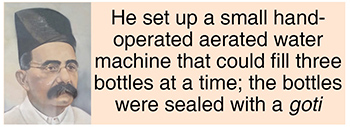
Pirosha decided to stay on in Nagpur, where his family joined him. The Empress Mills started by Jamsetji Tata was a major industry and employer at that time. But Pirosha decided he had had enough of working for other people and would start his own enterprise, however small. Near the main gate of the Mills, known as Lakshmi Gate, he set up a small hand-operated aerated water machine that could fill three bottles at a time; the bottles were sealed with a goti (marble). The mill laborers began to enjoy this new drink in lemon and raspberry flavors, sold at half an anna a bottle. Hard work and the blessings of Goddess Lakshmi propelled Pirosha to move to a bigger place, with more machines and an increasingly popular and profitable business. Thereafter, his son, grandsons and great-grandsons, one of whom is Naushad, all took to business in Nagpur and made a success of each such endeavor.
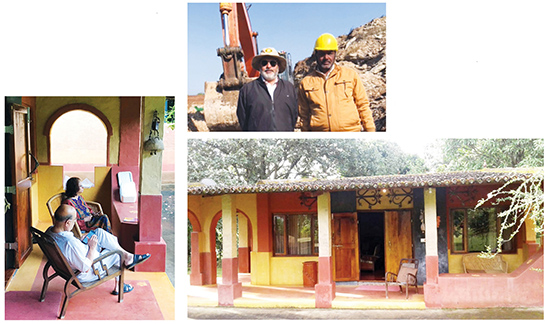
Clockwise, from top: Naushad Bhagwagar (l) at limestone mine;
Naushad’s cottage at Chandoori Sai; Edul and Dilnavaz Bhagwagar on verandah of the cottage
Above l: Edul and Dilnavaz with mine manager;
above r: trucks ready to load at CIMMCO limestone mines, Katni;
below: Pirosha Bhagwagar
Naushad’s work often necessitates his traveling to places where the industries he is supplying to are located. Some months ago, he needed to go to the aluminum refineries of Vedanta and NALCO in the Koraput district of Orissa. Due to the non-availability of his usual mode of travel he decided to make the trip by road. Having been Nagpur-bound since March 2020, my husband and I felt the long drive would be a beneficial getaway and change for us, in addition to providing company for our son. Our children and grandchildren in the USA were unhappy about this. "At your ripe old age, you are advised to stay at home and go out only if necessary. Instead, you want to be reckless, travel through three states and jeopardize your immunity?” We were touched by their concern. Nevertheless, we don’t feel "ripe” or "old” so we set off on this interesting journey, promising not to be reckless!
From Nagpur in Maharashtra, it is a 14-hour drive through Chhattisgarh and on to Orissa. We broke our long journey for a night at the royal palace of Kanker, in the town of the same name. We were hoping to stay in the palace where one wing is open to guests. But because of the coronavirus and possible infection from guests, the royal family had temporarily closed the palace to outsiders. Instead, we stayed in their very clean, comfortable and well-appointed guest house on the sprawling green lawns around the palace.
Naushad had stayed there on earlier visits and knew the family. Youngest of the three brothers Ashwini Deo, called Jai, welcomed us and made sure we were comfortable. Older brother Surya Pratap Deo, known as King Jolly, lived up to his nomenclature of being friendly and gregarious. He dropped by at sundown, apologizing that he couldn’t have us over at the palace because of safety measures for the wives and children necessitated by the virus. Instead, he and his dog with his friend and public relations (PR) man Babbu, joined us for a drink and hot, tasty chicken tikkas. Jolly regaled us with stories of the state and the princely family. While the two brothers we met live in Kanker, the eldest of the three is a senior professor at St Stephen’s College in Delhi.
The next morning we had planned a quick breakfast and an early start to our destination in Orissa. But that was not to be. Babbu joined us for breakfast and regaled us with so much information and such entertaining stories of Kanker that we found it hard to leave. "You have come at a bad time,” said Babbu. "Because of the coronavirus we have extremely few visitors. When the guest house has more people, we have a bar, local music and dances by tribal groups in the evenings. In the daytime we take tours to the temples, markets and tribal villages. More than Indians, we have foreigners, mainly Italian and French groups, staying with us.” How do they know about these places, I wondered aloud. "Purely by word of mouth. They pass on our website
kankerpalaceheritage@gmail.com to friends. Just as we hope you will too!” he said. Apart from being a good PR person, Babbu was very well informed and extremely knowledgeable about Kanker, its history and attractions. The one-hour delay in our planned departure was well worth the time.
The next seven-hour drive from Chhattisgarh to Orissa was through the tribal and iron ore mining belt of Bastar. We stopped to see the local artisans in Kondegoan who still keep alive the very intricate and painstaking lost wax brass metal casting process. Ironsmiths, who previously shaped spears, swords, axes, farming and kitchen tools, now also do tribal art in iron. We picked up a trio of intricately molded brass bulls. They now occupy pride of place on the bar in our drawing room.
After a scenic drive, we reached the potters’ village of Gaudiguda, in the Koraput district of Orissa. Minutes later, we drove into the gates of Chandoori Sai, whose owner Leon Mahoney was at the door to receive us. As if his warm welcome was not enough, one of the Paraja tribal girls who help look after the guest house unrolled a brightly printed sari (the tribal equivalent of a red carpet) across the entrance for us to walk on!
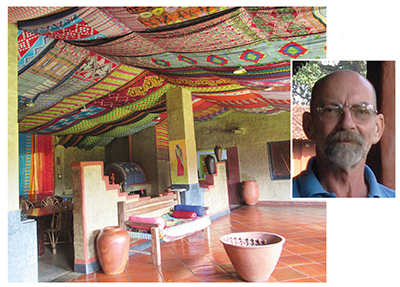
Chandoori Sai guest house with owner Leon Mahoney (inset)
Above, l: Tailor’s shop with quaint name board; r: tribals’ weekly local market
Our son, who visits NALCO every couple of months in connection with his mining business, had earlier stayed at the company’s guest house. He discovered Mahoney’s place because he is always looking out for something unusual.
The story of Mahoney and his guest house is unusual. In 1980 Mahoney, who lived and worked in Australia on oil mining rigs, came to India for the first time. He loved it. He returned several times on short trips to different parts of the country. In 2001 he gave up his job in Australia and moved to India where he has remained ever since. On his travels around the country, he happened to come to the tribal district of Orissa. There was no going back after that! He leased a piece of land near the potters’ village of Gaudiguda and started building the resort which he named Chandoori Sai, the local name for a big mango tree in his backyard.
It is a colorful scene all around with the tribal women in their differently draped, bright and colorful saris and wide, welcoming smiles on their faces. Mahoney himself walks around barefoot clad in a lungi. But he does not speak a word of the local language. Instead he has taught the tribal women a smattering of English, enough to understand and be understood.
Naushad started staying at Chandoori Sai whenever work took him to Koraput. Mahoney and he built up a strong friendship. In time, Naushad constructed his own personal cottage in the compound, keeping to the same design and character but with two bedrooms and a finely furnished and well equipped drawing-dining-kitchenette. It is now our little home in this beautiful part of the world.
Chandoori Sai is not a luxury resort but probably more esthetically pleasing, comfortable and peaceful than most resorts, with good, fresh home cooked food. It does not even have a television set. The washing of clothes is done by the tribal women in a circular stone water fountain in the garden. Other than their laughter and chatter, the only sound is that of chirping birds and crickets. If you are writing a book and need peace and quiet or if you enjoy reading and long walks along beautiful green fields, this is the place to be in.
The tribals’ most keenly looked forward to event is the weekly local market day. Fresh vegetables, chickens and animals are transported from the surrounding villages, some in rickety vans packed with produce and people, many sitting on the carrier on top, others walking the distance. Potters from the villages bring their pots, strung from bamboo poles balanced across their shoulders. Colorful saris and copper or gold coated jewelry are on sale. Social distancing and masks are unheard of at the market!
From our cottage in Gaudiguda one can walk to different villages, each with a character of its own. The one closest is a potters’ village, where they make mostly matkas (earthenware water pots) and a few decorative items. The damaged or slightly leaking matkas have their own market value. These are filled with water and placed near very young, growing mango and cashew nut trees, to supply them with constant dripping water.
The week at Gaudiguda flew by. Seven days, on one of which I celebrated my 77th birthday in the middle of nowhere. It was a celebration complete with chilled champagne, starters of cold cuts, biscuits, cheese and a roast chicken with potatoes made by Mahoney. A super cake from Tauby’s Bakery in Nagpur (Tauby is our daughter-in-law) was the perfect end to a wonderful evening.
Before we knew, it was time to return home. We said our goodbyes to Mahoney and the tribal girls who had made our stay so comfortable. Driving back through villages and small towns, a quaint hoarding over a tailor’s shop caught my attention. It read: "God Makes Man. Tailor Makes Gentleman.”
On our return journey we made an overnight stop at the Chitrakoot Falls in Chattisgarh.
The waterfalls were breathtaking. They seemed to be within touching distance from the balcony of our room at the guest house run by the Government of Chattisgarh, Tourist Department. Set amid beautiful greenery, the rooms were comfortable, the service, good and the food, fine. After breakfast we made the long eight-hour road drive back to Nagpur, with beautiful memories.