Nation-building is a constant theme in the advertisements
issued by the Tata group from its early days
Deborah D'Souza
On September 9, 1925, Jehangir Tata wrote a letter to his father Ratanji Dadabhoy Tata from the barracks in the south of France. The 21-year-old had come up with a way to help the family business. He wanted Pathé News, a famous newsreel maker of the time, to produce short films about current events in India to be shown in the country’s cinemas.
The young Tata scion believed that footage of Mohandas Gandhi’s visit to their steel factory in Jamshedpur in 1925 would be "excellent and free propaganda and advertising.” "Too many people in India believe that steel works are just the same as a cotton mill, a foundry or a power station,” he wrote. "That is why they are all so amazed when they see that people who have seen this marvellous plant and the fine town we have built don’t wonder afterwards or shout where the (Rupees) 21 crores have gone to!”
Jehangir Tata, who would later be popularly known as J. R. D. (JRD) Tata, apologized to his father in case he was "talking rubbish...It is the best way to talk sense one day, isn’t it?” he wrote. The letter was but a small glimpse into events that would transpire in the future.
Nation-builders
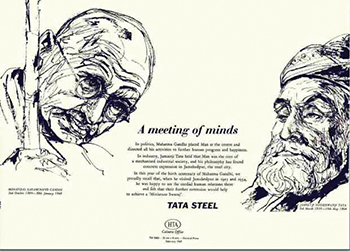
Gandhi had made the trip to Jamshedpur to resolve labor disputes and ask that the Jamshedpur Labour Association be recognized by the company. Jehangir Tata had been informed that Gandhi’s preconceptions were shaken after he visited the factory and believed sharing the footage with the public would quell any similar distrust among them. In 1969, the year of Gandhi’s birth centenary, a Tata Steel advertisement from that time said, "We proudly recall that when (Gandhi) visited Jamshedpur in 1925 and 1934, he was happy to see the cordial relations there” and felt if this bonhomie was extended to other places it would help achieve ‘Miniature Swaraj.’
The culture industry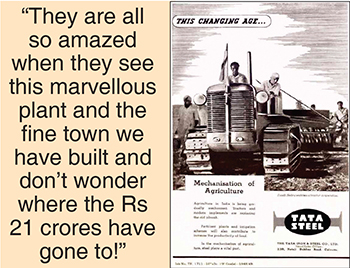
J. R. D. Tata took charge as chairman of the Tata group in 1938. During his 53-year tenure at the helm, the group published numerous advertisements asserting its contribution to the country. The messages were asking consumers to "Jaago Re (wake up)” or add a pinch of "Desh ka Namak (country’s salt)” to their food. Tatas were communicating — in a variety of ways — their alignment with India’s mission to be self-sufficient, enlarge the economy and raise the standard of living. One theme that runs right through them is nation-building. Over 200 vintage advertisements of the conglomerate, from the early 20th century up to 1990, along with the letter that J. R. D. Tata wrote to his father, are on display at the Tata Central Archives in Poona.
"The exhibition (Tata Vintage Advertising and Publicity) showcases not only the genesis and history of the Tata group, but also highlights in parallel the integral role that the group has played in India’s industrialization and progress,” states the press release.
The foundation of the Tata group was laid by Jamsetji Tata in the 1870s with a textile mill. The young Parsi who had held nationalist sympathies had made a tidy profit of Rs 40 lakh sending supplies to the British troops during the Abyssinian war. After Jamsetji’s death, Lord Curzon, the viceroy of India between 1898 and 1905, said that "no Indian of the present generation had done more for the commerce and industry of India.”
After Independence the Tatas continued to be regarded as patriots. But Indian leadership at the time also held strong socialist ideals, and both large private enterprises and advertising were viewed with suspicion.
 Early in 1968, J. R. D. Tata, in a letter to World Bank adviser George Woods, wrote: "I am afraid that in spite of all the lessons of the past 20 years, there’s no real change in Delhi’s attitude toward ‘big business,’ nor have our politicians and bureaucrats realized that what seems big business to them would be little more than peanuts elsewhere.”
Companies in the private sector faced strict government controls and often felt that they were at the mercy of politicians’ caprices. Author and researcher Claude Markovits observed in his essay "The Tata Paradox” that the group lost its unique pre-Independence position when it had enjoyed the protection and support of the colonial state and benefited from patriotic enthusiasm simultaneously. "When British rule came to an end, other big Indian firms had a more intimate connection to the Indian state as a result of the support they had given the Congress during the independence struggle. This was particularly true of the Birlas and some of the Ahmedabad textile magnates,” wrote Markovits.
Against this backdrop, the advertisements emphasized the company wanted to be viewed as a force for good — one that wasn’t focused on accumulating wealth and power for its owners and shareholders, but devoted to improving the country.
From India to the world
Veteran adman Roger Pereira, whose early assignments involved working on Tata advertisements at J. Walter Thompson in the 1960s, mentions a time when advertising helped the company navigate political hurdles. In 1977, George Fernandes, the industry minister at the time, wanted to nationalize Tata Steel. In response, the company ran a campaign that detailed its philanthropic work and added, almost in passing, "We also make steel.”
"They said, ‘We’ve built these hospitals, we’ve done this and this…and we also make steel. This is how we spend our money,’” said Pereira. The Tatas "weren’t profiteering for the sake of profiteering, they were investing in the country. That was a brilliant campaign, the most brilliant advertising campaign of all time in India. That’s what made Fernandes really look like a fool.”
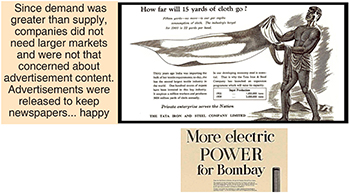
This brand positioning is also seen in an October 1955 Tata Iron and Steel Company advertisement created by J. Walter Thompson. It portrays a man in a loincloth holding a long sheet, and says that from importing the bulk of her textile requirements 30 years ago, India has the second-largest textile industry in the world. Written in a larger font size below was, "Private Enterprise Serves the Nation.”
Field day
An advertisement announcing the opening of the Trombay Power Thermal Station in 1956 said it was "yet another Tata contribution to a higher standard of living through an expanding economy” and an "example of the work of enlightened Free Enterprise.”
Earlier in 1949, in an advertisement that talked of the mechanization of agriculture, Tata made the connection between steel and agriculture. The visual had a photograph of Nehru watching a tractor in operation. That same year the company ran an advertisement that said, "Steel links India’s Frontiers,” and described how 7,000 tonnes of steel were used in the newly-laid railway line connecting Assam to the rest of the Indian Union.
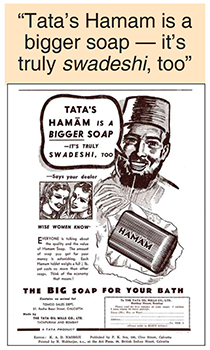
Indian companies at the time strove to distinguish themselves from multinationals by emphasising their swadeshi credentials. Tata was no exception with its Hamam soap. One advertisement read "Tata’s Hamam is a bigger soap — it’s truly swadeshi, too.” Another reminded consumers that Jamsetji Tata had set up the Swadeshi Mills Company in 1886, 20 years before the swadeshi movement gained prominence.
 "Winning the government’s approval was important during the Licence Raj days. This meant appearing to serve the people,” said Arvind Rajagopal, professor of media studies at New York University. "Large companies also began to reflect aspects of national developmentalist ideology. Advertising agencies, many foreign owned, all publicly avowed support for the planned economy.”
"Nation-focused advertisements were released not only by Tata but by all companies,” said Arun Chaudhuri, head of the marketing research company BRAND and the author of Indian Advertising: Laughter and Tears. "Obviously, all these advertisements helped to support the government line that India was on a rapid path of progress. The reality was that the majority of the people lived pitiable lives hardly managing a square meal a day.”
According to Chaudhuri, another reason why advertisements tended to focus on the country and its progress before liberalization may have simply been a lack of creative output from agencies. Since in most industries demand for goods was greater than supply, companies did not need larger markets and were not that concerned about the content in advertisements. Advertisements were released to keep newspapers — an important tool for public relations — happy.
Holding the fort
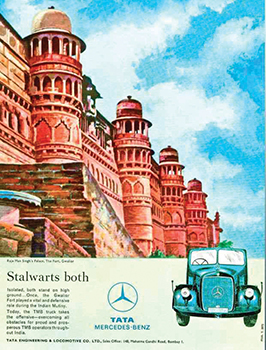
Also in short supply were Tata Mercedes Benz trucks, which were "speeding prosperity to the countryside,” stated an advertisement from August 1960. The truck was compared to the Gwalior Fort that played a role during the Indian Mutiny ("Stalwarts Both”) and the India Gate ("Gateways to Prosperity”).
The message was clear: Tata wasn’t just driving India to a brighter future; they were also taking her back to her illustrious past. A Tata Exports Limited advertisement talked about "reviving the age-old glory of Indian exports.” Other Tata Iron and Steel Company advertisements refer to "implements of steel used by master craftsmen of ancient India,” "exquisite swords of Indian steel” used in the past and admired by outsiders and Indian ships being "once again on the high seas.”
If this rhetoric sounds familiar today, it is because it was used by politicians to invoke a sense of national pride. But for the Tatas, that was not the only motivation. Even today, according to a recent survey, Tata Motors, a company that was founded 73 years ago, is viewed by Indians as the second-most patriotic brand in the country.
Reprinted with permission from scroll.in. Images courtesy: Tata Central Archives