When the Nightingale sang the Lion was smitten and so began
the union of Roshan and Noshir Pundole
Hootoksi Tyabji
Nothing I write can adequately express my debt of gratitude and love for my parents Roshan and Noshir Pundole. Their loving union lasted 71 years and they left this world just a few weeks apart, he on July 5, 2016, aged 95 years, and she on September 28, aged 94. They were exemplary in so many ways — she as the Nightingale of Bombay, and he for bringing the Lions movement to India and as a businessman.
Born to Nowroji and Mehra Pundole (née Narielwala) on March 1, 1921, Noshir had two older sisters, Maki and Naju, and two younger brothers, Russi and Kali. He was his grandfather’s favorite and everyone in the family knew this, especially young Noshir who was accustomed to getting his way with just about everything.
Articulate and excelling at school, Pa grew up to be a self-taught and highly successful businessman, principled and with an acute moral compass. His sense of responsibility toward family was honed when Nowroji died suddenly just as Noshir was finishing high school. As the eldest son, Noshir took over the family watch business and was able to look after his mother and siblings. He introduced Lionisim to India and various other countries in South East Asia and was affectionately known as "The Father of Lionism in India.” The current president of Lions International, Bob Corlew, said: "Noshir inspired devotion of service in every Lion he met. Because of his inspiration and leadership, that legacy of service will continue with new generations of Lions.”
In later life Noshir fulfilled his dream of acquiring a Master’s degree in business from the University of California. His thesis was based on the processing of edible oil in Malaysia and was later used by the government as a guideline for more effective practices in edible oil production.
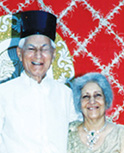
Roshan and Noshir Pundole on
their 50th wedding anniversary
The Pundole family (L-R): Hootoksi (standing), Noshir, Roshan, Shehernavaz and Kershasp
Roshan was born on June 12, 1922 to Jehangir and Tehmina Lalkaka (née Kharas). Her father was one of India’s foremost portrait artists of the time. She was the youngest of three children. Their mother made no bones about the fact that she preferred her sons, Cavas and Sarosh. With her love for the outdoors, Roshan preferred climbing trees, singing, and chasing monkeys with her brothers to studying at school.
"Roshi” was her dad’s favorite. Spending many hours in her father’s studio, she learned art appreciation and developed an uncanny eye. She could spot a masterpiece in a junkshop or charity bazaar. She once picked up an unsigned painting for a few dollars, insisting it was by the famous artist Maqbool Fida Husain. And she was right! Years later the artist acknowledged and signed the painting which has been the best family investment by a long shot!
1) Noshir Pundole (suited, standing) with parents and siblings;
2) Roshan Lalkaka (standing center) with family
3) and 5) Roshan in 1933 and in 1945; 4) Noshir (left) with Russi on becoming navars;
6) Noshir speaking as the first Asian to hold office of the International Director of Lions Club;
7) Roshan and Noshir on their wedding day
Blessed with a beautiful voice, Roshan studied music after passing out of school and became an accomplished singer, performing in Bombay on stage, in choirs, for All India Radio and as a playback singer for Bollywood films. She also gave voice lessons and taught music at schools. She soon became known as the Nightingale of Bombay and The Times of India’s reviewer wrote on August 14, 1955: "The concert at the Scots Kirk was a most notable one… As for Roshan Pundole, well, her voice is indeed a gift from heaven. Her Handel selection Angels Ever Bright and Fair and Edward German’s Love is Meant to Make us Glad proved that she can easily transcend the austere heights of classicism and the lyrical qualities of modern composers with the rare charm and deportment which has won the hearts of all who have heard her sing.”
Noshir, an avid Boy Scout, organized a charity event in 1944 to raise funds for the war, an event at which Roshan sang. He was completely bowled over by her and so began their love story. They were married at Allbless Baug on March 27, 1945, when she was 23 and he 24. Starting life with very little they lived as paying guests, working side by side at their bookstore and laundry with Roshan always supporting and encouraging her ambitious husband.
Together they built a loving and harmonious nest for their children, Shehernavaz, Kershasp and Hootoksi. They always taught us by example rather than words. My parents were very spiritual and Papa spent hours in prayer, meditation and contemplation. Zoroastrianism was practiced in our home; traditions were upheld though rituals were kept to a minimum. We went to the fire temple on auspicious days and were taught to think for ourselves and not to follow things blindly. Pa would say, "My thoughts and opinions must never be yours unless they resonate with you.” We were encouraged to respect all religions and worship one God, Ahura Mazda. We saw our parents living by good thoughts, good words and good deeds which they performed quietly and without any fuss or fanfare.
They moved to Malaysia in the 1960s where Noshir set up a pioneering palm oil processing plant for the Birlas. After a few years it was purchased by the Malaysian Government but he continued to live there and in 1977 established a property development business which he ran successfully till he retired in 2003, amply fulfilling his dream of providing for his children, grandchildren and great-grandchildren.
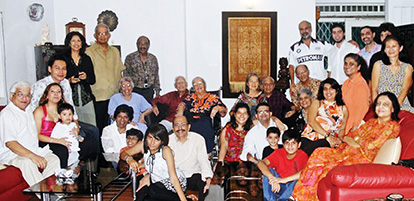
Their home in Kuala Lumpur (KL) was the focal point for all Parsis. Papa was the guardian of the community and as an ordained navar performed several jashans, navjotes and death ceremonies. Yazdi Bankwalla, a member of Malaysia’s tiny Parsi community, said, "They were like the oasis, providing care, encouragement and nourishment to many for decades. They smiled much and loved life, strong willed and determined. This inspiration of theirs will live in the hearts of many. They were the loving Twin Towers of KL and much more.”
Our parents supported and encouraged us in everything and accepted our opinions and way of life even when it diverged totally from theirs. Education was very important; we were encouraged to excel but never made to feel inadequate if we came home with poor results. For them it was enough if we did our best. Papa made us "check and double check” every document, paper and fact. We were taught the value of family and money and learned to respect both. Papa would say, "Cut your coat according to your cloth” and "If you can’t afford to pay for it, you can’t have it; simple as that!”
Mama was very proud of her 300-year-old roots in the Lalkaka family and as children she delighted in taking us to the annual general meeting of the Lalkaka Family Fund. She encouraged us to keep in touch with our relatives all over the world. She would teach us proverbs in Gujarati and in English, her favorites being "There is no religion higher than truth,” "Spare the rod and spoil the child” and "Be a little deaf and blind, happiness you’ll always find.” She did not merely spout these, she lived and practiced them.
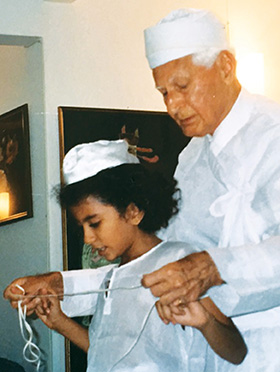
Noshir performing a navjote in Kuala Lumpur
I once took a taxi to their apartment in KL and as the driver dropped me off he asked: "Do you know the lady who wears a scarf and drives a blue Mini? She lives in this building and always helps everybody.” When I told him she was my mother, he refused to accept the fare. Another woman confided that when she was a saleslady in a shop Ma had saved her eyesight by getting her timely treatment and paying for it.
For over 20 years in Malaysia Ma volunteered at the Bukit Nanas Home for orphans who were disabled victims of war. She raised money for them, taught them songs, bought them gifts and was the light in their lives till many of them passed away. She also worked tirelessly for the SPCA (Society for the Prevention of Cruelty to Animals), raising funds and finding homes for abandoned animals.
Papa was disciplined in thought and habits. You could set your clock by his actions. To him, prayer was of paramount importance and nothing was allowed to come in the way of the time set aside for it. Physical exercise, eating regular meals and a catnap in the afternoon were part of his routine. Ma loved a good party and as much as she enjoyed having people around her Pa treasured his solitude and enjoyed silence.
At the end of their lives their most fervent wish was to return to Bombay to live out their last days in peace in their own apartment; but sadly the lady to whom my mother showed only kindness has taken over the flat and the litigation continues to this day. Throughout this difficult time Ma exemplified universal love even to those who had hurt, lied and stolen from her. She would say: "It is easy to laugh and to smile, when life goes along like a song, but the man worth his while, is the man who can smile when everything goes dead wrong!”