Delhi Parsi Anjuman president Adil Nargolwala plans to preserve
the organization’s legacy while outlining his roadmap for the future
"Financial independence, community harmony and succession planning amongst the youth” will be the top three priorities for Adil Nargolwala, the newly elected president of the Delhi Parsi Anjuman (DPA). He was responding to Parsiana’s queries by email on October 3, 2025 regarding his priorities on assuming the mantle. Having served as a trustee for the last 29 years, Nargolwala gives credit to "successive boards and in particular the treasurers and trustees connected with financial matters who have ensured that we are a financially viable and sound Anjuman… Financial security will ensure that the Anjuman properties and assets are well maintained and managed.”
To earn income from their assets, around 20 years ago the DPA permitted non-Parsi travellers to stay at their Mengusi Dharamshala after reserving a certain number of rooms for Parsis. This has increased occupancy rates as also revenue. Likewise their Bhiwandiwala Hall Godrej Cultural Center can be hired by non Parsis, mentioned Nargolwala. "The Anjuman has always been fortunate to receive funds and donations from our members as well as other Parsis and been able to execute projects. The latest solar electricity project funded majorly through donations not only saves us huge electricity costs but also allows us to work toward an ecological and sustainable planet.”
Adil Nargolwala (l and inset) with wife Rinchen
Heading a 12-member board of trustees elected on September 21, Nargolwala mentioned that the team is in charge of the regular running of the Anjuman. Decisions are taken by them conjointly with the various committees that include members who may not be trustees. "Even the non-Parsi spouse members are included on the committees to promote diversity and inclusion. A lot of autonomy is given to these committees (like the social center committee or the dharamshala committee) to take independent decisions, including financial ones.”
He referred to the pragmatic decision taken over 50 years to include non-Parsi spouses as members of the Anjuman with access to all facilities barring entry to the Kaikhushru Pallonji Katrak Dar-e-Meher or interment at the aramgah. Children of interfaith marriages were accepted as Zoroastrians once their navjote ceremony is performed. This decision was taken when Adil’s father Shiavax Nargolwala was the president of the Anjuman. "It has stood us in good stead and I hope that looking at future demographics the trustees and members at that time in future take further steps to ensure the continuity of the legacy of our founding fathers,” stated Adil.
For 25 years Shiavax had served as DPA president until his demise in a car accident in 1986. Just as he had held the community together, his successors — Lt Gen Adi Sethna, Dadi Mistry, Yezad Kapadia and Ava Khullar — have maintained unity in the community numbering around 500 in Delhi NCR (National Capital Region). Even though the number of deaths keeps increasing, Adil doesn’t envisage any space shortage at their Parsi aramgah for many years to come.
"Considering that we are dwindling and over the next 25 years may end up losing 40% of our population we need to ensure that our younger generation works with the same passion and enthusiasm to continue the tenets of our faith and community,” he said, advocating the need for succession planning to enthuse the youth to come forward and take charge. "We are all aware the youth are our future and we need to do everything possible to keep them connected. The post of a youth trustee was created at DPA to ensure youngsters had a voice on the board. In fact during Sethna’s presidency he proposed my name and nominated me as the youth trustee in 1996. As my mother Nergish was already a trustee and there was no precedent of having two members of the same family on the board, the general body at the AGM made an exception and confirmed my trusteeship,” he recalled. Sethna was a father figure, guiding and mentoring him.
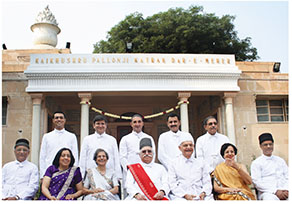
Ava Khullar, Dadi Mistry, Yezad Kapadia (seated, 3rd to 5th from l) with Adil (standing, center)
In addition to the secretary’s annual report that keeps the members apprised of Anjuman developments, the president too periodically sends out a note to members highlighting the Anjuman affairs. Further, members learn of community developments at social functions. Urgent matters that need to be shared are communicated by email or on their WhatsApp group. The DPA magazine Dipanjali is published on momentous occasions.
Valuing the "equity and recognition that DPA enjoys amongst various anjumans in India and the world,” Adil observed that The Federation of the Parsi Zoroastrian Anjumans of India (FPZAI) was once a relevant body when people like his father and erstwhile honorary secretary Keki Gandhi were in charge. "In my mind the Ahmedabad meeting was a turning point in the history of FPZAI and created factions that led to its downfall. [The December 2004 meeting was disrupted by agitators brought in by some traditionalist groups who opposed the formation of a world Zoroastrian body (see "Fascism at the Federation,” Parsiana, January 2005).] Should the FPZAI be revived? Yes. Should it look inward, introspect and be liberal? Yes. But will it? That is the question. Otherwise like the proverbial ostrich with its head stuck in the sand it will continue to believe all is well in the Parsi universe.”
Another major issue our community faces is the lack of priests. In 1961 when our Dar-e-Meher was being constructed, then Anjuman trustees were advised by Vada Dastur (Dr) Firoze Kotwal, who consecrated the fire, not to have an agiary but a dadgah. This sound advice has stood us in good stead and today we run our fire temple with Behdin Pasbans assisting our priests. The DPA is happy to mentor and train any youngster who wishes to become a priest, and guarantee him a lifetime of employment with housing, food and other facilities.
Even though community numbers will continue to decline, Adil does not expect the community in India to get extinct believing that "at a tipping point the elders of the community may open the gates especially to non-Parsi spouses, their children, etc and keep the community going. Parsis then may not have a strong voice or be at the helm of major institutions. The overseas Zoroastrian institutions seem to be doing good. I am not really in touch with them but that’s something on my agenda.”
Resolute racer
Adil lives on his farm in New Delhi or apartment in Gurgaon with his wife Rinchen. His elder son Jahan with his wife Achala live in the neighborhood while his younger son Shaun is in Canada. Adil is a corporate senior vice president at WNS Global Services, a digital led business transformation and services company listed on the New York Stock Exchange. He also heads the sports division of the company, WNS Sports, and is active on the WNS Cares Foundation. Sharing details of his professional and sports accomplishments at Parsiana’s request, Adil mentioned that his association with WNS commenced from the time the business process outsourcing company Trinity that he had helped found with some friends was acquired by WNS. Prior to that he was running Computec Systems, a company he co-founded at the age of 17, a year after he lost his father. From selling printer cartridges and printing paper they progressed to making and selling their own computers, and later built LAN (local area network) systems for big companies. Subsequently he branched out on his own.
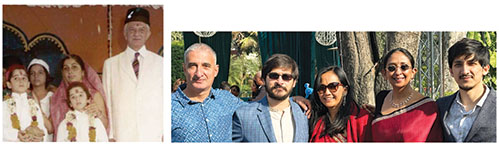
Above left: Shiavax Nargolwala with wife Nergish at Adil and Mehrab’s navjote;
right: Adil, Jahan, Rinchen, Achala and Shaun Nargolwala
Seventeen was also the age when he was selected by Yamaha Motor India to be part of their racing team. Among the top motorcycle riders in the country at that time, a memorable race for him was when he was in the lead, had a bad fall and broke his collar bone in Dehradun. Despite this injury he continued the ride to Delhi and finished third. He has been active in the motorsport world too having taken part in many car rallies in India as a senior steward. Later he emerged as a Triple Super Randonneur of the Audax Club Parisienne (world’s oldest cycling club) for completing a series of notified long distance rides of 200 km, 300 km, 400 km and 600 km three times. Running though remains his abiding passion. He takes pride in describing himself as the first and only Indian to have completed an Ultraman (10 km swim, 424 km cycle, 84 km run); an Ironman (3.8 km swim, 180 km cycle and 42.2 km run in 14.2 hours); run marathons in all seven continents including Antarctica; finished the seven world marathon majors (New York, Boston, Chicago, London, Berlin, Tokyo, Sydney) and holds multiple records in the Limca Book of Records.
Five days ahead of the white marathon in Antarctica, Adil had a fall when riding a cycle and fractured his hand. Although advised surgery, he opted to pursue his dream run. Proceeding on multiple flights over 50 hours to Punta Arenas in Chile to reach Antarctica and despite high fever he resolutely finished the run with a broken hand. With over 400 races to his credit, Adil occasionally runs for a cause, raising donations for the underserved and disabled.
He and his wife love to travel and combine running events with vacations, coining them as Runacations. They wish to visit more countries than the 50 they have already been to. Having a conversation with Adil is interesting as he can discuss a variety of subjects, especially history, as he is a voracious reader.
Over the years he has also collected substantial amounts for various schemes for the improvement and betterment of the Anjuman, such as renovating the community hall or Dar-e-Meher.
Since there is no limit on the amount of terms a DPA trustee can serve, many have continued for decades. Tenure brings in a lot of perspective and history, helping trustees to take decisions. His predecessor Ava Khullar who passed away on October 5 had put in around 40 years before she retired. How many more years Adil continues to serve "depends on how well I do as well as how long the members of the Anjuman want me to serve.”