Lt Jamshed Maneckshaw died on the Chittagong front during World War II
Prakash Bhandari
The world knows late Field Marshal Sam Manekshaw as the man who, as the chief of the Indian army in the 1971 Indo-Pakistan War which resulted in the liberation of Bangladesh, made great contributions to the creation of that nation. He had also served on the Burma front as a captain of the 12th Frontier Force and was seriously wounded while fighting the Imperial Japanese Army during World War (WW) II.
But the world is unaware that another Maneckshaw — Lt Jamshed (Jimmy) Maneckshaw — also defended Indian territory against the Japanese invasion in the Dohazari region of the Chittagong front during WW II. While Sam survived his bullet wounds, Jamshed died in Dohazari on May 14, 1944 and became an unsung martyr.
Jamshed belonged to Bulsar in Gujarat and worked in Kabul, Afghanistan, before he joined the Indian army as a commissioned officer. He was sent to fight against the Japanese Imperial forces in the northeast part of India and in the Chittagong area, now Bangladesh.
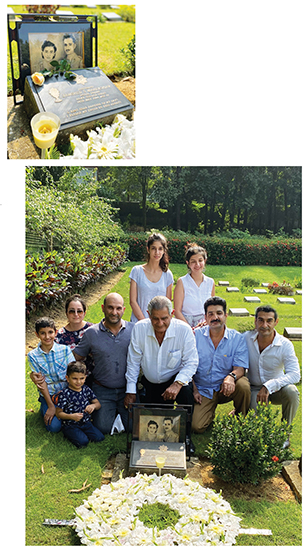
Top: Lt Jamshed Maneckshaw’s grave with portrait of him and wife Zarine;
above: son Navzar and his family paying homage at the site
Clockwise from top l: Navzar signing the visitors’ book;
Commonwealth War Cemetery, Chittagong;
Memorial Register bearing names of martyrs
Jamshed Maneckshaw: in action, in uniform, on horseback and in mufti
A large number of Indian, British, Australian and African soldiers died in action there. The last rites of these brave soldiers were performed, based on their religion, in the various war cemeteries built by the British army in the region.
A few Parsi families had businesses in Dhaka and Chittagong. The British took the help of one Mr Medhora who lived there at that time, in performing Jamshed’s last rites.
Originally, there were 400 persons buried in these cemeteries under the army’s supervision. Later, when the Commonwealth War Cemetery was created in Chittagong, the graves were transferred there. There are now 731 Commonwealth graves of the 1939-45 war in Chittagong, 17 of which are unidentified. This cemetery is funded and maintained by the Commonwealth War Graves Commission of Britain.
The burial area is situated at the bottom of a slope directly behind Finlay’s Guest Houses, surrounded by a large area planted with fruit, flowering and jungle trees. It is not easily visible from the road.
The writer is a journalist who regularly visits Dhaka in connection with the Moyeen Foundation Jaipur Foot artificial limb fitment camp where he is a team leader. Also present when the camp was being planned in 2017 was Salahuddin Ahamad, a former Indian bureaucrat who served as the chief secretary of the Rajasthan government. He is executive president of the Jaipur-based Bhagwan Mahaveer Viklang Sahayata Samiti, the parent body of the world famous Jaipur Foot. Ahamad is passionately interested in war cemeteries and in addition to the various burial grounds in India he has travelled to see war cemeteries in Myanmar and in Egypt to pay homage to the great warriors resting there.
When visiting Dhaka, with his friend from Bangalore, Kalyan Ganguli whose ancestors were from Dhaka, they drove to Chittagong accompanied by the writer. They reached the cemetery in the morning and were impressed by the maintenance of the graveyard. Rows of plaques bore the names of soldiers, their units and the year in which they had died. Each plaque had a symbol denoting the religion to which the soldier belonged, such as a cross for Christians and a temple insignia for Hindus.
As they reviewed the plaques, the writer suddenly noticed a Zoroastrian symbol in one row. Intrigued, he read the plaque. To his surprise, he found that this was the only Parsi laid to rest there. The inscription read: "Lieutenant Jamshed S. Maneckshaw, Royal Indian Army Service Corps, 14th May 1944, Age 33, O Rest, Dear Partner of My Days I Pledge My Troth (fidelity) to Thee Always.” The visitors were immediately reminded of Field Marshal Sam Manekshaw as he was the only Manekshaw in the military they had heard of.
After taking pictures of the plaques, they thought of sending a photograph to Jamshed’s family members. Ahamad contacted his Parsi friend Brig Dara Gowadia who made frantic efforts to search for Maneckshaw’s family, but drew a blank.
Through Facebook, the writer sent messages to all the Maneckshaws along with a photograph of the plaque with a request to connect him with the family. He reached out to his friend Farokh Maneckshaw, who runs a resort in Goa, for help. After several months, Farokh messaged back to say that he had been able to locate the son of the deceased, Navzar, a retired assistant commissioner of police. Navzar knew about this cemetery in which his father had been laid to rest.
He was barely 15 months old when he lost his father and has no memory of him. "The army general sent my mother a letter informing her about the death of my father. We were then in Bulsar. My mother Zarine raised me with great difficulty. She procured a job in a boarding school in Nasik where she taught art and I completed my schooling. She was a good painter and this skill helped her get the job. After schooling, I completed my college education. My mother brought me up very well. I then joined the Bombay Police. My mother stayed with me till her demise. I retired as assistant commissioner of police in January, 2001. Since then, I am conducting a security agency and crime consultancy,” Navzar shared.
After getting in touch with the writer, the Maneckshaw family decided to go to Chittagong to pay homage to Jamshed. "I wanted my sons and grandchildren to see the final resting place of my father. I wish my mother was alive,” he said.
Navzar flew to Chittagong with his three sons Jimmy, Sam and Roomi. The first son was named after his grandfather, the second son after the Field Marshal, the hero of the Indo-Pakistan War who effected the surrender of the Pakistan army in East Pakistan after which Bangladesh was created.
Navzar, his sons, two daughters-in-law, two granddaughters and two grandsons visited the cemetery along with the writer.
The ceremony was well organized. A specially made wreath with white roses and lilies was placed on the plaque and a lamp lit. The family joined in prayer. It was a touching moment. For Navzar, it was a dream fulfilled.
"I shall cherish these moments all my life and the time spent at the Chittagong cemetery,” said Navzar. "For me this is not a cemetery but a place of pilgrimage. I salute my father.”
Reprinted with permission from the author and with inputs from the Maneckshaw family. The article had appeared earlier in The Daily Star from Dhaka, Bangladesh.