Though heartened at first to read Farrokh Jijina’s summary of the Parzor Jiyo Mobed workshop ("Mentoring mobeds,” Parsiana, June 7, 2017), one is quickly pulled up by the objectives of the attending mobeds. Frankly, open-mindedness and non-Gujarati communication skills, absolutely necessary among our uniformed clergy, are rather thin on the ground. Added to these are sprinklings of "inner fire” and "spiritual satisfaction;” some wish to counsel. All surely praiseworthy — if they are really up to it.
On what basis do these qualifications rest: being Zoroastrian priests or Parsi prelates? Or will there be a carefully considered set of syllabuses by Parzor to fulfil young priestly ambitions?
 Quite mind-boggling is the ervad — a Time-traveller on the rebound? — who claimed that knowledge of history (the past) could recreate (refashion?) the future! One among the non-Parsi worthies even contradicted with "live in the here and now, forget the past!” The here and now aspects of human existence, in fact, preoccupied Zarathushtra and he had fully catered for them.
A short, extremely pertinent, ninth century text clearly laid out the basic virtues of a priest: Incorruptibility, exercising discrimination in thoughts, words, and deeds; to regard as a dastur him who is a most wise guide who teaches according to the knowledge and truth of the faith; veneration of the yazads / izads (worship-worthy beings) with true words; steadfastness in his duty to propitiate by day and night; to contend with his own opinionatedness; not to turn away throughout life from professing the faith; and to be zealous in his proper duties. By way of contrast, and from a different text, the priestly faults are: heresy; avarice; forgetfulness; laziness; contempt; disbelief in the faith. The Grant Medical College professor of psychiatry listed 30 qualities of a good priest; our ancients did the same in less!
The much-revered name of Adarbadh Mahraspand remained little recalled, if at all, during this workshop. He too, way back in the fourth century, had laid forth several communication requisites for good priests and lay folk. Might it be suggested that future sessions be modelled, at least in part, on these timeless ancient wisdoms before jettisoning them for modern-day glitzy "here today; gone tomorrow” productions? Ancient wisdoms will endure blazingly when all others have faded...
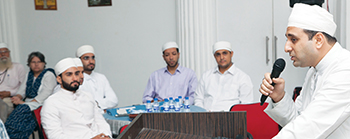
"If you think education is expensive, try ignorance!” punchily declares an oft-repeated quote. This indeed is why this fresh Parzor Jiyo Mobed initiative (pictured) needs full encouragement and every support. The aspirations of younger priests, men and women, must be facilitated for influencing far beyond the sub-continent.
FARROKH VAJIFDAR
f.vajifdar@btinternet.com
London, UK