Through its training and advocacy initiatives, the Xavier’s Resource Centre for the Visually Challenged has been attempting to create accessible avenues for the disabled
Parinaz Gandhi
Located at the far end of the corridor on the ground floor, the sighted may miss the door leading to the Xavier’s Resource Centre for the Visually Challenged (XRCVC). For Persons with Disabilities (PwDs) this may well be among the most frequently visited areas at St Xavier’s College known for its accessible campus with tactile pathways and Braille labels on doors to guide those with visual impairment, and ramps and lifts to assist those with motor disabilities.
"We are a very small unit in terms of physical space occupied (one of the smaller classrooms in the Indo-Gothic heritage structure at Xavier’s plus a second branch at the Viviana Mall in Thana) and manpower (12-member team) but we are well known in government bodies,” stated Dr Sam Taraporevala, founder and executive director of this proactive organization that has come of age, having completed 21 years. "With an agile culture we have grown organically; we don’t want to grow physically. We want to build replicable models, create pathways that others could tread,” he reinforced.
Dr Sam Taraporevala
Top row, from l: visually impaired students learn the abacus; use the Brailler;
above l: ATM made accessible to the visually impaired; at the orientation and mobility course conducted by XRCVC
An alumnus of St Xavier’s College, during his 50 years of association with his alma mater, as a visually impaired student, as the first visually impaired associate professor, as the founder of XRCVC, Taraporevala’s commitment has been commendable. At the turn of the century when he realized that visually impaired students preferred to join Ruia College that had a resource center rather than Xavier’s, he approached the Jesuit management. They supported his proposal to establish a resource center at Xavier’s if he was willing to shoulder the responsibility, managerial and financial.
Thus he started operations from an assigned space under a staircase with one computer and requisite software financed by the Tatas in 2003. XRCVC was able to draw visually challenged students from the following year. While students from the College availing of its facilities may average six to 10 a year, the Centre’s impact is manifold. To ensure that we have the correct figures, Disha Kapadia, lead consultant — awareness, shares a PowerPoint presentation that reflects the magnitude of their work in three key areas of operations. In the sphere of inclusive education they have reached over 8,300 people with disabilities with over 700 accessible books and more than 2,000 teaching/learning aids. To determine the accessibility of products and services they have tested over 100 gadgets and reached more than 13,000 participants through assistive technology awareness events.
Their strongest impact though has been through awareness and advocacy work where they have reached over 45,000 persons. Under their registered trademark, Antarchakshu has conducted more than 680 simulation based sensitization workshops. As per their "1:10 philosophy, to empower one visually impaired person, awareness needs to be created in 10 sighted persons,” conveys Taraporevala. The 360° approach to inclusion, simultaneously involving the child, parents, teachers, peers, recommends sending visually impaired children to integrated schools so that "they do not remain in a protected environment but learn to face the good, the bad and the ugly, and their needs can be understood by others.”
One of XRCVC’s major struggles resulted in the Copyright (Amendment) Act 2012 permitting the conversion of copyrighted works into accessible formats (Braille, large fonts, audio or digital) by nongovernmental organizations and educational institutions to facilitate those facing disabilities as long as it is not a profit-making endeavor. This provision in the Copyright Act to assist the print disabled was included after six years of persistent efforts during which time Taraporevala says he "must have visited Delhi over 25 times to meet and convince politicians and publishers.”
Past member of the Braille Council of India as also the general council of the National Institute of the Visually Handicapped, he recalled the genesis of this time-consuming endeavor: One of his visually impaired students required an accessible copy of an Economics text book running into several hundred pages. When Taraporevala approached the publisher for a soft copy of the book, he was told it would be considered an infringement of copyright. Not to be deterred, he kept calling the publisher persistently until his calls were blocked. "By nature, I don’t take ‘no’ for an answer,” said Taraporevala who until then had "no knowledge of social advocacy” but brought on board other like-minded organizations supporting the disabled until they ultimately succeeded in revising the law.
To seek a change in Reserve Bank of India (RBI) and National Securities Depository Ltd rules and regulations that debarred visually impaired persons from independently operating bank and demat accounts, Taraporevala was emboldened to meet Dr Usha Thorat, then deputy governor of RBI. "A visually impaired person may be a PhD (doctor of philosophy) but was treated on par with an illiterate,” Taraporevala provided insights into the then prevailing discrimination.
As key consultants to Indian Banks’ Association, NCR Corporation of India and Diebold India, XRCVC was a major force that resulted in the design and deployment of 30,000 plus accessible talking ATMs (automated teller machines) across India. Taraporevala, who was a member of the Indian Banking Association’s Subcommittee on ATM Systems for Visually Challenged Persons, well remembered the Antarchakshu event at the intercollegiate Malhar festival hosted by Xavier’s College when the talking ATMs were first showcased. Thereafter their usage has been widespread, giving the visually impaired customer using a headphone the choice of two languages (English or Hindi) to independently operate the ATM. The user is further given the option of keeping the screen blank if he/she fears shoulder surfing (prying into confidential data by a person standing behind) while making a bank transaction. In fact, such features are now provided on their mobile phones too.
"Breaking barriers, achieving access” continues to be the guiding principle at XRCVC. They take pride in the accomplishments of Kritika Purohit, the first visually impaired Indian to earn a degree in physiotherapy. Until then the visually impaired would practice physiotherapy after completing a certificate or diploma course. To enable her to achieve her goal Taraporevala had first to approach the Higher Secondary Certificate board which until then did not permit visually impaired students to study science. To enable her to earn a degree, further sanctions had to be sought. She now has a flourishing private practice. Changes in the rules of the Central Board of Secondary Education and psychology education were likewise introduced following the intervention of XRCVC.
Top: Taraporevala and Ketan Kothari (seated 2nd and 3rd from l) with XRCVC team;
above: at Antarchakshu disability sensitization workshop
Pranjal Patil, India’s first visually impaired woman Indian Administrative Service officer (batch of 2018), gave credit to XRCVC for providing moral support and computer skills that "infused confidence, sense of independence and ever growing ambitions in me… Prof Taraporevala always serves as a role model for me on how a leader should be.” Yet another success story is that of Ronak Shah, PhD candidate, Cybersecurity department, Technical University of Delft in the Netherlands, who mentioned, "I have always wanted to become an Information Technology professional though the world tries to dissuade me. Each time it does, XRCVC helps me to break the barriers…to live my life just like any other person without disability.”
The XRCVC team has also been given credit for supporting end-to-end development of an accessible physiotherapy machine which through its auditory software guides physiotherapists on optimal use. An accessible air safety manual and in-flight menu for Akasa Air, and an innovative audio-tactile restaurant menu for Bombay Blue Restaurant were the creations of XRCVC. Their valuable inputs and feedback have been sought by websites and mobile applications like MyJio, Amazon.in, Paytm.
As a department of Xavier’s College, XRCVC offers direct support to its students plus their state-of-the-art Assistive Technology hub serves as a training center for all age groups, whether toddlers or senior citizens. It is not only the visually impaired but persons with any disability who are helped. Aniket Gupta, executive assistant and manager — administration and finance, demonstrated the use of Seedee, a motorized, portable wheelchair kept outside the XRCVC entrance, for the convenience of those facing mobility issues.
"There are 21 disabilities recognized under The Rights of Persons with Disabilities Act, 2016. Any PwD coming here is not charged,” stated Ketan Kothari, XRCVC’s managing consultant — programs. Some of their specially installed computers have software that can show magnified images or read aloud a scanned Braille page or use face recognition features to unlock the system for the user. "There is a whole range of technology available. What you saw is only a drop in the ocean,” Taraporevala told this reporter.
Since the visually impaired cannot read the CAPTCHA (Completely Automated Public Turing test to tell Computers and Humans Apart) characters used as a security measure, an audio CAPTCHA circumvents the problem, mentioned Kothari who is also visually impaired. While earlier very few periodicals were available in an accessible format for the visually impaired who were hence dependent on family, friends and contacts to read to them, currently he has the option of "so many magazines that I have no time to read them,” revealed Kothari.
Very helpful are mobile phone features like TalkBack, a screen reader that provides spoken feedback, describing actions, announcing alerts and reading out text. Be My Eyes/ Be My AI is yet another alternative that can be used when in need of visual descriptions. One of XRCVC’s visually impaired team members took out his mobile phone, clicked a photo of a few individuals standing in his proximity and then made us hear the almost instant auditory description of the individuals in the photo provided by the App.
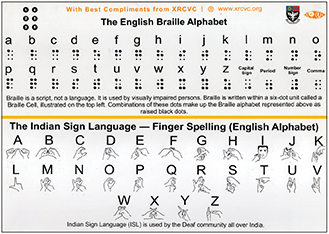
Despite all the technological advances, knowledge of Braille is considered one of the fundamental tools for those facing visually impairment from an early age. "Braille is a script, not a language,” we are reminded on being presented a leaflet bearing the English braille alphabet on the front flap and the Bharati Braille on the back flap. The leaflet opens to show illustrations of the Indian sign language (English alphabet denoted with gesticulation of fingers) on the top half and a brief introduction to XRCVC’s activities on the lower.
Yet another pamphlet on Disability Etiquette recommends dos and don’ts. "Don’t use outdated terms like ‘the handicapped’ or euphemisms like ‘specially abled,’” the reader is advised. To Kothari, "How you treat us is more important than what you call us.” Elaborating on some of the common misconceptions like "The blind have a sixth sense,” he clarifies, "When we don’t even have five, we have to optimally use our remaining senses.” He is also bemused when visually impaired people are expected to recognize others by the sound of their voice or the touch of their hand or presumed to need assistance if they are standing at the corner of a road and perforce made to cross to the other side!
XRCVC is "almost like a black hole, though not with any negative connotations, sucking me into it more and more,” admits Taraporevala. Even after his retirement as head of the sociology and anthropology department in 2019 on completing 60 years of age he has retained his ties with XRCVC for he believes "it keeps me energetic.” Currently tied up with the care of his nonagenarian parents, he may not be physically present at the Centre but his virtual involvement is sufficient to motivate the team. "Sir is omniscient and omnipotent,” jests Kapadia.
Finding funders primarily remains Taraporevala’s responsibility. Have they received support from Parsis? "Many donors have been Parsis,” attests the founder. Last year two of the Tata Companies lent support as part of their corporate social responsibility commitment. Funding from Godrej plus other Parsi trusts and individuals has also been crucial. To ensure that XRCVC remains self-sustaining is his ultimate goal while promoting its vision of "a diverse and inclusive world where all, irrespective of disability, can thrive.”