Researcher Kaiwan Mehta
asks what constitutes architecture
Farrokh Jijina
The Crystal Palace Exhibition held in Hyde Park in London in 1851 was best known among Indians as the locale where the Koh-i-noor diamond was open for public viewing for the first time. What is lesser known is that it was the first in a series of world fairs, exhibitions of culture and industry that became popular in the 19th century.
Kaiwan Mehta
Dr Firdaus Gandavia (left) and Dr Nawaz Mody
The exhibitions held over the past century-and-a-half, of which the Crystal Palace Exhibition alone attracted an estimated six million visitors, saw the "coming together of art and industry,” stated Kaiwan Mehta. A theorist and critic in the fields of visual culture, architecture and city studies, he was presenting a paper on "Collecting Architecture, Making History — The Historiography of Indian Architecture” at The K. R. Cama Oriental Institute on December 22, 2016. Mehta, a research fellow of the Avabai Wadia Research Fellowship has recently submitted his doctoral thesis on architectural ornamentation to Manipal University. "Historiography is the study of how history is written,” he explains.
The Crystal Palace Exhibition produced the first idea of modern design, and demonstrated the "relationship between handicrafts (from the colonies of the Empire) and industrial crafts (from the UK).” The exhibition however perpetuated the stereotype that "ornamentation in design is primitive,” and industrial design had to be functional. The Exhibition was the "first step in collecting, categorizing and creating a design archive” and led to the development of a formal approach to art teaching, and training. It shaped the syllabi of art schools in the Empire, including the J. J. School of Art in Bombay,” the historian said.
Mehta cited examples of architecture from around Bombay. During the construction of Victoria Terminus, the researcher said students of the J. J. School of Art were invited to work with the architects to embellish the building. The famous elephant with the howdah motif first displayed in the Crystal Palace Exhibition lent itself to buildings in the Kalbadevi area in South Bombay, where carved elephants are found as embellishment for buildings that stand even today, he said. Referring to the logo of the Indian Institute of Management in Ahmedabad, the theorist stated The Sidi Saiyyed Jali, the oft repeated trellis work panel from the mosque of the same name in Ahmedabad, went from India to London "where designs were documented” and then became popular in India. A significant milestone in the historiography of architecture was the development of catalogs on design. The objects on display at various exhibitions held in the UK were meticulously documented by English artists. Detailed designs and plans, and casts of architectural details were prepared and circulated to the colonial world, including India, he said, pointing out the details in the richly illustrated presentation that accompanied his talk. "The motifs travelled as ready reckoners, almost as if someone were saying ‘these are the elements to incorporate, if you want such and such a design,’” Mehta quipped.
"The image of the Indian craftsman emerges from the European concept that crafts in the country were stagnant,” mentioned Mehta. The accepted school of thought was that the Indian craftsman was a "digit of continuity,” implying the same kind of patterns and designs were handed from generation to generation down the ages with no innovation. "Craftsmen did share ideas,” he said, commenting that commonality of motifs was found in works executed in different mediums like timber, metal and fabric by different sets of artisans.
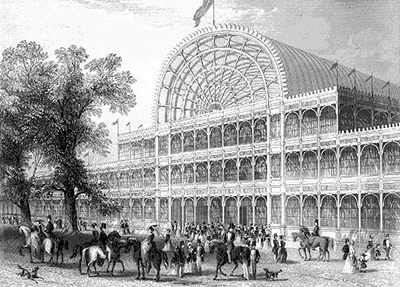
The Crystal Palace Photo Wikipedia
Architecture also borrowed from famous painters of the day, according to Mehta, illustrating how some Raja Ravi Varma’s paintings of ladies of the late 19th century influenced depiction of the human form in later day temple architecture of his time. Aerial photography of destroyed cities like Hampi was a major milestone in recording the history of architecture, the speaker stated.
"What shapes the idea of architecture?” asked Mehta. "Is it form, texture, or ornamentation?” he queried. The historian concluded that all of these constituted architecture, adding that "surface development (ornamentation) is also a key element of architecture.”
Introducing Mehta to the audience, Dr Firdaus Gandavia, research scholar and writer who presided over the talk, spoke of Mehta’s work as managing editor of Domus, the India edition of the international magazine on art, design, architecture and city studies published by Spenta Multimedia. He also referred to Mehta’s recent work with art historian Rahul Mehrotra and art critic Ranjit Hoskote where they co-curated the national exhibition on architecture, "The State of Architecture: Practices and Processes in India” at Bombay. The vote of thanks was proposed by Dr Nawaz Mody, honorary secretary of the Institute.