What Zoroaster was doing amid philosophers
of a later age in The School of Athens
Farrokh Vajifdar
What is the Sage of Ancient Iran, Zarathushtra — prophet to some, preceptor to others — of circa 1000 BCE doing amidst a motley "western” crowd of mostly male elders from much later epochs in the Raffaello (Sanzio da Urbino Raphael) mural popularly known as The School of Athens? Shown as holding aloft a luminous blue-grey sphere Zoroaster had obviously never met the others in person. A multi-faceted story opens up the moment the main figures are identified, with plots and sub-plots to sustain them.
The actual fresco, measuring some 25 x 17 ft (approx. 8 x 5 metres) was conceptualized and commissioned in 1509 from Raffaello by Pope Julius II (1443-1513). It was to newly adorn, with others of non-Christian, indeed pagan character, the vast walls of the opulent Segnatura chambers in the Vatican —those very chambers used as the Pope’s private offices and library. And there they stand to this day for the appreciation and wonderment of awestruck visitors.
Pope Julius II (r.1503–1513) was a very headstrong supreme pontiff — "warrior Pope” and "terrifying (terribile!) Prelate” were among his accustomed epithets. He was a soldier who saw active service, as well as an impassioned patron of the arts and literature. Having succeeded the hated, murderous Spanish Borgia Pope Alexander VI, he commissioned the rebuilding of Saint Peter’s basilica and Michelangelo’s decoration of the Sistine Chapel amongst his other grandiose projects. Importantly, he was Raffaello’s friend and patron.
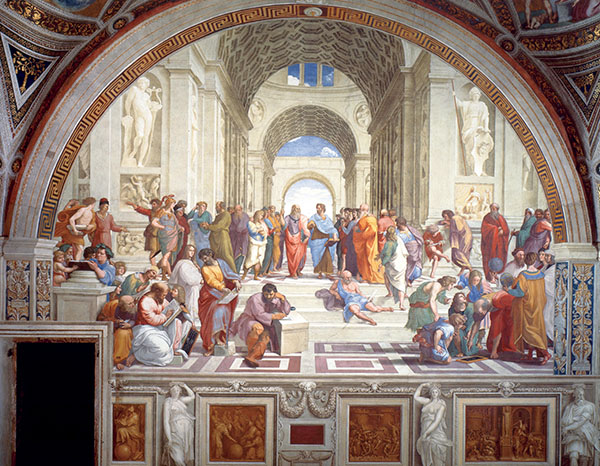
The School depicts as contemporaries the pagan (non-Christian!) philosophers who, in actual fact, were widely separated ideologically from one another in both time and space. The great mural is composed along symmetrical vertical divisions, and horizontally between the main figures and their three massive arches backdrop above. Thus, the top half gives grandeur to the receding arches, under the foremost of which are seen the central likenesses of a grey-bearded, barefoot Plato (to the left) deep in discussion with the sandalled younger Aristotle on the right.
In 387 BCE Plato had founded his Academy or "School” near Athens where the brightest of interested citizens would participate in discussion and debate, to learn to develop their individual ideas for an enduring system of ethical and moral guidance. Among his foremost students was Aristotle (384-322 BCE), some 40 years younger, who amicably worked alongside the master for 25 years. But there developed a major divergence of perspective, for whereas Plato had looked to the heavens for his theory, Aristotle taught that such intangible matrices were earthly, and that the archetypes for the material creations were to be sought here in the world of the senses. It was a scientific, non-mystical approach.
It is in the obvious context of their particular debate that Plato is shown pointing heavenward, while his illustrious student determinedly signals his palm earthward. Also, Plato carries his Timaeus thesis on cosmology; Aristotle grips his Ethics, rationally recommending how earthbound humans could best live. They present telltale signs of their theoretical differences: mystical vs pragmatic.
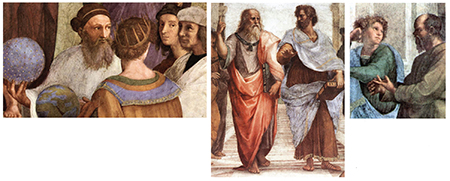
(Above) Ptolemy (he has his back to us on the lower right), holds a sphere of the earth,
next to him is Zoroaster who holds a celestial sphere. Raphael included a
self-portrait of himself, standing next to Ptolemy. He looks right out at us;
(left) an elder Plato walks alongside Aristotle; Aeschines and Socrates
As if these weren’t enough indications of philosophical divergences, the viewer’s gaze is invited towards the center right where a figure, formally attested as Zarathushtra/Zoroaster, balances a clearly astral sphere. He glances at Raffaello, who is in the painting. The first millennium BCE Sage Zoroaster disputes with Claudius Ptolemy, the second century CE Graeco-Egyptian astronomer, mathematician and geographer who, with back to the viewer, hefts a recognizably terrestrial globe. The reader now needs no reminding of the connection between the central duo, Plato vs Aristotle, with the disputant duo of Zarathushtra vs Ptolemy. It is undoubtedly the ancient Iranian sage who is the true key figure sustaining the central composition!
Significantly, the Asiatic Greeks of Ionia (Asia Minor) had progressed from theology and mythology into philosophy through a spirit of enquiry. Reason and rationality entered their religious world from the East with the Persian conquest. Among those who had travelled to the East in search of Magian knowledge was the sixth century BCE Pythagoras (originally from Ionia). In his quest for a coherent religion, he also visited India before returning to his Mediterranean home. Clement of Alexandria (150-215 CE), the Christian apologist and Church Father, wrote of him: "Pythagoras was an ardent pupil of Zoroaster, the Persian Magian.” Pythagoras had arrived at the belief that the universe is based on reason, and that only reasoning can disclose its inner reality — Zarathushtra’s teachings yet again!
There are other depicted figures who fit into the broader context of this mural. For instance, the isolated figure, left on the steps, deep in gloomy thoughts, is the obscurely philosophizing Heracleitus (540-480 BCE) — the "dark philosopher” (!) from Ionian Ephesus. He gives us our first intimation that Greeks had through the Magi encountered the Persian religion. The Medean missionaries were already preaching in Ionia before Cyrus II and Darius I had absorbed it within their newly expanding Achemenid Empire. Heracleitus is rightly regarded in the West as the first philosopher of the mind — but few fulsomely acknowledge this.
In his time he had been a bluntly intolerant critic who arrogantly and contemptuously scoffed at Pythagoras’ wide-ranging knowledge, saying, "The learning of many things does not teach understanding, else it would have taught Hesiod and Pythagoras, and again Xenophanes and Hecataios.” The sixth century BCE Pythagoras is shown in the fresco’s front row, second from left. Peering over his shoulder is the 12th century Islamic polemicist Ibn Rushd (Averroës)!
Of close interest to Zoroastrians are Heracleitus’ very Gathic "Fire will come and judge all things” and "the world, past, present, and future, is an exchange of fire, extinguished in one place to blaze up in another!” He saw fire as the basic material principle of an orderly universe and of which even the soul is made: all things are an exchange of fire within the four elements of air, water, earth, and fire itself. One recalls Zarathushtra’s teaching that fire is strengthened through Asha — as the order of the universe and as within the enlightened human mind.
The story of the unkempt figure lolling about on the steps to the right bears brief mention in connection with the figure of a helmeted Alexander the Macedonian (shown top row, left center). It is that of the latter’s encounter with the harum scarum Diogenes of Sinope who lived in a large ceramic jar, and who went about in daylight with a lit lamp, declaring, "I am looking for an honest man!” When Alexander approached him to ask if he could do something for him the famed philosopher barked "Yes! get out of my light!”
In closing, it is noted that Raffaello used the likenesses of contemporary artists and acquaintances as models for the pagan philosophers, none of whom he could possibly have met. Thus, Leonardo da Vinci stands in for Plato; Heracleitus is Michelangelo; Aristotle is da Sangallo; Raffaello, beside the right arch support, is himself; and Zarathushtra is the universally respected diplomat and High Renaissance author, the noble-minded Baldassare Castiglione. The Sage would have rejoiced!