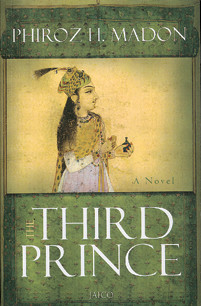
The Third Prince by Phiroz H. Madon. Published in 2010 by Jaico Publishing House, A-2, Jash Chambers, 7-A Sir Phirozshah Mehta Road, Fort, Bombay 400001. Pp: 343. Price: Rs 295.
One wonders what compels a person in his 50s who has a degree in electrical engineering from IIT (Indian Institute of Technology) and a masters in computer engineering from Rutgers University, USA, to write a historical novel entitled The Third Prince. Was it the love for literature which was instilled in the heart of a young school boy about 40 years ago by a sincere, thorough and inspired teacher of English literature which created in him a passion to take an active part in the cultural and social aspects of life to counter his "traumatic” education at IIT and has now made him publish his first novel? Perhaps, it was this germ which caused Phiroz H. Madon to remain awake half a night reading John Keay’s India – A History, a book he picked up by chance during a holiday visiting friends.
Phiroz Madon: creating credible characters
The conception of Madon’s The Third Prince lay in Keay’s description of the Mogul reign which fired his imagination and caused him to select this period from the entire panorama of Indian history. It was the stark contrast of this era which fascinated him, and he decided to portray the Moguls, not as over-romanticised characters, but as they really were, warts and all, faulty and inspired at one and the same time.
Madon dramatises the crisis in the Mogul court where Akbar is ill and is dying and, hence, the urgent need to appoint a successor. This emergency provides an opportunity for Madon to describe the intrigue and maneuvering amongst the nobles in Akbar’s court. In a short scene, Madon successfully describes the ‘choosing’ and presents a host of convincing characters and the ulterior motives they have for the choices they make. One of the contenders is Akbar’s son, Jahangir, who is inordinately fond of wine, women and song, is known for his cruelty, and does not inspire any confidence in the nobles of the court. The second is Jahangir’s son, Khushrau, who Madon shows is equally inept and unfit for the role which is being thrust on him. The nobles are called in to choose a successor and they elect the mysterious Third Prince, a child whose sex they are unaware of but who is rumored to have been fathered by Akbar in a bloody battlefield.
The ‘third prince’ could be interpreted on different levels. At one level, Jahangir could be the third prince, the other two being Humayun and Akbar. However, Madon has woven a compelling piece of fiction and has invented a character Paru, whom he places as a foil to Jahangir and Khushrau. The plot revolves around Paru who in 1603 travels with her uncle to Agra to be initiated into the mysteries of dance which implied she was being trained as a courtesan. The fees for the training amount to twelve rupees of which she can provide seven, the balance being contributed by her affectionate and doting uncle. However, when she is asked to provide a guarantee, all of a sudden she produces a turban pin comprising a huge ruby surrounded by diamonds set in intricately patterned gold.
One of Madon’s great achievements is the creation of very credible and complex characters. Initially the author portrays Jahangir as a usurper, ineffectually leading an army against his father. He has no claim to fame other than being the son of Akbar and lacks the skill with which Akbar rules his empire as is very evident from the few short scenes at the beginning of the novel. In the first encounter between Jahangir and Akbar, Jahangir cuts a sorry figure compared to the decisive, albeit cruel, steps Akbar takes to quell a possible rebellion. However, Jahangir certainly proves himself gradually and the 12 decrees which he promulgates toward the end of the novel are, to say the least, astonishing keeping in mind the times in which he lived.
Another character who acts as a foil to Paru and who is extremely well portrayed is Nur Jahan. She is a fighter and a woman who is full of courage. Not one to give in easily, Madon reveals her true character in the very first scene in which she appears when she refuses to give in to Sher Afghan’s demand that she ask her powerful father for favors and more money. In the interest of the relationship between Jahangir and Nur, Madon takes the liberty of advancing the meeting between the two, which actually takes place much later, in 1611. Her devotion to Jahangir is unquestionable and, in both Nur as well as Paru, Madon portrays personae who are trying to obtain their rightful pace in a hostile and unfriendly court.
There are a host of minor characters who are also unforgettable and this seems to be Madon’s special gift. Whether it is the snake charmer who befriends Paru, or Pithu who, in spite of being a rival in the profession of dancing, is willing to risk her life to protect her friend. Sometimes Madon overdoes the use of a series of short sentences to enhance dramatic effect and give the impression of urgency and speed, but on the whole his first novel is a very convincing and enjoyable read. We welcome yet another Parsi novelist to the growing number and look forward to his next novel with anticipation.
FIRDAUS GANDAVIA