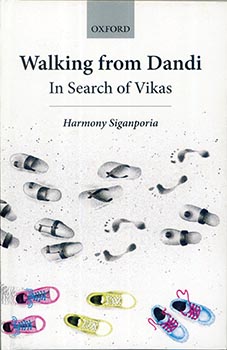
Walking from Dandi: In Search of Vikas by Harmony Siganporia. Published in 2022 by Oxford University Press, Great Clarendon Street, Oxford, OX2 6DP, UK, website:
www.oup.com Pp: xvi + 292. Price: Rs 1,495.
In the light of Rahul Gandhi’s Bharat Jodo padayatra which captured the imagination of the nation, Harmony Siganporia’s book

Walking from Dandi: In Search of Vikas on Mahatma Gandhi’s Dandi March, is particularly relevant. Siganporia, an assistant professor at MICA (formerly Mudra Institute of Communication) in Ahmedabad, along with two companions, Chirag Mediratta, a cultural researcher and a former student of hers and Sushmit Prabhudas, a doctor of medicine and dear friend, retraced in reverse the route of Gandhi’s 1930, 400 km Salt March. All have long been interested in Gandhi and the story of modern Gujarat, and decided to document the journey audio-visually while on the road. Their walk in February 2019 lasted 25 days exactly as long as the original Salt March.
The Dandi yatra was to protest against a vicious salt tax imposed by the British colonial rulers to tax the poorest of the poor. The 1882 Salt Act gave the British a monopoly on the collection and manufacture of salt, levying a tax in the process. The violation of this Act was a criminal offense. Even though salt was freely available to those living along the coastline, Indians were forced to buy it from the colonial government. At each halt during his protest march Gandhi would address thousands of people and explain the issue to them as well as the need to boycott British cloth and other goods.
Siganporia contrasts the concepts of Gandhi’s "swaraj” with that of today’s "vikas” as being diametrically opposed. Vikas means expanding progress or development. "Swaraj is self-rule, and for Gandhi freedom from external (players), whomsoever they may be, is incomplete without this inner transformation accompanying it. Vikas is decidedly not swaraj.” Siganporia’s walk does not entail living amongst the people or eating their food – she and her companions halt mostly at guest houses, yatri nivases and dhabhas. Despite this limitation she captures well the lives of the people as she traverses the different districts leading to Ahmedabad.
In the Surat region she explains at length the plight of the sugarcane laborers. She then moves northwards to Baruch district with its cotton farming and further towards "tobacco land.”
As she traverses the district of Surat she insightfully narrates how irrigation of the land from the many rivers there has increased sugarcane cultivation in the area thereby enriching the landholding Patels. She explains in detail exploitation of labor through a chain of mukadams or contractors where the worker is basically pushed deep into debt with hardly any reimbursement other than food. There are virtually no health or maternity facilities.
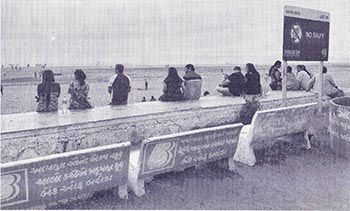
Top: Harmony Siganporia; above: Dandi beach
Finally, she reaches Ahmedabad with her two companions, exhausted and tired. Walking, eating, living and resting together seem to have added depth to their relationship.
"The physical aspects of the walk were the easiest to cope with: it is everything else that will take a lifetime to come back from. What I started thinking about then, and what I keep with me now that the walk is walked, is the notion that in a neo-liberal order where everything is mediated by markets and we are forced into ever more atomized and reified existences, friendship and love are truly radical acts.” She believes "friendship — mindful, considerate, empathetic… can provide us with radically transformative forms of kinship.”
Though the author does not provide an alternative form of human association beyond the confines of the family she hints at a commune form of social association: "The ashram, then, is an example of what Sophie Lewis describes as ‘inventive kinning,’” which, she argues, "has taken place in every corner of the planet ever since the institution of marriage started, being forcibly imposed on poor, indigenous and colonized people.” (German British academic and author Lewis is known for her radical ideas in which people do not live in family units but care for one another in a larger system.) True, after all, monogamy and the family only arose with the evolvement of private property; until then, people lived in common association.
A word about the "Afterword.” I am yet to read as sensitive an account of the plight of migrants during the inhumane lockdown. The author has veritably touched on every nerve of their agony, from their hand-to-mouth existence in the cities to the casteist inhumanity and impoverishment in the villages. As she puts it, the migrants live between the devil and the deep blue sea: "As things stand today, studies show that rural India is incapable of absorbing the estimated 23 million interstate and intrastate migrant laborers who might return home from urban areas due to the Covid-19 lockdown,” because the "rural economy is already overburdened, excessively dependent on agriculture and has widespread hidden underemployment.” She ends with: "The constant engendered and visible workings of caste hierarchies and their ubiquity lead the author to postulate that for the migrant worker the city may be cruel and indifferent, but the village is a life sentence without escape.”
One wonders whether Siganporia, by going back to her earlier existence, will end up disillusioned as she seems truly a person of the future.
KOBAD GHANDY
Ghandy is a political and social activist, and author of Fractured Freedom, on his 10 years in prison as a Maoist sympathizer.